Context: Vikram-1 Orbital Rocket Launch
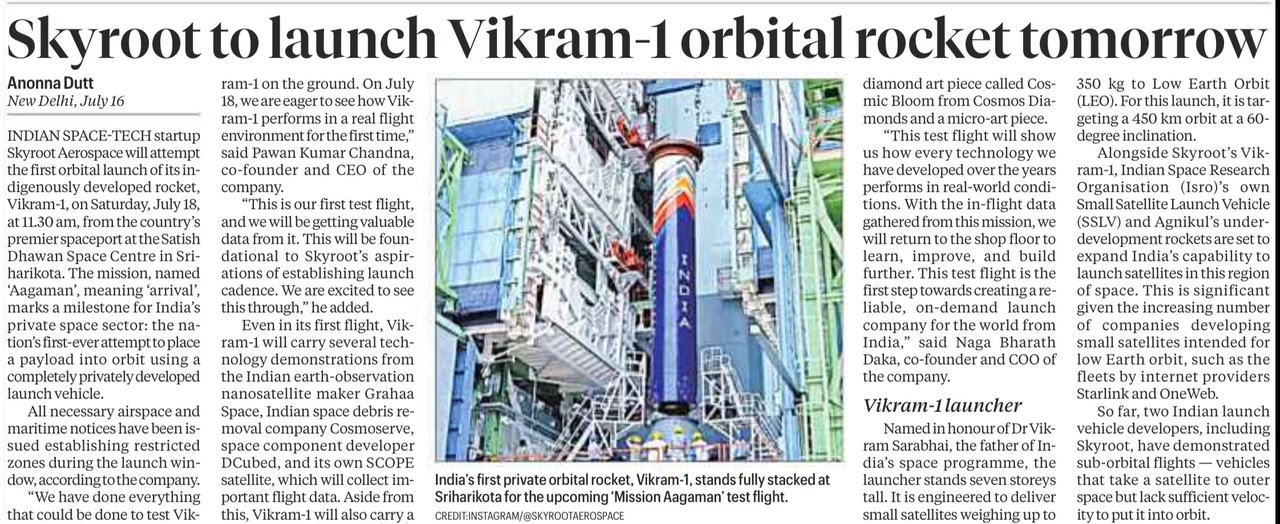
Skyroot Aerospace is set to launch Vikram-1, India’s first privately developed orbital launch vehicle, from Satish Dhawan Space Centre, Sriharikota under Mission Aagaman.
The mission marks a major milestone in India’s private space sector by attempting to place a payload into Low Earth Orbit using an indigenous private rocket.
Vikram-1 – Basics
Developer
Skyroot Aerospace, a Hyderabad-based private space start-up.
Named After
Dr. Vikram Sarabhai, father of India’s space programme.
Mission
Aagaman, meaning “Arrival”.
It is the first orbital test flight.
Payload Capacity
Up to 350 kg to Low Earth Orbit.
Target Orbit
450 km altitude at 60° inclination.
Purpose
To launch small satellites into orbit and demonstrate indigenous private orbital launch capability.
Why Is It Significant?
1. First Private Orbital Attempt
It is the first attempt by an Indian private company to place a payload into orbit.
2. Private Space Ecosystem
It strengthens India’s commercial space ecosystem after space-sector reforms.
3. Complements ISRO
It complements ISRO’s Small Satellite Launch Vehicle for the growing small-satellite market.
4. Commercial Launch Market
It improves India’s competitiveness in global commercial launch services.
Broader Importance
Private participation in space can help India expand:
- Small satellite launches
- Commercial launch services
- Space manufacturing
- Space start-up ecosystem
- Global space-market share
Key Takeaway
Vikram-1 represents the shift from a government-only space model to a more commercial and start-up-driven space ecosystem in India.