Context: Gen Z Employment Challenges India
India’s demographic dividend can be realised only through productive, formal and quality employment.
The challenge is not only about creating jobs. It is also about ensuring better labour force participation, employability, social security and a smooth transition from education to work, especially for the youth.
Key Challenges in Gen Z Employment
1. Low Labour Force Participation
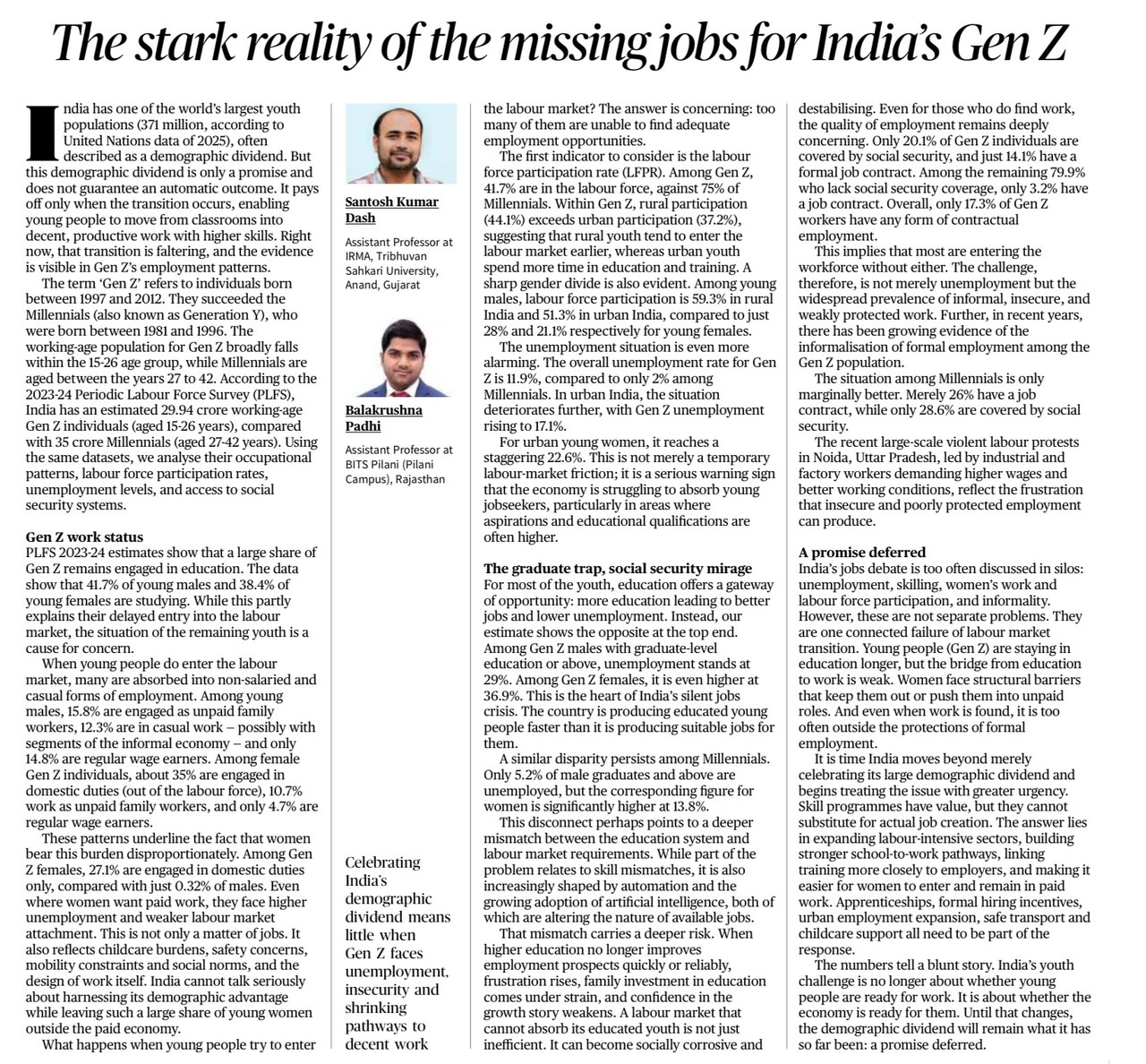
Labour Force Participation Rate is only 41.7% among Gen Z, compared to 75% among Millennials.
This indicates delayed or weak entry into the labour market.
2. High Unemployment
Overall Gen Z unemployment is 11.9%.
It rises to:
- 17.1% in urban areas
- 22.6% among urban women
This reflects poor job absorption.
3. Graduate Employment Crisis
Unemployment among graduates stands at 29%.
For female graduates, it rises to 36.9%.
This highlights the education-employment mismatch.
4. Informal and Insecure Employment
A large share of youth is engaged in:
- Casual work
- Unpaid family work
- Informal employment
Only 17.3% have formal employment contracts.
5. Weak Social Security
Only 20.1% of Gen Z workers are covered by social security.
This makes youth employment highly vulnerable.
6. Gender Disparities
Women continue to face lower labour force participation due to:
- Unpaid care work
- Safety concerns
- Social norms
- Limited access to quality jobs
7. Structural Labour Market Challenges
Employment opportunities for educated youth are affected by:
- Skill mismatch
- Automation
- Artificial Intelligence
- Slow growth of labour-intensive sectors
Why This Matters
India’s demographic dividend can become a demographic burden if young people are educated but unable to find productive and secure employment.
The issue is especially serious because unemployment is high among graduates and urban women.
Way Forward
1. Labour-Intensive Manufacturing and Services
Promote sectors that can generate large-scale quality employment.
2. School-to-Work Pathways
Strengthen:
- Apprenticeships
- Vocational education
- Industry-academia partnerships
3. Skill Alignment
Align higher education and skilling with industry demand and emerging technologies.
4. Formal Employment
Expand written contracts, social security and labour protection.
5. Female Labour Force Participation
Increase women’s participation through:
- Childcare support
- Safe transport
- Flexible work arrangements
- Gender-sensitive workplaces
6. Private Investment and MSMEs
Encourage private investment, MSMEs and urban employment opportunities to fully harness India’s demographic dividend.
Key Takeaway
India’s youth challenge is not only unemployment. It is also about insecure work, weak social security, gender gaps and poor transition from education to employment.