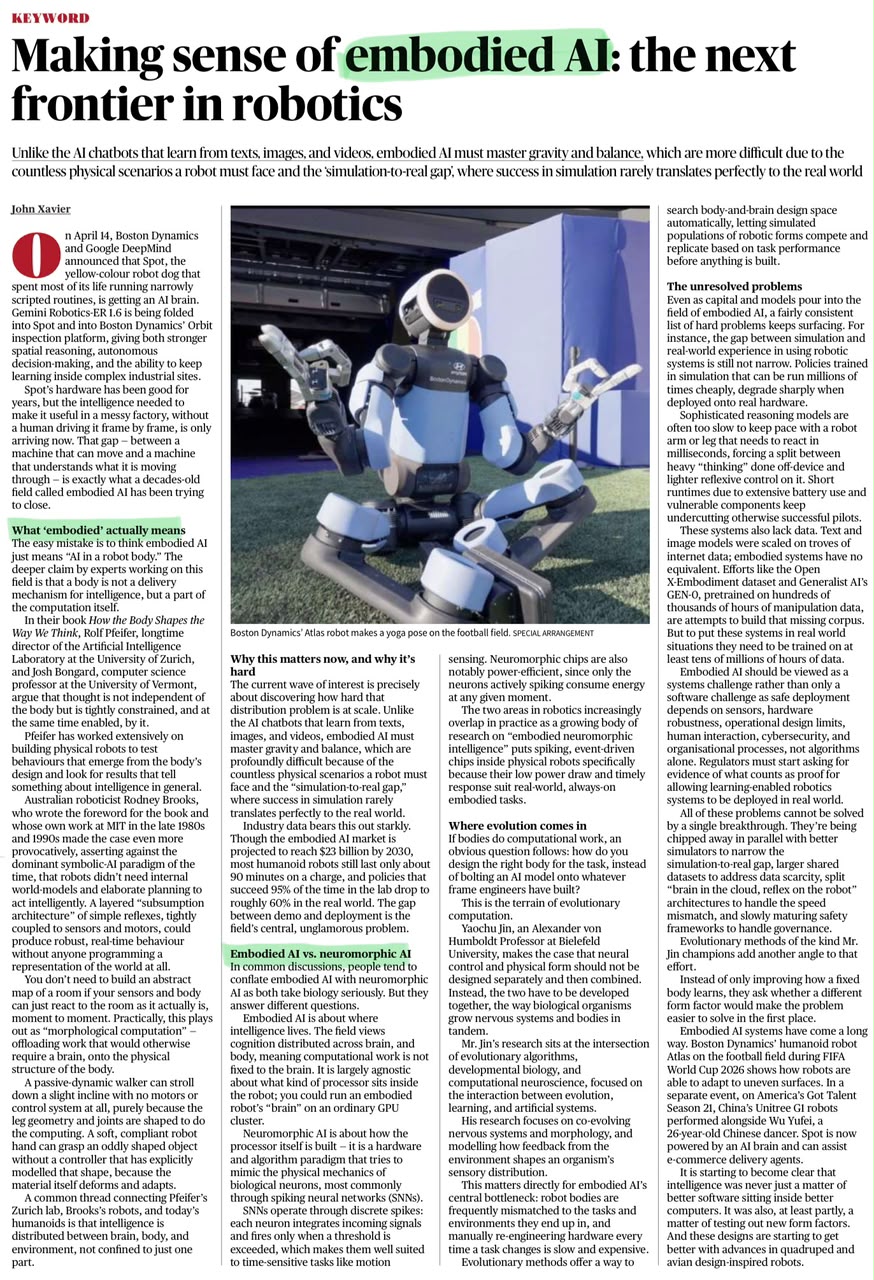
Context: Embodied AI in Robotics
Artificial Intelligence is evolving from software-based systems to Embodied AI, where intelligent robots can perceive, learn and interact with the physical world.
This expands the use of AI across industry, public services, defence, healthcare and disaster response.
Embodied AI vs Neuromorphic AI
Embodied AI
Embodied AI focuses on AI with a physical body, usually a robot.
It learns through:
- Sensing
- Movement
- Interaction with the environment
Neuromorphic AI
Neuromorphic AI focuses on brain-inspired hardware.
It uses AI chips that mimic biological neurons to make AI faster and more energy-efficient.
Easy Recall
Embodied AI = AI with a Body
Neuromorphic AI = AI with a Brain-like Chip
Embodied AI
Embodied AI means AI integrated with a physical robot capable of:
- Sensing
- Reasoning
- Learning
- Acting
Here, intelligence is distributed across:
- Brain or AI system
- Body or robot
- Environment
Key Challenge: Simulation-to-Real Gap
A major challenge in embodied AI is the simulation-to-real gap.
This means performance in computer simulations often does not match real-world conditions.
For example, a robot may work well in a controlled lab simulation but fail in real life because of:
- Uneven surfaces
- Unpredictable human behaviour
- Weather conditions
- Obstacles
- Physical wear and tear
- Sensor limitations
Applications
Embodied AI can be used in:
- Manufacturing
- Logistics
- Healthcare
- Defence
- Disaster response
- Household assistance
- Elderly care
- Industrial automation
Significance
1. Robotics Revolution
Embodied AI can make robots more useful in real-world environments.
2. Public Services
It can support disaster rescue, hospital assistance and public infrastructure maintenance.
3. Defence and Security
Robots with embodied AI can help in surveillance, mine detection, logistics and risky operations.
4. Industry
It can improve automation in factories, warehouses and supply chains.
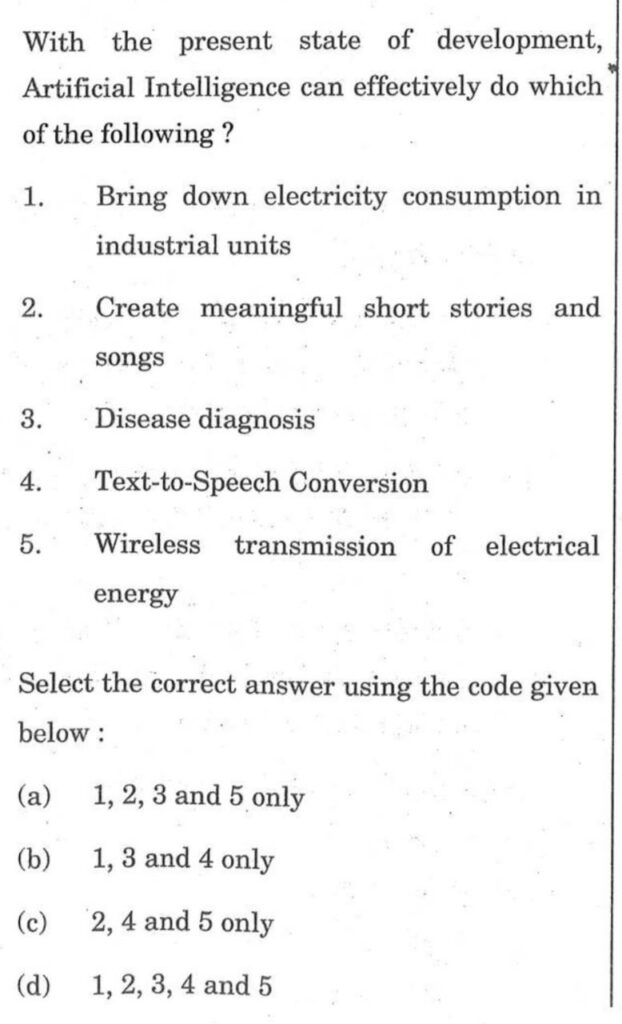
PYQ Link
AI can currently be used for:
- Reducing electricity consumption in industrial units
- Creating short stories and songs
- Disease diagnosis
- Text-to-speech conversion
- Wireless transmission of electrical energy
Key Takeaway
Embodied AI is the next step in robotics because it takes AI beyond screens and software into physical machines that can act in the real world.