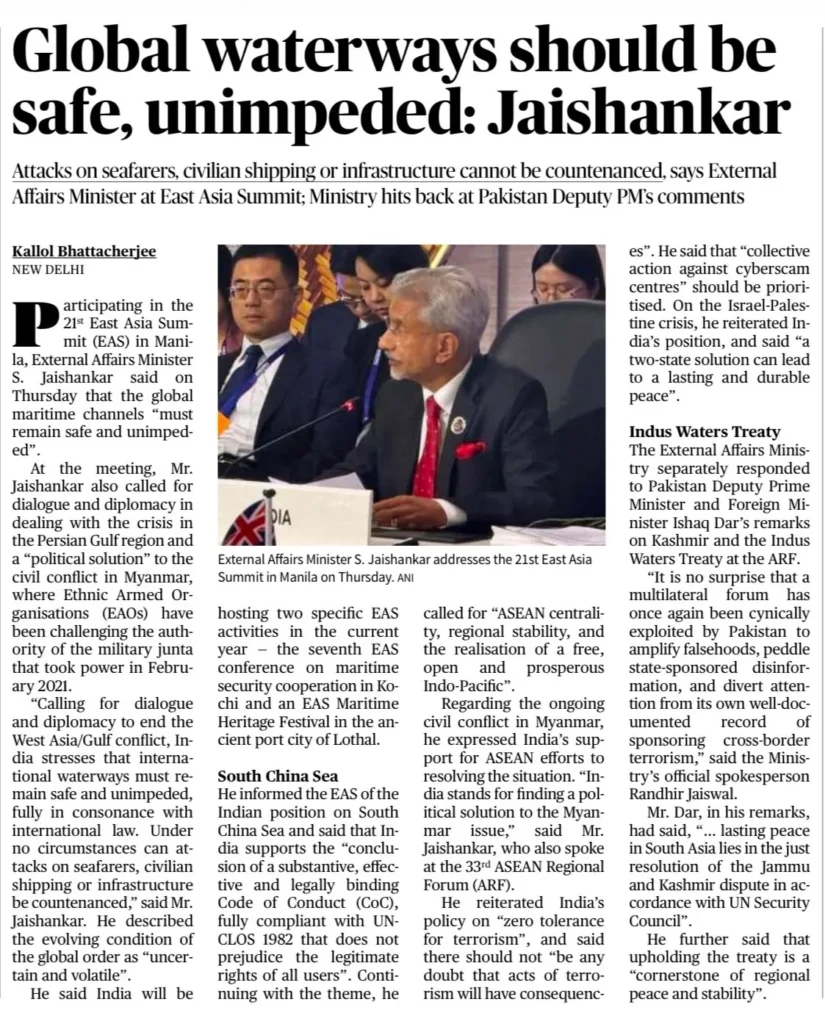
Context: East Asia Summit 2026
At the 21st East Asia Summit, India reaffirmed its vision of a free, open, inclusive and rules-based Indo-Pacific.
India emphasised maritime security, peaceful resolution of disputes, ASEAN centrality and adherence to international law.
India also reiterated its position on the South China Sea, Myanmar, West Asia, terrorism, cybercrime and the Indus Waters Treaty.
Key Takeaways
1. Maritime Security
India called for safe, secure and unimpeded international waterways.
It also condemned attacks on civilian shipping and maritime infrastructure.
This is important because maritime routes are essential for global trade, energy flows and supply chains.
2. Rules-Based Order
India reaffirmed support for UNCLOS, 1982.
India also supported an effective and legally binding Code of Conduct for the South China Sea.
3. ASEAN Centrality
India reiterated support for ASEAN-led regional architecture.
This fits with India’s vision of an open, inclusive and prosperous Indo-Pacific.
4. Regional Conflicts
India called for dialogue and diplomacy to resolve conflicts in Myanmar and West Asia.
It also reaffirmed support for a two-State solution in the Israel-Palestine context.
5. Counter-Terrorism
India again highlighted its policy of zero tolerance for terrorism.
It also called for coordinated action against cybercrime and transnational cyber-scam networks.
6. India-Pakistan Issues
India rejected Pakistan’s remarks on Kashmir and the Indus Waters Treaty.
India reaffirmed its position against cross-border terrorism.
East Asia Summit
The East Asia Summit is a leaders-led forum for strategic, political and economic cooperation in the Indo-Pacific.
It was established in 2005.
The first summit was held in Kuala Lumpur, Malaysia.
Members
The EAS has 18 members:
- 10 ASEAN member states
- India
- Australia
- China
- Japan
- New Zealand
- Republic of Korea
- Russia
- United States
India is a founding member of the East Asia Summit.
Areas Covered by EAS
The EAS discusses:
- Maritime security
- Connectivity
- Regional security
- Trade
- Energy
- Climate change
- Disaster management
- Health
- Emerging technologies
Key Takeaway
India’s East Asia Summit position reflects its wider Indo-Pacific approach: secure sea lanes, ASEAN centrality, rule of law, zero tolerance for terrorism and peaceful resolution of disputes.