Corruption Governance Challenges India | UPSC Notes

Context: Corruption governance challenges India
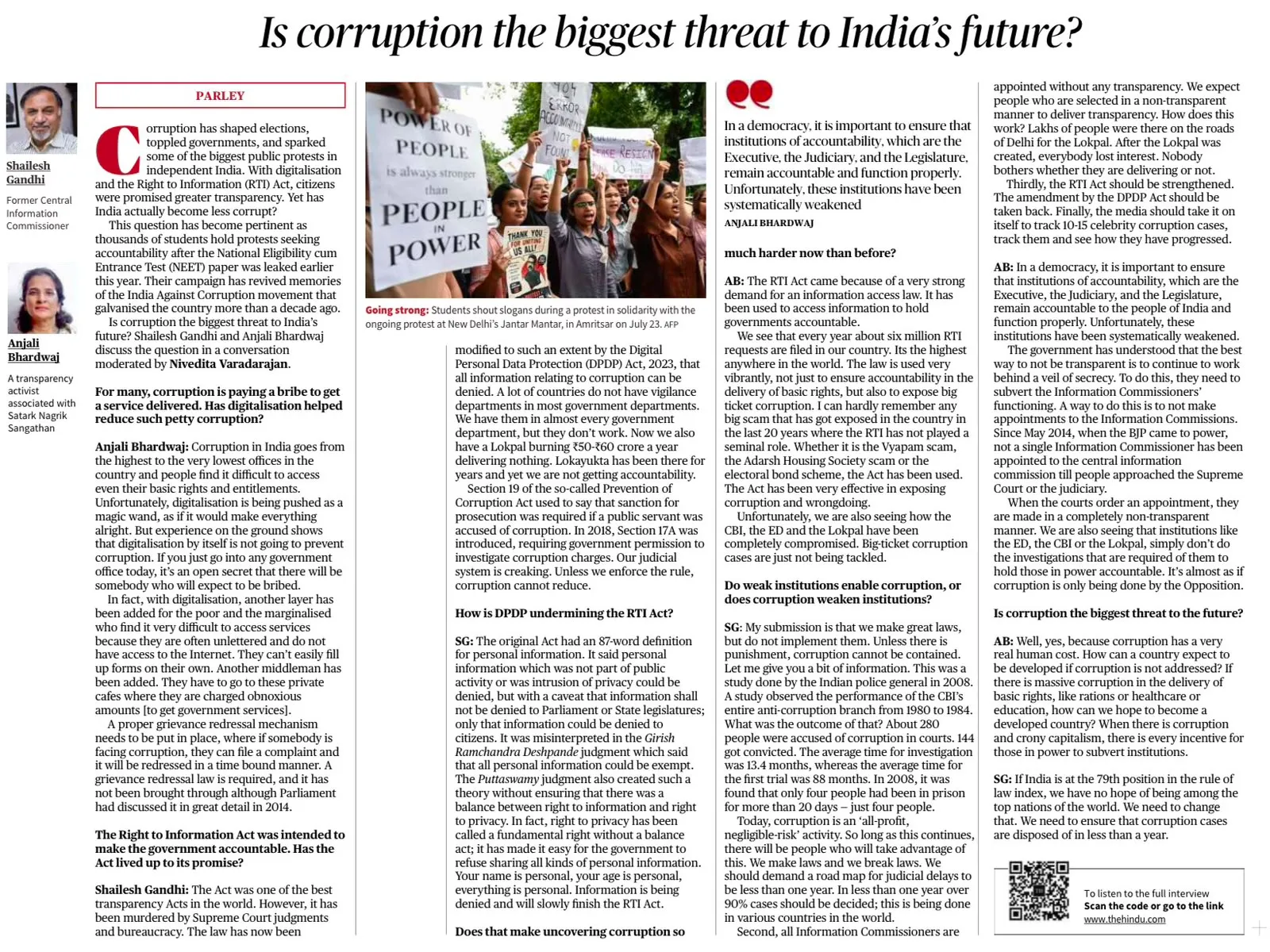
The article discusses India’s larger governance challenge around corruption, transparency and accountability.

Recent debates around the RTI regime, Lokpal, Information Commissions and investigative agencies show that anti-corruption laws are useful only when backed by strong institutions, timely enforcement and public accountability.

Core Issue

India has several laws and institutions to fight corruption.

However, the real challenge lies in implementation, institutional independence and timely action.

Digitalisation has reduced some forms of petty corruption, but systemic and high-level corruption remains a major governance concern.

Key Challenges in Tackling Corruption

1. Weakening of Accountability Mechanisms

Transparency and accountability mechanisms have become weaker in practice.

Institutions must not only exist on paper but also function independently and effectively.

2. Declining Institutional Effectiveness

The effectiveness of institutions such as the RTI framework, Lokpal, Information Commissions and investigative agencies has come under question.

This affects public trust in governance.

3. Delays in Investigation and Trial

Delays in investigation, prosecution and judicial disposal reduce the deterrent effect of anti-corruption laws.

If punishment comes too late, the law loses much of its impact.

4. Weak Implementation

India has a robust legal framework, but implementation gaps often weaken the fight against corruption.

5. Digitalisation Is Not Enough

Digital governance has reduced some petty corruption by limiting direct contact between citizens and officials.

However, it has not fully addressed systemic and high-level corruption.

6. Lack of Transparency in Appointments

Opaque appointments and weak institutional processes affect public confidence.

Transparency in appointments is necessary for institutional credibility.

Strengthening the Anti-Corruption Framework

India needs to safeguard the independence and autonomy of accountability institutions.

The RTI framework must be reinforced so that citizens can access information effectively.

Corruption cases should be investigated, prosecuted and disposed of within a time-bound framework.

Public appointments and decision-making should be made more transparent.

Grievance redressal, social accountability and citizen participation must be strengthened.

Ethics Angle

For GS4, this issue can be linked with:

  • Integrity
  • Probity in governance
  • Transparency
  • Accountability
  • Rule of law
  • Citizen-centric administration
  • Institutional ethics

Key Takeaway

Corruption is not only a legal problem. It is an institutional and ethical governance problem. Strong laws need strong institutions, timely enforcement and a culture of public accountability.

Subscribe
Notify of
guest
0 Comments
Oldest
Newest Most Voted

Corruption Governance Challenges India | UPSC Notes

Got a question? We're here to help!

Our dedicated Student Support team is ready to assist you and guide you every step of the way.
Reach out to us, and let’s tackle your queries together!

About the UPSC Civil Services Examination (UPSC CSE)

The UPSC Civil Services Examination (CSE) is one of the most competitive and esteemed examinations in India, conducted by the Union Public Service Commission to recruit officers for services such as the Indian Administrative Service (IAS), Indian Police Service (IPS), Indian Foreign Service (IFS), and others. The exam comprises three stages — Prelims, Mains, and the Personality Test (Interview) — designed to test a candidate’s knowledge, aptitude, decision-making, and leadership skills.

How to Prepare Effectively for UPSC CSE

Cracking the UPSC CSE requires a deep understanding of the syllabus, consistent revision, structured answer writing, and smart test-taking strategies. The Prelims test analytical and conceptual clarity, the Mains focuses on critical thinking, articulation, and subject mastery, while the Interview assesses presence of mind, ethical judgment, and personality traits relevant to public service.

At UnderStand UPSC, we empower aspirants with a personalized and focused approach to each stage of the exam.

Why Choose UnderStand UPSC?

UnderStand UPSC is a mentorship-driven platform offering a clear, clutter-free strategy to tackle the Civil Services Examination. Our programs like Transform (for beginners and intermediate learners) and Conquer (for advanced mains preparation) provide structured study plans, syllabus-wise video content, interactive live sessions, and answer writing support.

We emphasize:

  • Concept clarity through topic-wise lectures

  • Test series designed around real UPSC standards

  • Personalized mentorship in small groups

  • Regular performance tracking and peer benchmarking

  • Doubt-clearing sessions, current affairs analysis, and monthly magazines

Join the UnderStand UPSC Learning Community

Our mission is to make UPSC preparation less overwhelming and more strategic. We combine mentorship, discipline, and academic rigor to help you clear CSE with confidence. Whether you’re preparing from Delhi, Mumbai, Bangalore, or a remote village — our online-first model ensures quality guidance reaches every corner of India.

Join the thousands of aspirants who trust UnderStand UPSC to guide their journey toward becoming civil servants.

Stay connected with us through our Telegram, YouTube, and Instagram channels for daily tips, strategies, and updates.

Copyright © 2026 USARAMBHA EDUCATION (UnderStand UPSC). All Rights Reserved.

Fill out the form for

Downloading the free Agriculture Short Notes


0
Would love your thoughts, please comment.x
()
x