Context: National Investment Policy for Urea 2026
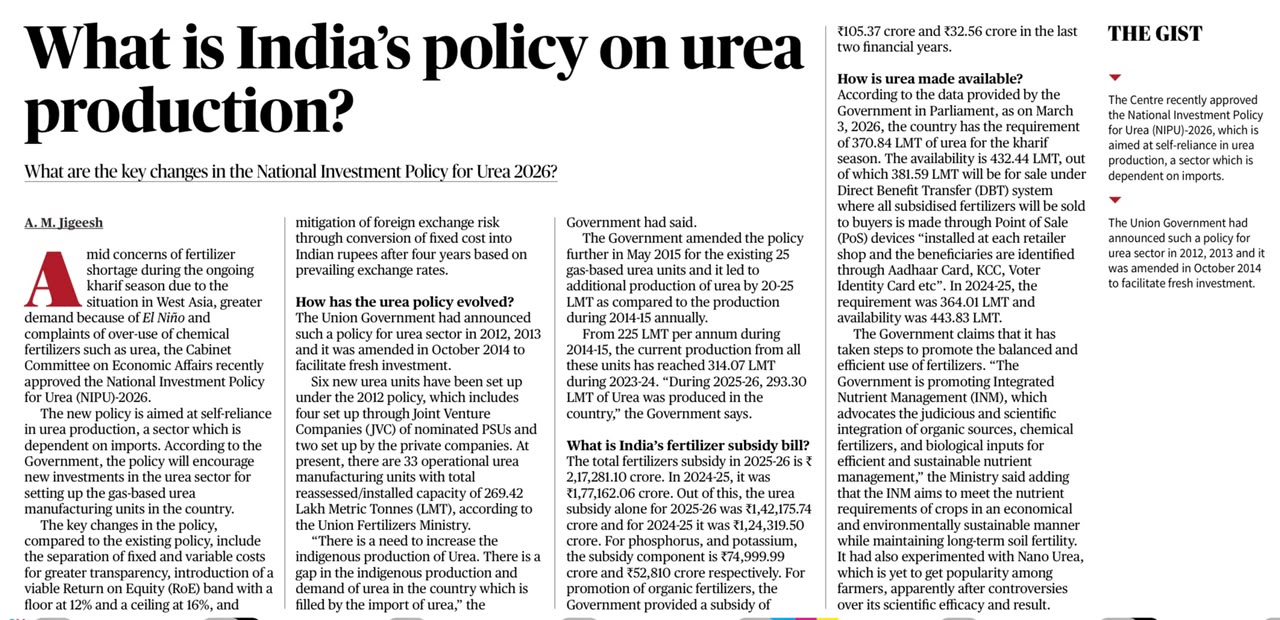
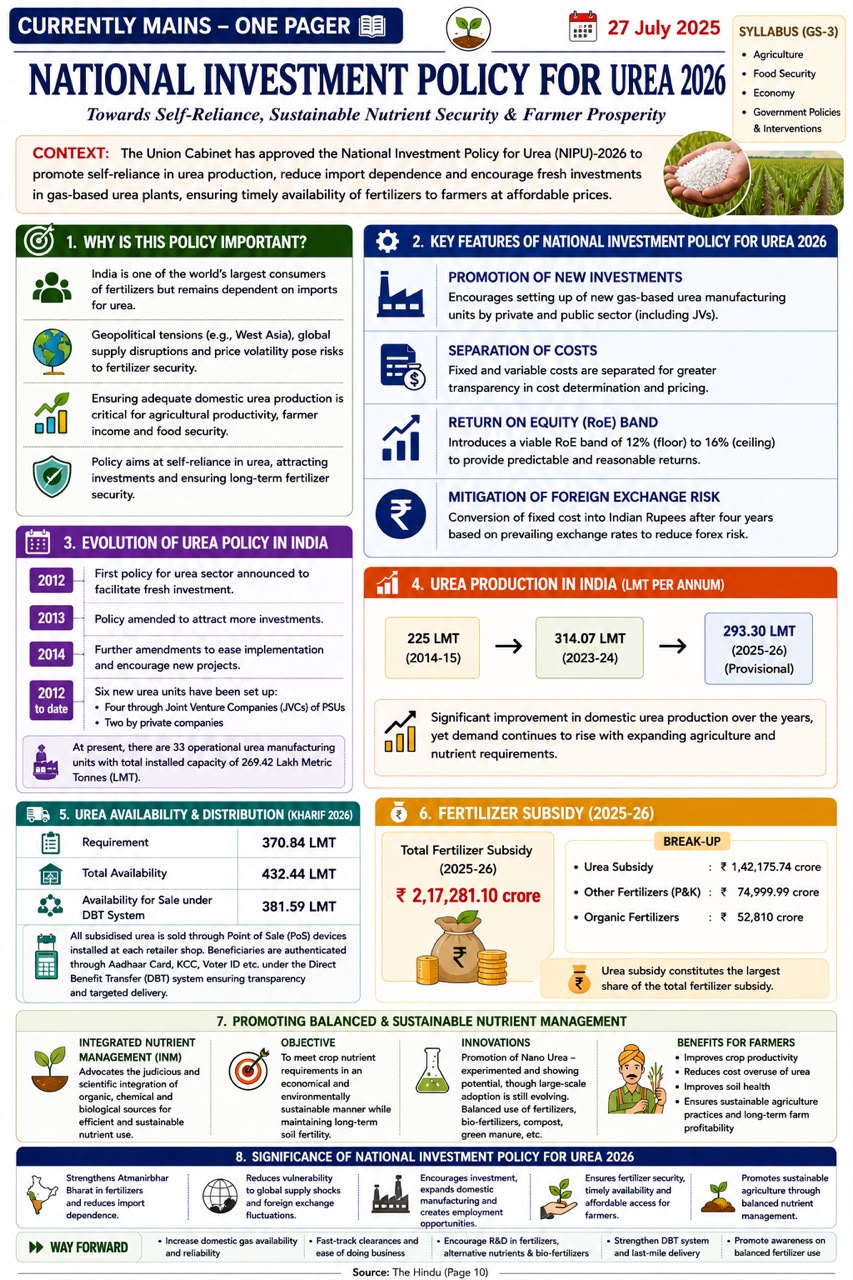
The Centre has approved the National Investment Policy for Urea 2026 to promote self-reliance in urea production, reduce import dependence and encourage fresh investment in gas-based urea plants.
The policy is important because India is one of the world’s largest consumers of fertilisers and remains dependent on imports for urea.
Why Urea Policy Matters
Urea is a key nitrogen fertiliser used widely in Indian agriculture.
Adequate domestic production is important for:
- Food security
- Farmer income
- Timely fertiliser availability
- Reducing import dependence
- Managing subsidy burden
- Protecting against global supply shocks
National Investment Policy for Urea 2026
The policy aims to encourage new investments in gas-based urea manufacturing units.
It seeks to improve domestic production and ensure timely availability of fertilisers to farmers at affordable prices.
Key Features
1. Promotion of New Investments
The policy encourages the setting up of new gas-based urea plants by private and public sector entities, including joint ventures.
2. Separation of Costs
Fixed and variable costs are separated for better transparency in cost determination and pricing.
3. Return on Equity Band
The policy introduces a viable Return on Equity band of 12% to 16%.
This is intended to provide reasonable returns while encouraging investment.
4. Foreign Exchange Risk Mitigation
Fixed costs may be converted into Indian rupees after four years based on prevailing exchange rates.
This aims to reduce foreign exchange risk.
Urea Production in India
India’s urea production has improved over the years.
The PDF notes the following production data:
- 225 LMT in 2014–15
- 314.07 LMT in 2023–24
- 293.30 LMT in 2025–26 provisional data
However, demand continues to rise with expanding agricultural and nutrient requirements.
Urea Availability and Distribution
For Kharif 2026:
- Requirement: 370.84 LMT
- Total availability: 432.44 LMT
- Availability for sale under DBT system: 381.59 LMT
Subsidised urea is sold through Point of Sale devices installed at retailers.
Beneficiaries are authenticated through Aadhaar, KCC, Voter ID etc. under the Direct Benefit Transfer system.
Fertiliser Subsidy
For 2025–26, total fertiliser subsidy is ₹2,17,281.10 crore.
The break-up includes:
- Urea subsidy: ₹1,42,175.74 crore
- Other fertilisers: ₹74,999.99 crore
- Organic fertilisers: ₹52,810 crore
Urea subsidy forms the largest share of the fertiliser subsidy.
Sustainable Nutrient Management
India also needs balanced and sustainable nutrient management.
The Integrated Nutrient Management approach promotes the scientific use of organic, chemical and biological nutrient sources.
The government is also promoting Nano Urea, though large-scale adoption is still evolving.
Significance
The policy can:
- Strengthen Atmanirbhar Bharat in fertilisers
- Reduce import dependence
- Improve fertiliser security
- Support farmers through timely supply
- Encourage investment
- Improve domestic manufacturing capacity
- Promote sustainable nutrient management
Key Takeaway
India’s urea policy is about more than fertiliser production. It is linked with food security, import reduction, farmer welfare, subsidy management and long-term nutrient sustainability.