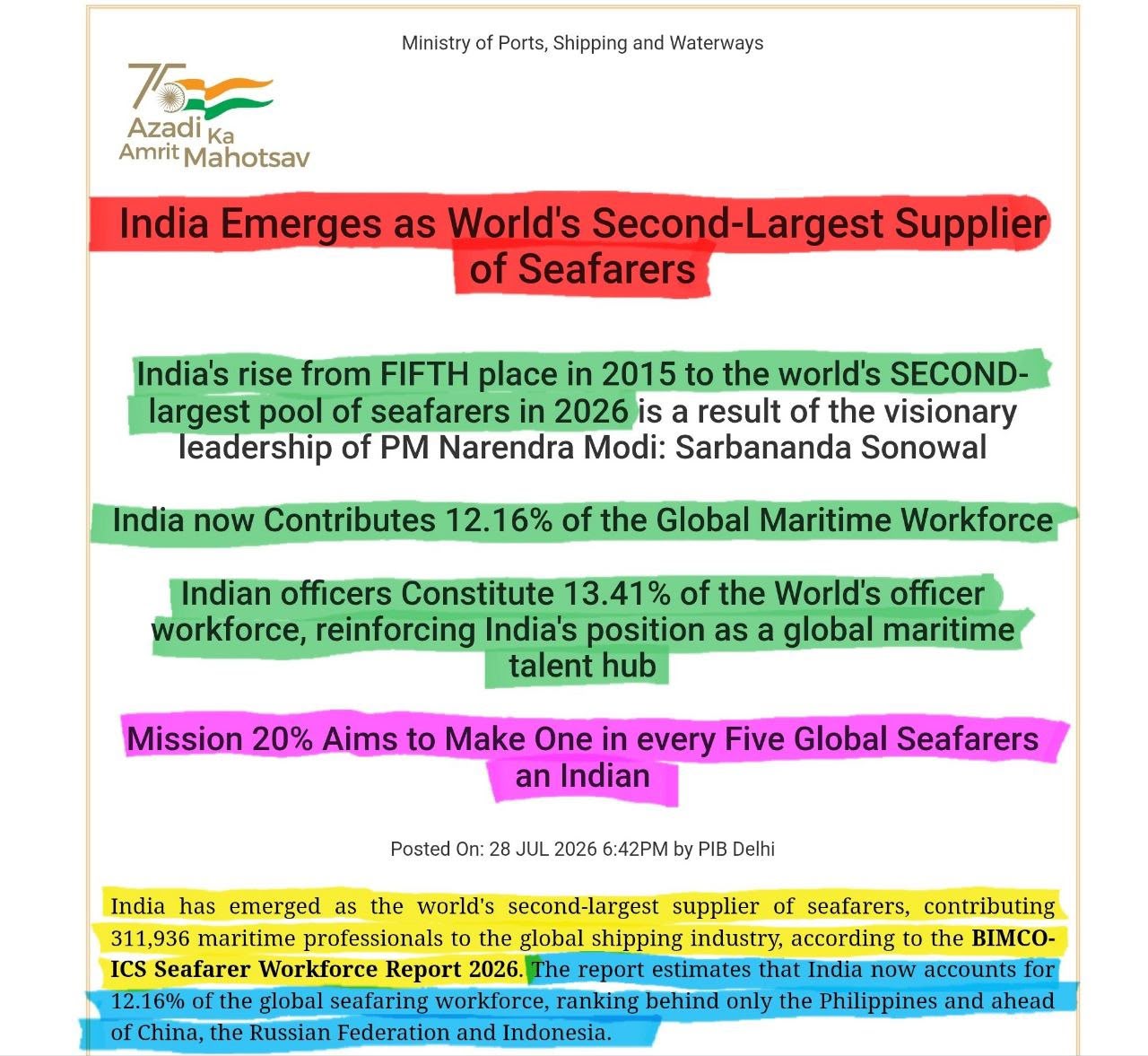
Context: India Second Largest Seafarer Supplier
According to the BIMCO–ICS Seafarer Workforce Report 2026, India has become the world’s second-largest supplier of seafarers.
This highlights India’s growing importance in the global maritime industry.
Major Highlights
India has improved from 5th place in 2015 to 2nd place in 2026 globally in supplying seafarers.
India now contributes 12.16% of the global seafaring workforce.
The goal of Mission 20% is to make one in every five global seafarers an Indian.
Who Is a Seafarer?
A seafarer is a trained person employed on a merchant ship.
Seafarers may be responsible for:
- Navigation
- Engineering
- Cargo handling
- Ship operations
- Safety duties
- Other onboard work
Why This Is Important for India
India’s rise as a major seafarer supplier strengthens its position as a global maritime talent hub.
It also supports India’s maritime economy and shipping ecosystem.
A larger trained maritime workforce can help India expand its role in global shipping and maritime services.
Recent Issues Faced by Indian Seafarers
Indian seafarers face risks due to conflicts and piracy.
Houthi attacks in the Red Sea and Gulf of Aden have exposed seafarers to security threats.
Piracy near the Gulf of Aden and Somali coast remains a concern.
Geopolitical conflicts have also led to:
- Detentions
- Delayed crew changes
- Disruptions to shipping routes
- Safety risks for Indian workers
Policy Significance
India needs better maritime training, welfare and protection systems.
As more Indians work on global vessels, consular support and emergency response become important.
India’s maritime policy must protect both ships and seafarers.
Key Takeaway
India’s rise as the world’s second-largest supplier of seafarers strengthens its maritime profile, but it also increases the responsibility to protect Indian seafarers in conflict-prone global waters.