Context: India Private R&D Expenditure FY24
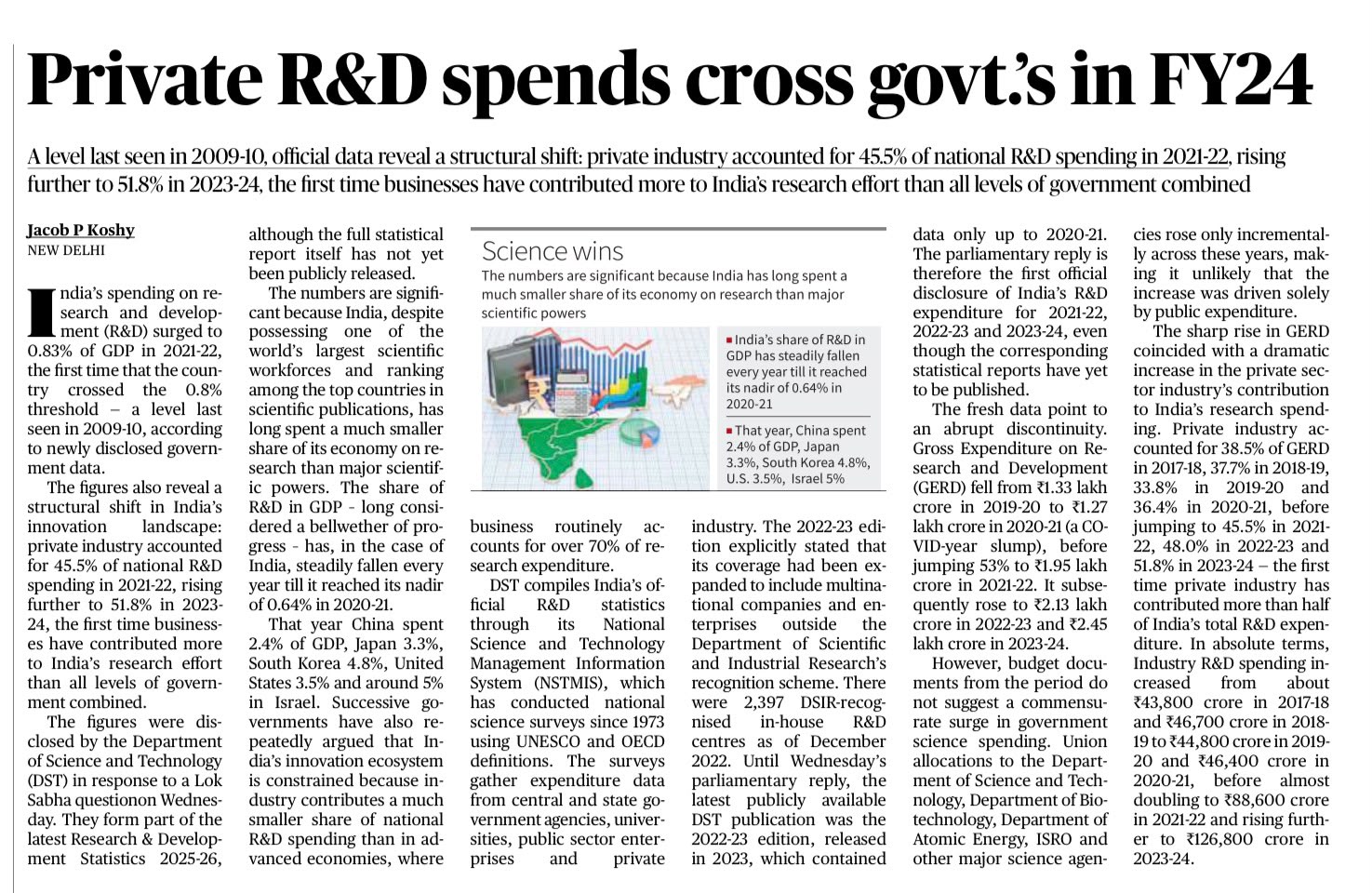
Government data released by the Department of Science and Technology shows that private industry contributed more than the combined government sector to India’s R&D expenditure for the first time in FY 2023–24.
This marks a major shift in India’s innovation ecosystem.
Gross Expenditure on Research and Development
Gross Expenditure on Research and Development, or GERD, measures total national spending on R&D.
It includes spending by government, higher education institutions, public sector enterprises and private industry.
Major Findings
India’s GERD reached 0.83% of GDP in 2021–22.
This crossed the 0.8% mark for the first time since 2009–10.
The private industry’s share in total R&D expenditure increased from:
- 45.5% in 2021–22
- 48.0% in 2022–23
- 51.8% in 2023–24
This means private industry contributed more than all levels of government combined for the first time.
Surge in Private Investment
Private sector R&D spending increased from:
- ₹46,400 crore in 2020–21
- ₹88,600 crore in 2021–22
- ₹1,26,800 crore in 2023–24
This shows that India’s innovation ecosystem is becoming more industry-driven.
Global Comparison
R&D expenditure as a percentage of GDP in 2021:
- India: 0.64%
- China: 2.4%
- Japan: 3.3%
- United States: 3.5%
- South Korea: 4.8%
- Israel: 5.0%
Despite improvement, India’s R&D intensity remains far below leading innovation economies.
Why This Matters
Higher private participation can improve commercialisation of research.
It can promote innovation-led growth and support Atmanirbhar Bharat.
It can also strengthen industry-academia linkages and technology development.
However, India still needs to increase overall R&D expenditure as a share of GDP.
Private participation alone is not enough if total R&D spending remains low.
Key Takeaway
India’s R&D ecosystem is becoming more industry-driven, but India must raise overall R&D intensity to compete with major scientific and technological powers.