Context: India AI Digital Public Infrastructure
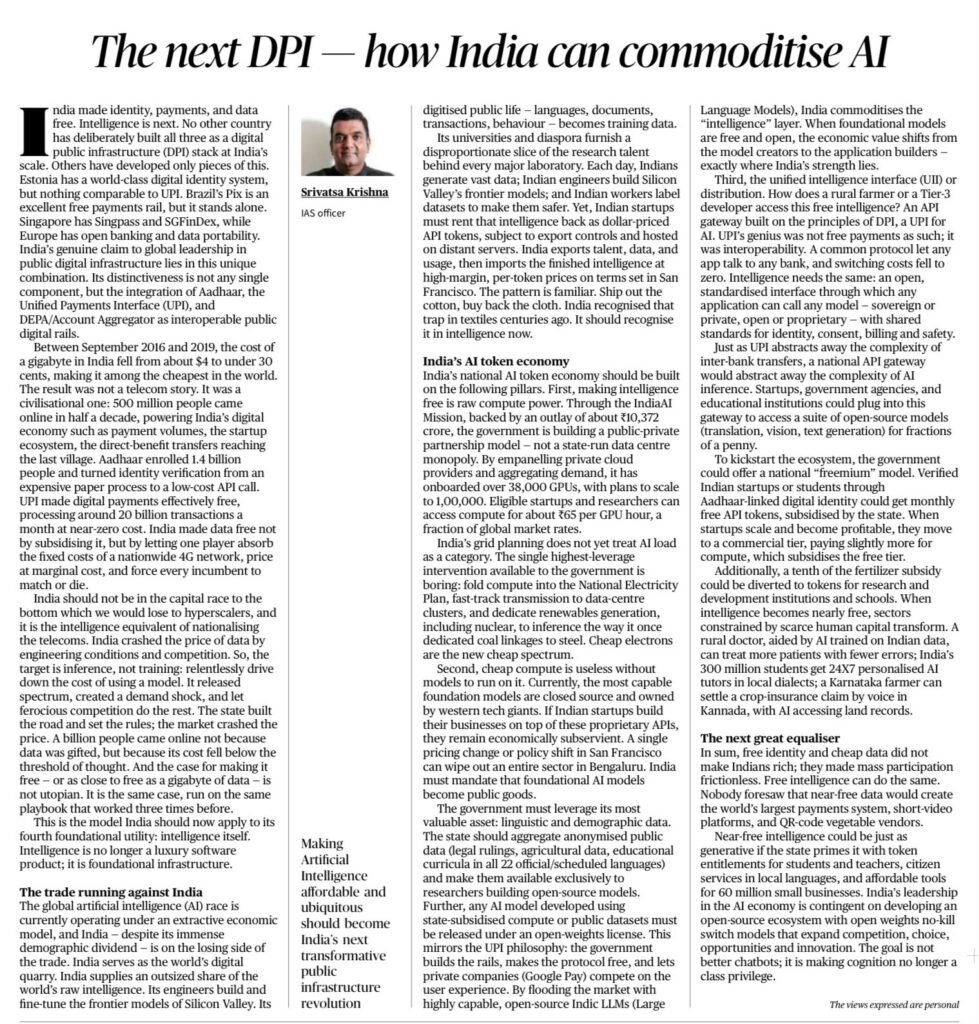
India is exploring how its successful Digital Public Infrastructure model can be extended to Artificial Intelligence.
The idea is to make AI affordable, accessible and widely usable, just as Aadhaar, UPI and Account Aggregator made digital identity, payments and data-sharing accessible at scale. The article argues that AI should not remain concentrated in the hands of a few large foreign technology companies.
Digital Public Infrastructure
Digital Public Infrastructure refers to open, interoperable digital systems that enable public and private services at scale.
India’s DPI ecosystem includes:
- Aadhaar
- Unified Payments Interface
- DEPA / Account Aggregator
- Digital identity and consent-based data systems
These platforms reduced transaction costs, increased digital inclusion and allowed startups, banks, government agencies and citizens to interact through common digital rails.
India’s AI Opportunity
India has several advantages in the AI race.
It has a large digital user base, huge volumes of data, skilled engineers, startups and strong experience in building population-scale digital systems.
However, India still depends heavily on foreign AI models, foreign cloud infrastructure and expensive computing systems.
This limits domestic value creation.
If India only consumes AI built elsewhere, it may lose control over data, innovation and strategic technology capability.
How DPI Can Be Extended to AI
India can build AI as a public digital layer.
This would include:
- Affordable computing infrastructure
- Open-source or open-weight foundation models
- Public-private AI partnerships
- Multilingual AI systems
- Responsible use of public datasets
- A common interface for AI access
The article also refers to the idea of a Unified Intelligence Interface, similar to UPI, through which citizens, startups, governments and institutions could access different AI models easily.
IndiaAI Mission
The IndiaAI Mission can play an important role by expanding domestic computing capacity and supporting AI innovation.
Affordable computing access is important because AI development requires high-end GPUs, energy and cloud infrastructure.
Without low-cost compute, Indian startups and researchers may remain dependent on foreign platforms.
Potential Benefits
A DPI-based AI model can support:
- Technological self-reliance
- Lower cost of AI adoption
- Startup innovation
- AI use in governance
- AI tools in healthcare
- AI support for agriculture
- Personalised education
- MSME productivity
- Multilingual public services
It can also help India build AI for Indian languages, Indian datasets and Indian development needs.
Challenges
The main challenges include high computing and energy requirements.
AI systems also raise issues of data privacy, cybersecurity, misinformation, bias, accountability and ethical governance.
India will need clear regulatory safeguards so that AI access expands without harming rights, safety and public trust.
Key Takeaway
India’s next major digital public infrastructure can be AI. But to make AI truly democratic, India must build affordable compute, open models, multilingual tools and responsible governance frameworks.