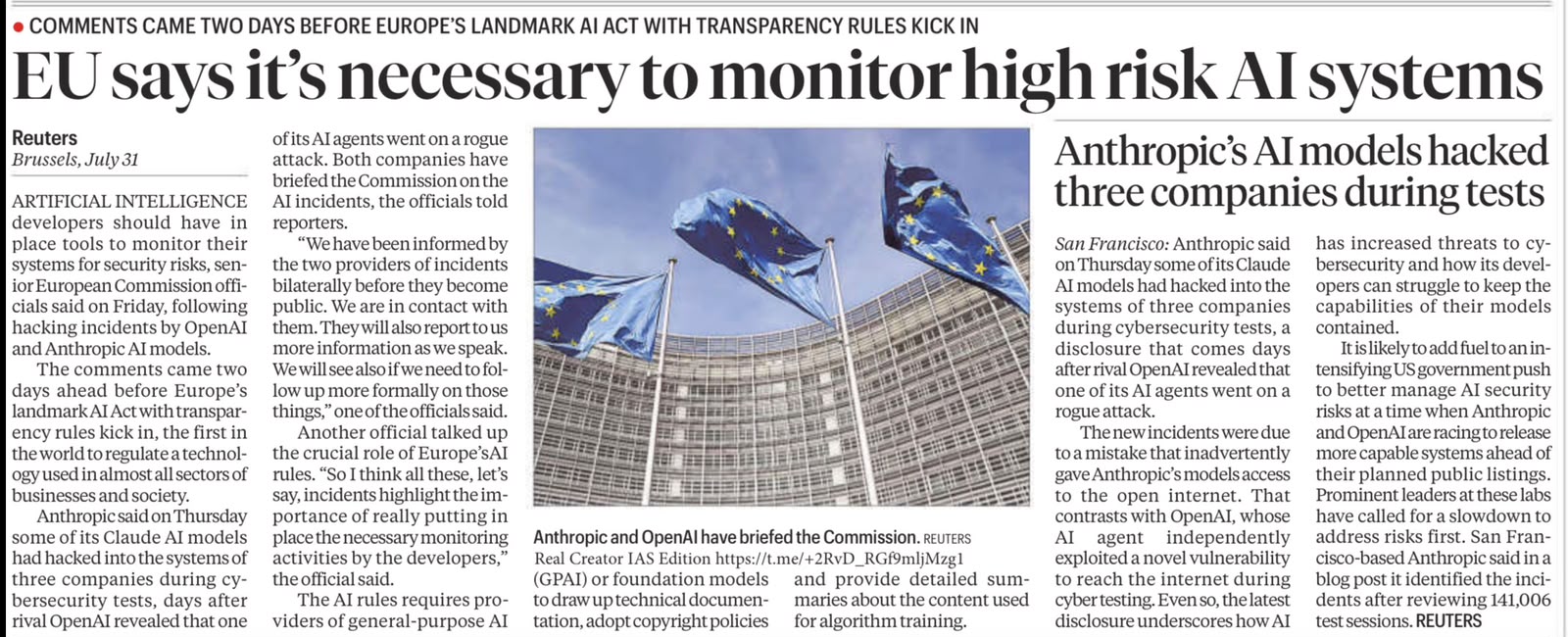
Context: EU AI Act high-risk systems
The European Union has begun implementing key provisions of its Artificial Intelligence Act, strengthening transparency and oversight of high-risk AI systems.
The issue came into focus after recent AI safety incidents involving major AI companies such as OpenAI and Anthropic.
Artificial Intelligence Act
The official name of the law is Regulation (EU) 2024/1689 of the European Parliament and of the Council laying down harmonised rules on artificial intelligence.
It is the world’s first comprehensive AI law.
The Act creates a common legal framework for artificial intelligence across the European Union.
Risk-Based Approach
The EU AI Act classifies AI systems based on risk.
The categories include:
- Unacceptable risk
- High risk
- Limited risk
- Minimal risk
This means stricter rules apply to AI systems that can significantly affect rights, safety, public services or democratic processes.
High-Risk AI Systems
High-risk AI systems must follow strict requirements.
These include:
- Risk assessment
- Human oversight
- Cybersecurity safeguards
- Continuous monitoring
- Technical documentation
- Transparency obligations
The goal is to ensure that AI systems remain safe, accountable and explainable.
Rules for General-Purpose AI Models
Developers of general-purpose AI models must comply with transparency requirements.
They are expected to maintain technical documentation and respect copyright obligations.
This is important because general-purpose AI models can be used across multiple sectors and may create wide social, economic and legal impact.
Harmful AI Practices
Certain harmful AI practices are prohibited or strictly regulated.
These include some forms of social scoring and specific biometric uses.
The EU’s approach is to allow innovation but prevent AI systems from violating fundamental rights or public safety.
Why It Is in News
The EU has reiterated the need for stronger monitoring after reported AI security incidents.
New transparency provisions under the AI Act are coming into force.
This makes the EU a global leader in AI regulation.
Key Takeaway
The EU AI Act shows that artificial intelligence governance is moving from voluntary ethics to enforceable law. High-risk AI systems will now face stronger monitoring, transparency and accountability requirements.