Context: Sustainable Crop Protection in India
India is strengthening science-based crop protection through safer technologies, precision agriculture and better regulation to ensure food security, public health and export competitiveness.
Crop Protection in Indian Agriculture
India uses only 0.31 kg/ha of pesticides, compared to the global average of 2.40 kg/ha.
This means India’s pesticide use is nearly one-eighth of the global average.
About 40–50% of India’s arable land is under structured plant protection.
Crop protection has played an important role in India’s agricultural transformation.
It supported the Green Revolution and helped India move from a food-deficit country to a food-surplus nation.
It has also contributed to agricultural exports of nearly $100 billion.
Transition Towards Sustainable Crop Protection
India has phased out DDT from agricultural use.
The country is gradually shifting towards safer and more targeted pesticides.
Precision agriculture has reduced pesticide application to 20–100 g/ha in several crops.
Modern crop protection is no longer only about increasing yield.
It now has to balance:
- Productivity
- Environmental sustainability
- Public health
- Export quality
Challenges
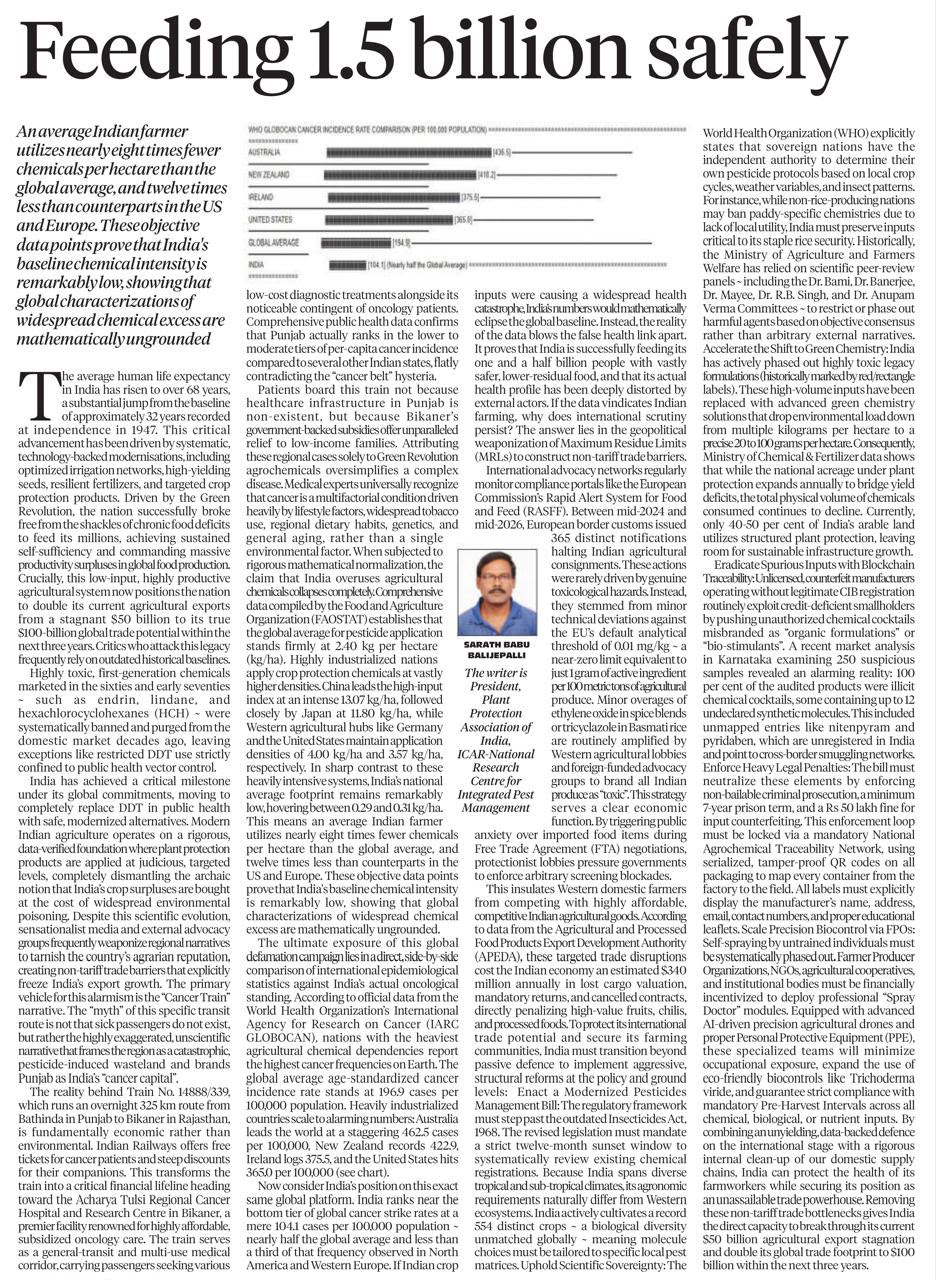
Cancer incidence in India is 104.1 per 100,000, which is lower than Australia, New Zealand, Ireland and the USA.
However, health outcomes depend on several factors beyond pesticide exposure.
India also faces stricter international food-safety standards.
Maximum Residue Limits, or MRLs, and Rapid Alert System for Food and Feed standards have become major challenges for India’s agricultural exports.
These can often work as non-tariff trade barriers.
Another major concern is the spread of illegal and counterfeit pesticides.
A survey detected undeclared chemicals in sampled products, which creates risks for:
- Farmers
- Consumers
- Agricultural exports
Way Forward
India should periodically review pesticide regulations based on Indian agro-climatic conditions and scientific evidence.
Integrated Pest Management should be expanded.
Precision agriculture, drone spraying and AI-based advisory services should be promoted.
QR-based traceability, quality surveillance and stronger enforcement against counterfeit pesticides are also needed.
Key Takeaway
India’s food security depends not only on producing more, but on producing safely. Crop protection must combine science, regulation, farmer support and export-quality standards.