
Learn UPSC PYQ Analysis Strategy with a practical framework to identify recurring themes, study depth, mistakes, and improve Prelims and Mains preparation.
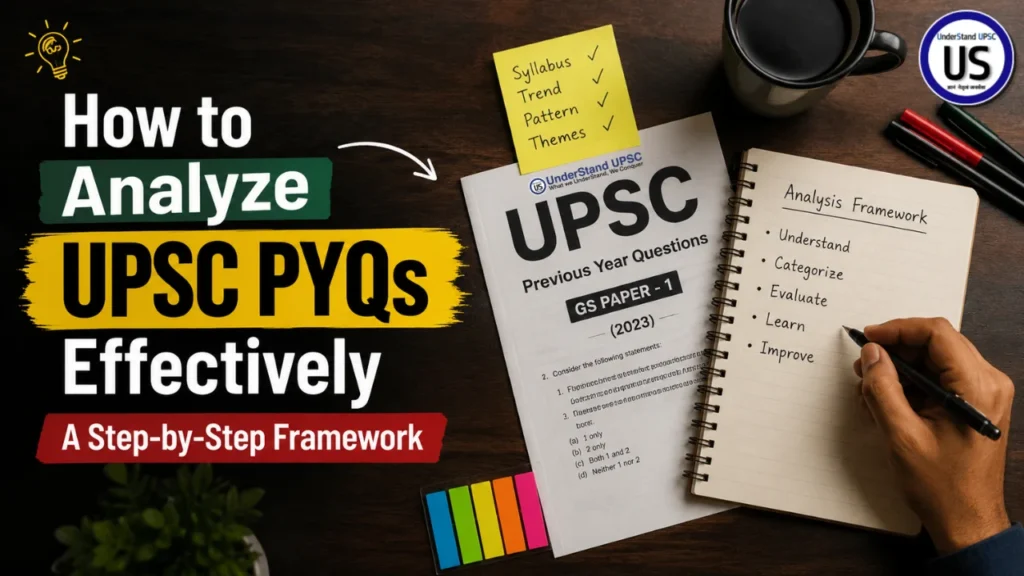
Most aspirants use previous year questions at the wrong stage. The UPSC PYQ Analysis Strategy should begin before you start studying a subject. They finish a subject, solve a few papers, check the answer key, and call it PYQ analysis. By then, they have already spent weeks reading every chapter, making notes from multiple sources, and memorising facts that UPSC has never shown any interest in testing.
The use of PYQs begins before studying. They help you decode the syllabus, decide the depth of reading, identify recurring concepts, and understand how UPSC converts one topic into several different questions. They are not a prediction tool. They are a filtering tool.
UPSC PYQ Analysis Strategy: A Step-by-Step Framework
Begin With the Question, Then Open the Source
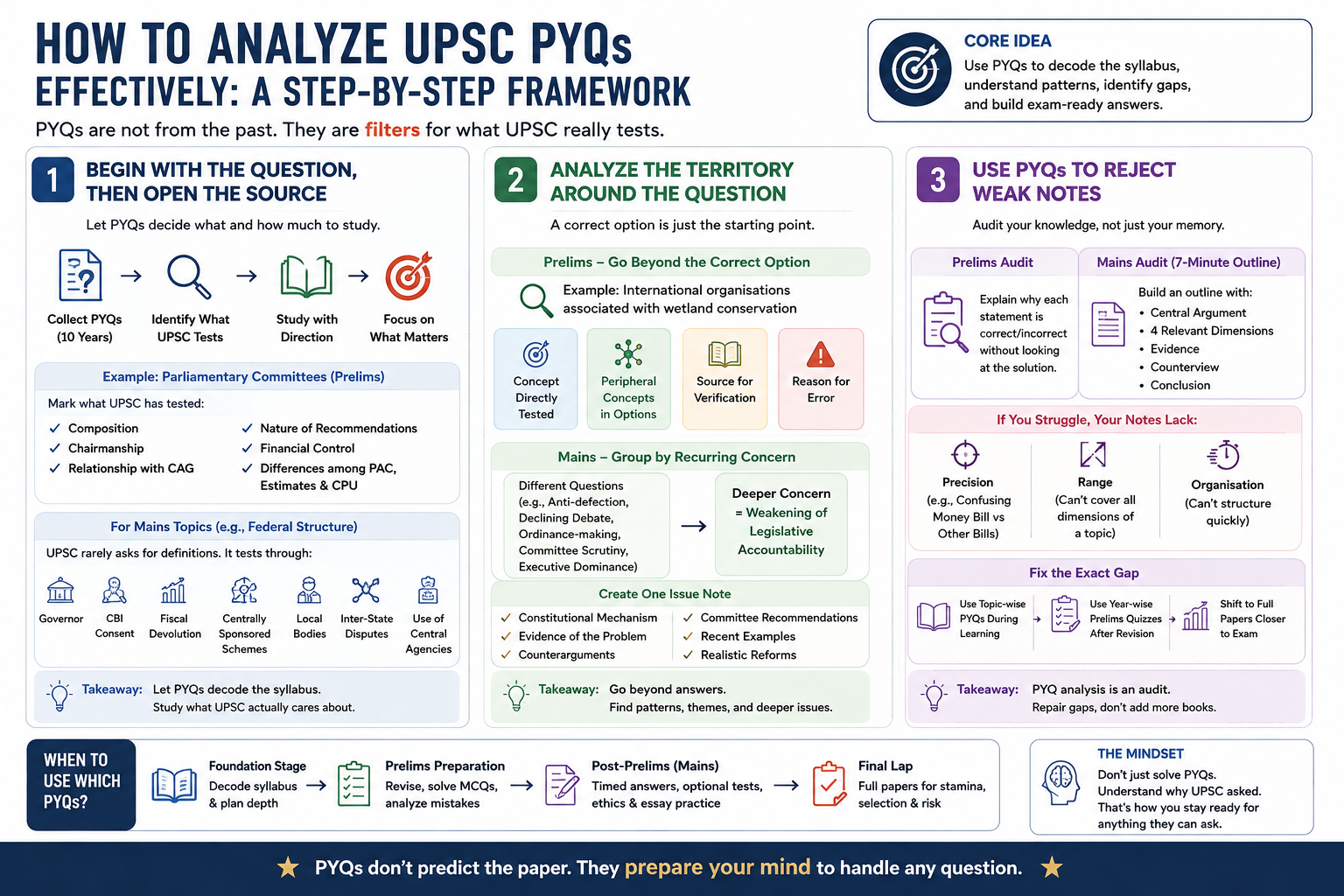
A good UPSC PYQ Analysis Strategy helps you identify the exact depth at which a topic needs to be studied. Suppose you are starting parliamentary committees from Laxmikanth. This is the foundation of an effective UPSC PYQ Analysis Strategy. Before reading the chapter, collect relevant prelims questions from ten years. Do not solve them immediately. Read every statement and mark what UPSC has tested: composition, chairmanship, relationship with the CAG, nature of recommendations, financial control, and differences among the Public Accounts Committee, Estimates Committee, and Committee on Public Undertakings.
Now open the chapter. You will read differently. The line connecting the PAC with CAG reports will no longer look like an isolated fact. You will notice the exact distinctions UPSC can convert into confusing statements. You will stop wasting equal effort on background details that do not clarify concepts or solve questions.
Use the same method for mains. Before studying “federal structure” in GS Paper II, place related questions together. You will find that UPSC rarely asks for a textbook definition of federalism. It approaches the subject through the Governor, CBI consent, fiscal devolution, centrally sponsored schemes, local bodies, inter-state disputes, and the use of central agencies.
This collection tells you what the two-word syllabus phrase actually contains. UnderStand UPSC’s GS Mains Micro-Syllabus can make this stage easier by breaking broad syllabus entries into workable themes. Pair it with the year-wise papers available in the UnderStand UPSC PYQ section instead of depending on random Telegram compilations.
Analyse the Territory Around the Question
A prelims PYQ is not complete when you identify the correct option. Every incorrect statement must also be studied because UPSC often hides future topics inside wrong options.
Suppose a question asks which international organisations are associated with wetland conservation. The correct combination is only the starting point. Examine every organisation mentioned. What is its parent body? Is it created by a treaty, a resolution, or an independent agreement? Does it publish a report? Does it work globally or regionally? Why was the incorrect option believable?
Create a simple four-part note: concept directly tested, peripheral concepts hidden in the options, source required for verification, and reason for your error. The reason matters. A wrong answer caused by lack of knowledge needs revision. A wrong answer caused by missing the word “only” needs better reading discipline. A correct answer reached through blind guessing should still be treated as a weakness.
For Mains, the UPSC PYQ Analysis Strategy should focus on recurring issues rather than memorising individual answers. Group questions by recurring concern rather than storing separate model answers. Questions on Parliament may appear through anti-defection, declining debate, committee scrutiny, ordinance-making, or executive dominance. The deeper concern is the weakening of legislative accountability.
Prepare one issue note around that concern. Include the constitutional mechanism, evidence of the problem, counterarguments, committee recommendations, recent examples, and realistic reforms. Such a note can be adapted across several questions without becoming a memorised template.
UnderStand UPSC’s Mains PYQ Practice can be used after this stage, not before it. First create your own framework. Then compare how the model answer handles the introduction, demand, evidence, and conclusion. The purpose is to identify what your framework missed, not to copy polished language.
Use PYQs to Reject Weak Notes
After completing a topic, close your material and return to the questions. For prelims, explain why every statement is correct or incorrect without looking at the solution. For mains, give yourself seven minutes to build an outline with a central argument, four relevant dimensions, evidence, a counterview, and a conclusion.
This is the audit.
If you have studied Parliament but still confuse a Money Bill with other financial bills, your notes lack precision. If your urbanisation notes cannot answer questions on municipal finance, informal employment, segregation, climate vulnerability, and service delivery, they lack range. If you know the content but cannot organise it quickly, your notes are not revision-ready.
Do not respond by adding another book. Repair the exact gap.
Use topic-wise PYQs during learning. Use UnderStand UPSC’s year-wise prelims quizzes after revision to test whether you can handle the same concepts under time pressure. Closer to the examination, shift to full papers because they test question selection, stamina, risk, and time allocation.
Aspirants who merely solve PYQs learn what UPSC asked. Aspirants who analyse them properly learn what UPSC considers worth asking, how far a topic must be studied, and whether their knowledge can survive an unfamiliar question.
1. How should UPSC aspirants analyze previous year questions effectively?
UPSC aspirants should analyze PYQs topic-wise before and during study. Identify the concept tested, related concepts hidden in the options, the required source, and the reason for any mistake. This reveals what UPSC actually tests and the depth required.
2. Should I solve UPSC PYQs before completing a subject?
Yes. PYQs can be used before studying a topic to understand which concepts UPSC has tested and how questions are framed. This helps aspirants focus their reading instead of giving equal importance to every detail.
3. How are UPSC Prelims PYQs different from Mains PYQs?
Prelims PYQs should be analyzed for concepts, statements, options, elimination, and recurring themes. Mains PYQs should be grouped around broader issues and analyzed for demand, dimensions, evidence, counterarguments, and possible reforms.
4. What should I learn from incorrect options in UPSC PYQs?
Incorrect options should not simply be ignored. They can contain related concepts that UPSC may test separately. Aspirants should examine why an option is incorrect and add relevant concepts to their revision framework.
5. How can PYQ analysis improve UPSC preparation?
Proper PYQ analysis helps aspirants identify recurring themes, determine the required depth of study, reject unnecessary information, identify gaps in notes, and understand how UPSC converts broad syllabus topics into questions.







