UPSC Prelims Cut Off 2027 explained with recent trends, score ranges, CSAT requirements, accuracy tips and a practical preparation target.
Every serious Prelims aspirant eventually asks the same question: “What score is actually safe?” It sounds like a numerical question, but UPSC’s recent cut-off history shows why there is no single number you can carry from one year to the next.
In five officially published cycles, the General-category cut-off has moved from the mid-70s to above 92. A score that looked comfortable in one year would have been risky in another. That is why cut-off analysis is useful only when it changes how you prepare – not when it becomes another prediction exercise.
For 2027, the goal is simple: understand the range, understand why it moves, and build enough accuracy that you are not depending on UPSC setting a paper that suits your preferred cut-off.
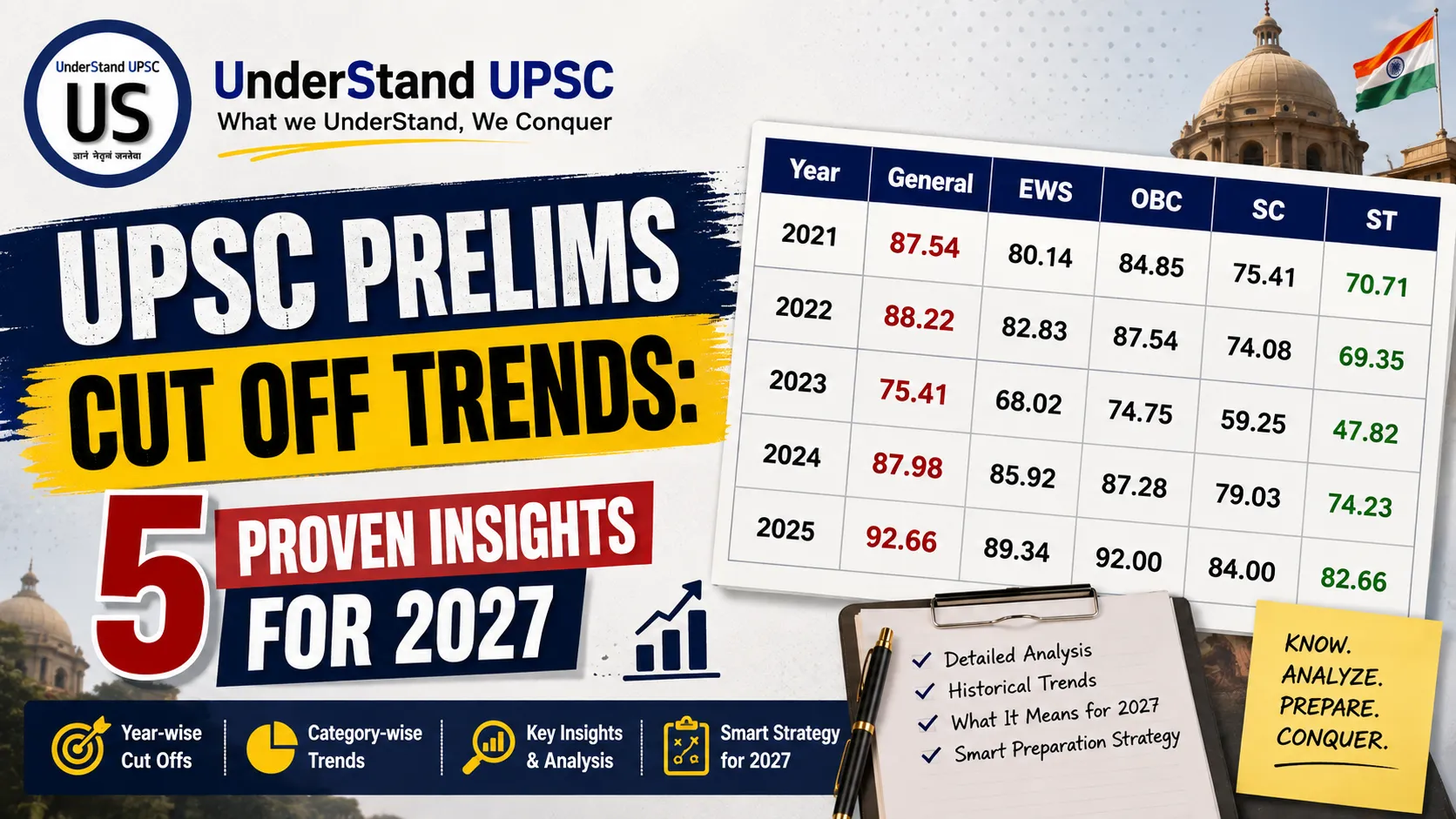
What the Last Five Official Cut-Offs Really Tell You
| Year | General | EWS | OBC | SC | ST |
| 2021 | 87.54 | 80.14 | 84.85 | 75.41 | 70.71 |
| 2022 | 88.22 | 82.83 | 87.54 | 74.08 | 69.35 |
| 2023 | 75.41 | 68.02 | 74.75 | 59.25 | 47.82 |
| 2024 | 87.98 | 85.92 | 87.28 | 79.03 | 74.23 |
| 2025 | 92.66 | 89.34 | 92.00 | 84.00 | 82.66 |
Note: These are the latest five officially published CSE Prelims cut-offs. The 2026 cut-off is not included because UPSC has not yet published it.
Insight 1 – There is no stable “90-mark cut-off”. The General cut-off was 87.54 in 2021 and 88.22 in 2022, collapsed to 75.41 in 2023, returned to 87.98 in 2024 and reached 92.66 in 2025. The highest and lowest points in just five cycles are separated by 17.25 marks.
The five-year General average is 86.36, while the median is 87.98. Both are useful for seeing the recent zone. Neither tells you what 2027 will be. The stronger lesson is that UPSC can move the qualifying line significantly without giving you advance warning.
Why the UPSC Prelims Cut Off Can Change So Sharply
Insight 2 – Cut-off movement is a property of the paper and the competition, not a yearly trend line. Candidates often see 75.41 in 2023 and assume UPSC has entered a low-cut-off era, or see 92.66 in 2025 and assume the next paper must cross 95. Both are weak conclusions.
A difficult paper pushes more candidates into lower score bands. A more accessible paper can create a tighter cluster of higher scores. What finally matters is the distribution of performance in that particular examination, along with the qualifying standard fixed by UPSC for each category.
That is why the jump from 75.41 in 2023 to 87.98 in 2024 matters more than any five-year average. It tells you that one unusual paper should never become the basis of your next attempt’s strategy.
Insight 3 – Negative marking makes accuracy more valuable than raw attempts. In GS Paper-I, a wrong answer attracts a penalty of one-third of the marks assigned to that question. Since each question carries 2 marks, one wrong answer costs about 0.67 mark. Moving the same question from wrong to correct changes your score by roughly 2.67 marks.
That means four better decisions can move your score by more than 10 marks. So when someone says, “You must attempt 90 questions,” the more useful response is: at what accuracy? Attempt count without accuracy tells you almost nothing.
| Track this after mocks: Separate your attempts into high-confidence, 50-50 and low-confidence questions. If your low-confidence attempts are consistently damaging the score, the answer is not ‘attempt more’. It is to improve elimination and restraint. |
The Cut-Off Is Only Half the Prelims Story
Insight 4 – The official Prelims cut-off is based on GS Paper-I; CSAT is a separate qualifying condition. UPSC’s cut-off notices clearly state that GS Paper-II is qualifying with 33% marks. Since CSAT is out of 200, that means at least 66.67 marks are required.
This distinction is easy to understand and surprisingly easy to ignore. You can score above the GS-I cut-off and still fail Prelims because of CSAT. You can also score 100+ in CSAT and gain no compensation for a weak GS-I score.
For 2027, the practical lesson is not merely “practise CSAT”. It is to know your risk early. If you are consistently hovering around 70 in full-length CSAT papers, you are not comfortably safe simply because 66.67 is the rule. Build a buffer before exam pressure, unfamiliar passages or one weak section can remove it.
What Should You Target for UPSC Prelims 2027?
Insight 5 – Your preparation target should sit above the likely cut-off zone, not on it. No one can responsibly tell you today that the 2027 General cut-off will be 88, 92 or 95. The last five official cycles themselves show why that confidence would be fake.
A better preparation benchmark is to become capable of scoring 100+ in GS Paper-I across serious, varied full-length mocks while keeping CSAT comfortably above the qualifying threshold. This is not a prediction that the 2027 cut-off will be 100. It is a way of building room for an unfamiliar paper, a few avoidable errors and the natural variation that comes on exam day.
Also, do not judge readiness from your best mock. Look at the pattern across several papers. If your scores are 108, 103, 97, 105 and 101 across different test styles, that tells you much more than one 118 on a paper that happened to match your strengths.
| A sensible 2027 approach: Use previous cut-offs to understand the danger zone. Use PYQs and mocks to move your normal performance above it. The aim is not to guess UPSC’s number; it is to stop one small shift in that number from deciding your attempt. |
The UPSC prelims cut off is useful because it gives context to your score. It is dangerous when it becomes the score you prepare to achieve.
If recent trends teach one thing, it is that the paper can change faster than your prediction model. For 2027, build strong fundamentals, learn when to eliminate and when to leave a question, keep CSAT genuinely safe, and create a score buffer through repeated full-length practice.
The safest strategy is not knowing next year’s cut-off. It is preparing well enough that you do not need to know it.
FAQs –
1. What is the UPSC Prelims Cut Off 2027?
The UPSC Prelims Cut Off 2027 is not known yet. It will be determined by UPSC after the examination. Recent official cut-offs show significant year-to-year variation, so candidates should not rely on a fixed predicted score.
2. What was the UPSC Prelims cut off in 2025?
The General-category UPSC Prelims cut off for 2025 was 92.66 marks, based on GS Paper-I. UPSC also specified that GS Paper-II is qualifying with 33% marks.
3. Is 100 marks a safe score for UPSC Prelims 2027?
No score can be guaranteed as safe before the examination. Aiming for 100+ in varied full-length GS Paper-I mocks can provide a useful preparation buffer, but it should not be treated as a prediction of the actual cut-off.
4. Does CSAT affect the UPSC Prelims cut off?
CSAT is qualifying and requires 33% marks. The official Prelims cut-off is based on GS Paper-I, but candidates must also clear the CSAT qualifying requirement to qualify for Mains.
5. Why does the UPSC Prelims cut off change every year?
The cut-off can change because candidate performance, paper difficulty, competition and the overall score distribution vary from one examination to another. The recent official figures demonstrate that the qualifying level can move substantially between cycles.