Confused about how to start UPSC after 12th or graduation? Join the GS Foundation 2028 course for beginners with structured classes, notes, and mentorship.
One of the biggest myths about starting UPSC early is that the sooner you begin studying like a full-time aspirant, the better your chances become.
That is not how good preparation works.
A student starting after Class 12 and a graduate beginning after college may both be “beginners”, but they are standing at very different points in life. One has time to build reading depth, academic maturity and awareness without immediate exam pressure. The other has less distance from a serious attempt and therefore needs to move much faster from understanding to revision, PYQs, answer writing and test performance.
This is where early preparation becomes meaningful. The goal is not to put both students through the same timetable. It is to use the same foundation differently according to what each stage actually demands. That’s the best thing about UnderStand UPSC’s GS Foundation 2028 course. It is useful at both stages precisely because it can be used differently.
GS Foundation 2028 Course for Beginners
After Class 12: The Course Is Most Useful as Guided Exposure
At 18 or 19, the problem is usually not lack of effort. It is lack of context. A beginner opens Laxmikanth, Spectrum, an Economy book and a newspaper on the same day and assumes all of them deserve equal urgency. They do not.
The first benefit of a structured foundation course at this stage is sequencing. The student encounters Polity, History, Geography, Economy, Society, Environment and the other GS areas in a planned order instead of building preparation around random online recommendations. This matters because early understanding compounds. Once federalism, inflation, monsoons or social justice make sense conceptually, later current affairs stop looking like disconnected news.
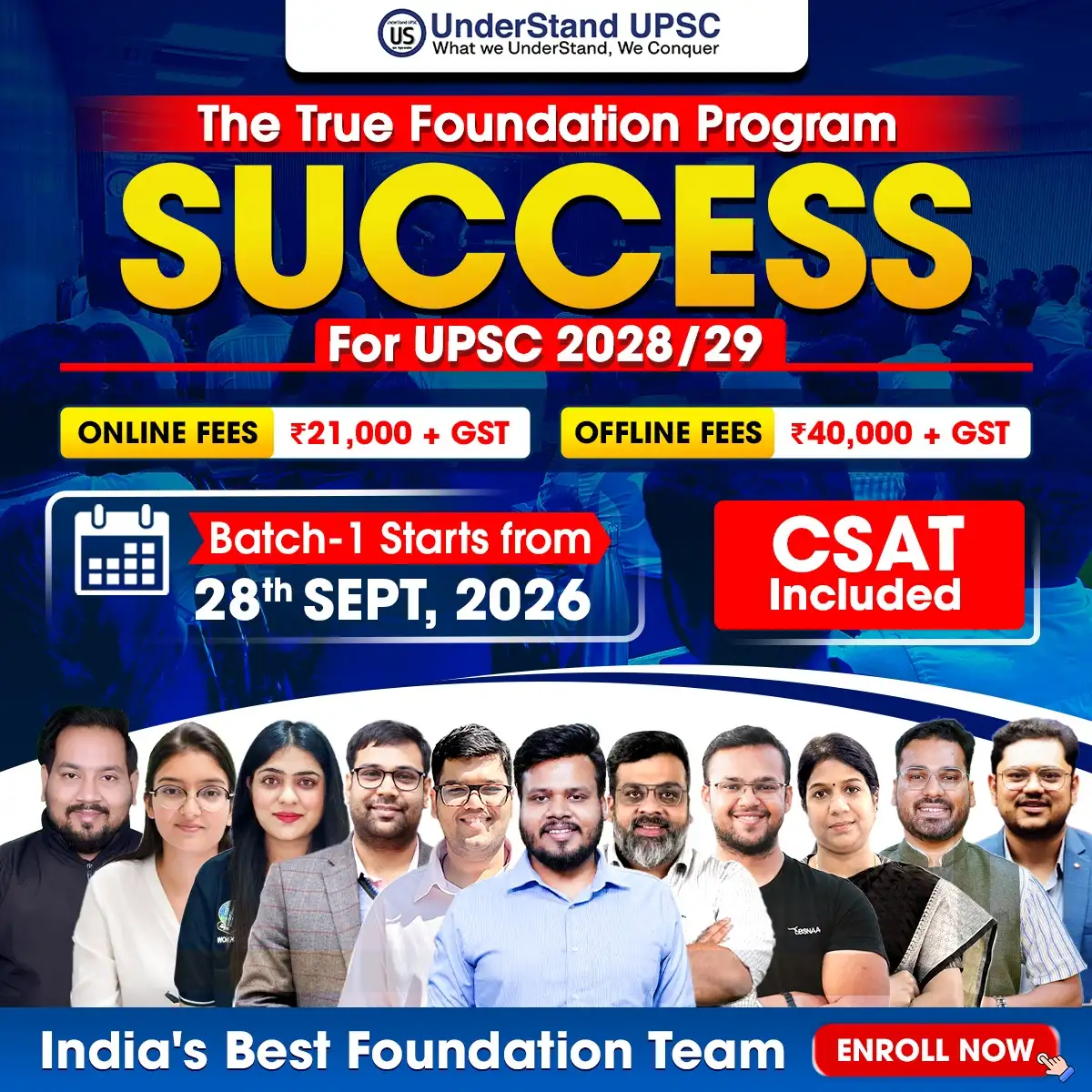
UnderStand UPSC’s 2028/29 foundation programme currently covers GS I-IV, Essay and CSAT, and integrates theme-wise PYQ analysis, tests, current-affairs linkage and answer-writing work. For a college beginner, these elements are useful at a lower intensity than they are for a graduate.
The GS classes give the student a first clean explanation of subjects that may be completely new. The class notes are useful as an anchor, not as material to memorise immediately. PYQs are useful because they show what UPSC eventually does with a topic, not because a first-year student needs to start chasing mock-test scores.
The same applies to answer writing. A Class 12 beginner does not need to write ten timed Mains answers every week. What is useful is learning the habits underneath good answer writing: understanding the directive, identifying the central issue, separating causes from consequences, and expressing a point in a few clear sentences.
CSAT can also be handled patiently. If basic numeracy or comprehension is weak, a foundation-to-advanced CSAT track gives enough time to repair the weakness before it becomes an attempt-year emergency. If CSAT is already comfortable, it can remain in maintenance mode while the student builds GS.
The scheduling and mentorship layer is non-negotiable at this stage because it prevents UPSC from taking over college. A college student needs room for the degree, internships, reading and ordinary intellectual growth. Guidance is valuable when it keeps preparation proportionate rather than constantly increasing the workload.
| What the course should produce at this stage: By the end of the early foundation phase, the student should understand the basic language of GS, know the broad syllabus, recognise PYQ patterns, and have a revision habit – without living like a full-time aspirant years before eligibility. |
After Graduation: The Same Course Becomes a Conversion System
For a graduate, the usefulness of the same foundation structure changes. You no longer have the luxury of treating every class as general knowledge. If 2028 is likely to be a serious attempt, each subject has to move towards exam output.
The GS classes now provide coverage, but coverage is only the first layer. Theme-wise PYQ analysis becomes a filtering tool: it tells you which distinctions UPSC repeatedly tests, which issues recur in different forms, and where your reading needs more depth. This is especially important because graduates often lose months by reading every chapter with the same intensity.
The test component becomes more consequential too. UnderStand UPSC’s current 2028/29 programme includes prelims tests, mains tests and post-test discussions. For a graduate, these are not just practice opportunities; they create a mistake record. A low score in Environment because of factual gaps needs a different correction from a low score caused by reckless guessing or poor elimination.
Answer writing also moves from learning structure to building speed and judgement. The programme’s answer-writing component and Mains evaluation become useful when the candidate writes first and uses feedback to diagnose what is missing: the demand of the question, evidence, structure, analysis or time control.
Current affairs now need to be integrated more aggressively with static GS. A Supreme Court decision should enter Polity or Governance notes; an inflation episode should enrich Economy; a climate event should connect with Geography, Environment and Disaster Management. The purpose is not to maintain a separate mountain of current-affairs notes. It is to make static knowledge contemporary enough to use in both Prelims and Mains.
A graduate also has to protect space outside GS. The optional cannot wait until “GS is over”, because GS never truly ends. CSAT has to be diagnosed early. Essay and Ethics need practice before the post-Prelims rush. A good foundation schedule helps only when the candidate uses the self-study time around classes to keep these parallel tracks alive.
Mentorship at this stage therefore becomes diagnostic rather than introductory. The useful questions are narrower: Which source can I drop? Why are my notes not revisable? Is my test score falling because of knowledge or decision-making? Is my optional progressing at the right pace? Where is my answer writing repeatedly weak?
| What the course should produce at this stage: A graduate should move from first reading to repeated revision, from PYQ awareness to PYQ-based prioritisation, and from answer-writing theory to timed, evaluated output. |
How the Same Foundation Components Work Differently at the Two Stages
| Course element | After Class 12 | After Graduation |
|---|---|---|
| GS classes | Build vocabulary and conceptual base | Complete exam-oriented coverage and identify revision units |
| Class notes | Reference material for first understanding | Compress into personal revision notes |
| PYQ analysis | Learn how UPSC thinks | Prioritise themes and determine required depth |
| Prelims tests | Occasional diagnosis; no obsession with rank | Accuracy, elimination, attempt strategy and error analysis |
| Answer writing | Learn question demand and basic structure | Timed answers, evaluation and speed |
| Mains tests | Limited exposure later in the foundation | Regular conversion of knowledge into marks |
| Current affairs | UnderStand recurring public issues | Add contemporary evidence to static GS |
| CSAT | Repair basics gradually if needed | Build a reliable qualifying margin |
| Mentorship | Pacing, source discipline and college balance | Performance diagnosis and attempt planning |
This is why it is misleading to ask whether a foundation course is “better after Class 12 or after graduation”. It is useful at both stages, but the academic return is different.
After Class 12, the return comes from avoiding bad habits before they become permanent: random sources, premature test anxiety, excessive current-affairs collection and weak conceptual reading. After graduation, the return comes from compression: fewer sources, faster syllabus completion, early error detection and a smoother shift from knowledge to performance.
What Should Be Different by the Time the Serious Attempt Arrives?
If you are starting early, remember this: you are not behind just because you do not know everything yet. You are exactly where a serious journey is supposed to begin.
After Class 12, you have time to grow into the exam. Use these years to become sharper, more aware, more disciplined and more curious about the country you may one day serve. After graduation, use the same preparation with greater urgency. Turn knowledge into recall, recall into answers, and mistakes into corrections.
There will be phases when progress feels slow. Some weeks your scores will fall. Some subjects will refuse to settle. At times, people around you may seem far ahead. Do not let that disturb your direction.
UPSC is not cleared by one extraordinary month. It is built through hundreds of ordinary days when you keep returning to the syllabus, correcting yourself and becoming a little better than before.
By the time your serious attempt arrives, you should be able to look back and know that you did not simply spend two years preparing for an examination. You used those two years to build the discipline, judgment and resilience required for the responsibility you are aiming for.
And when that day comes, you should not walk into the exam hall hoping that everything goes your way. You should walk in knowing that you have done enough to give yourself a real chance.
FAQs:-
Is a GS Foundation 2028 Course suitable for students after Class 12?
Yes. For students after Class 12, a foundation course can provide structured exposure to GS subjects, conceptual understanding, PYQs and basic answer-writing skills without requiring full-time UPSC preparation.
Can I start UPSC preparation after graduation for the 2028 attempt?
Yes. A graduate can use foundation preparation more intensively by focusing on syllabus coverage, PYQ-based prioritisation, revision, tests, answer writing and current-affairs integration.
What should students focus on after Class 12 for UPSC preparation?
Students should build conceptual clarity, reading habits, awareness of major GS subjects and familiarity with the UPSC syllabus and PYQs while maintaining a healthy balance with college studies.
How is UPSC foundation preparation different after graduation?
After graduation, preparation generally needs to become more exam-oriented. The focus should shift towards completing coverage, repeated revision, PYQ analysis, timed answer writing, tests and identifying weaknesses through evaluation.
What does the GS Foundation 2028 Course include?
The current UnderStand UPSC 2028/29 programme includes GS I–IV, Essay, CSAT, Prelims tests, Mains tests, PYQ analysis, answer writing, current-affairs lectures, mentorship, doubt resolution and ranker interaction.