Admissions Open: MAD-X for UPSC Prelims 2027 · Batch starts 1st Nov 2026 Explore MAD-X
US
UnderStand UPSC Daily Current Affairs Practice
0.00Score / 12
0 / 6MCQs Attempted
0%Accuracy
6 November 2026 • UPSC CSE

Read the news. Test the concept. Write the Mains answer.

This interactive edition converts each current-affairs item into one Prelims-level MCQ, one Mains-level question, and a compact value-addition section for revision.

+2 correct −0.66 incorrect Explanation after attempt Image/PDF answer upload
NEWS 1 GS3 • Defence Technology Source: The Hindu

DRDO Successfully Flight-Tests the Pralay Quasi-Ballistic Missile

Context: DRDO carried out a successful flight test of the indigenous Pralay missile off the Odisha coast as part of user-evaluation trials. Pralay is a short-range, surface-to-surface quasi-ballistic missile meant for precision strikes.
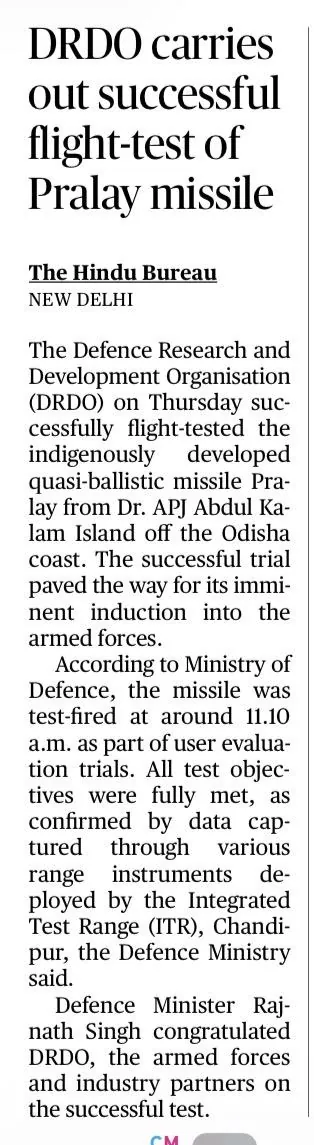
DRDO successfully flight-tests Pralay quasi-ballistic missile off Odisha coast (The Hindu)
Pralay was tested from Dr. A.P.J. Abdul Kalam Island off Odisha. Source: The Hindu

Pralay: Key Features

Type
Short-range, surface-to-surface quasi-ballistic missile.
Range
About 150–500 km; solid-propellant motor.
Payload
Can carry different conventional warheads; precise guidance.
Developer
Indigenously developed by DRDO.

Missile Types Compared

Ballistic
Powered mainly in the boost phase, then a high, gravity-driven arc. E.g. Agni, Prithvi.
Cruise
Powered through most of the flight, flies low using aerodynamic lift. E.g. BrahMos, Tomahawk.
Quasi-ballistic
Lower ballistic path and can manoeuvre mid-flight — harder to intercept. E.g. Pralay.

Strategic Significance

Precision strike
Hits high-value military targets with conventional weapons.
Hard to intercept
Manoeuvrability makes the path less predictable for air defence.
Self-reliance
Strengthens India's indigenous missile ecosystem.
Key Takeaway: Pralay fills a gap between artillery and strategic missiles: a conventional, precise and hard-to-intercept weapon for tactical deterrence, built entirely at home.

Prelims Practice MCQ

+2 correct • −0.66 wrong

Consider the following statements regarding missiles:
1. Ballistic missiles are powered mainly during their initial boost phase.
2. Cruise missiles use aerodynamic lift and remain powered during most of their flight.
3. BrahMos is a ballistic missile, while Agni-V is a cruise missile.
Which of the statements given above are correct?

Explanation: Statements 1 and 2 are correct. BrahMos is a supersonic cruise missile, whereas Agni-V is a ballistic missile.

UPSC Mains Question

10 Marks • 150 Words

What are quasi-ballistic missiles? Discuss the significance of the Pralay missile for India's conventional deterrence and defence indigenisation.

Attempt before opening the value-addition tab.
Accepted: JPG, JPEG, PNG, WEBP or PDF. The standalone file previews your answer locally; connect the API hook for real server submission.
Use after attempting the Mains answer
  • Pralay — DRDO; 150–500 km; solid fuel; conventional warheads; quasi-ballistic.
  • Compare — ballistic (Agni, Prithvi), cruise (BrahMos), hypersonic (HGV).
  • Strategic — conventional deterrence, Integrated Rocket Force idea, two-front threat.
  • Indigenisation — IGMDP legacy, Positive Indigenisation Lists, defence exports.
  • Link — Missile Technology Control Regime (India member since 2016).
NEWS 2 GS2 • International Relations Source: The Hindu (Sanjaya Baru)

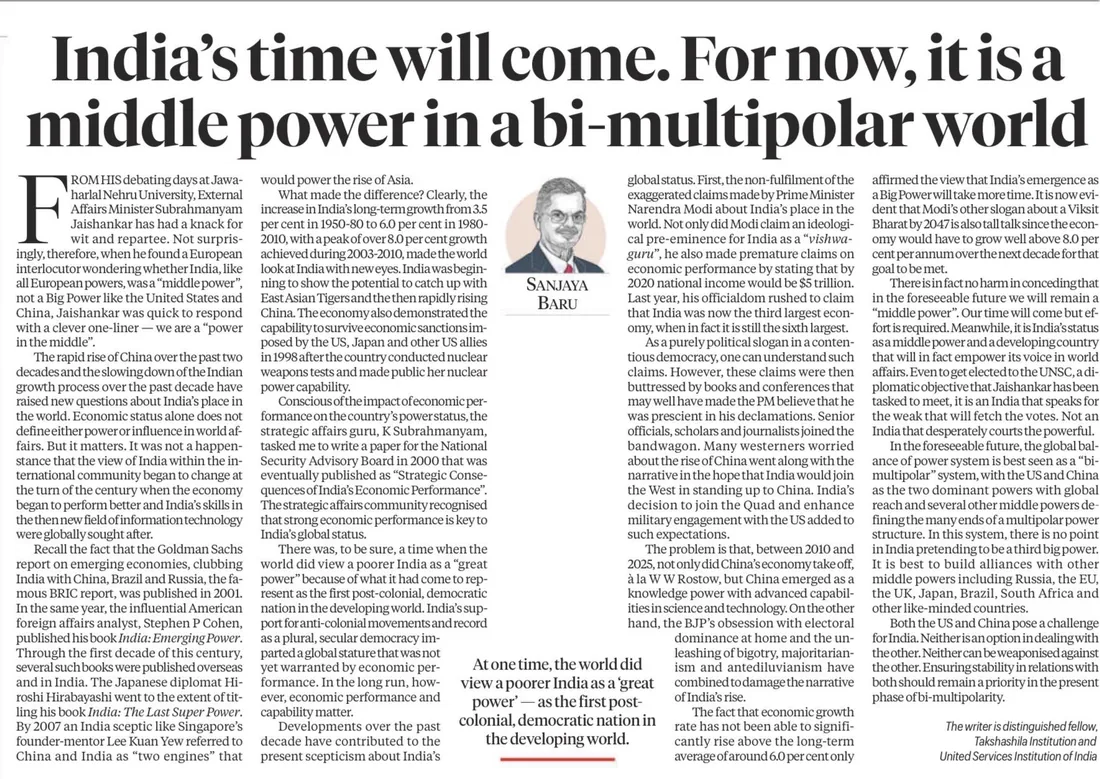
India's Time Will Come: For Now, It Is a Middle Power in a Bi-Multipolar World

Context: In an opinion piece, Sanjaya Baru argues that despite growth, nuclear capability and democratic credentials, India is still a middle power in a world dominated by the U.S. and China, and must grow fast and partner wisely to rise further.

India's time will come – for now, it is a middle power in a bi-multipolar world, Sanjaya Baru op-ed (The Hindu)
The U.S. and China dominate; others shape outcomes as middle powers. Source: The Hindu

Foundations of India's Rise

Growth
High growth in 2003–2010 raised India's profile.
Strategic
1998 nuclear tests strengthened its position.
Identity
A large, plural, secular democracy.

Why Still a Middle Power

Capability gap
Economic and technological scale below the U.S. and China.
China
China's rise has widened the gap with India.
Domestic
Institutional weakness and social divisions affect credibility.
Need
About 8% growth a year for a decade.

Key Concepts

Middle power
Significant regional influence but cannot dominate the system — e.g. India, Australia, Canada, South Korea.
Bipolarity
Two dominant powers — e.g. Cold War (U.S. vs USSR).
Bi-multipolarity
Two predominant powers (U.S., China) plus several influential ones (EU, Russia, Japan, India).

Way Forward

Economy
Productivity, industrialisation and technology.
Partners
Russia, EU, U.K., Japan, Brazil, South Africa.
Autonomy
Avoid rigid blocs; keep independent choices between U.S. and China.

Previous-Year Questions

UPSC Mains 2021 — GS II
'The USA is facing an existential threat in the form of a China that is much more challenging than the erstwhile Soviet Union.' Explain.
UPSC Mains 2024 — GS II
'The West is fostering India as an alternative to reduce dependence on China's supply chain...' Explain with examples.
Key Takeaway: Calling India a middle power is realism, not pessimism. Its global weight will grow only as fast as its economy, institutions and partnerships allow.

Prelims Practice MCQ

+2 correct • −0.66 wrong

In international relations, the term 'bi-multipolarity' refers to:

Explanation: Bi-multipolarity describes two predominant powers (today the U.S. and China) co-existing with several other influential centres such as the EU, Russia, Japan and India.

UPSC Mains Question

15 Marks • 250 Words

Is India a middle power or a rising great power? Discuss the factors that will determine India's place in an emerging bi-multipolar world order.

Attempt before opening the value-addition tab.
Accepted: JPG, JPEG, PNG, WEBP or PDF. The standalone file previews your answer locally; connect the API hook for real server submission.
Use after attempting the Mains answer
  • Concepts — middle power, great power, bipolarity, multipolarity, bi-multipolarity.
  • Strengths — economy, demography, nuclear and space power, democracy, diaspora.
  • Limits — per capita income, manufacturing, tech gap with China, social cohesion.
  • Strategy — strategic autonomy, multi-alignment (Quad, BRICS, SCO, G20).
  • Example — G20 presidency 2023 and African Union inclusion.
NEWS 3 GS2 • IR (West Asia) | GS3 • Energy Security Source: The Hindu (Reuters)

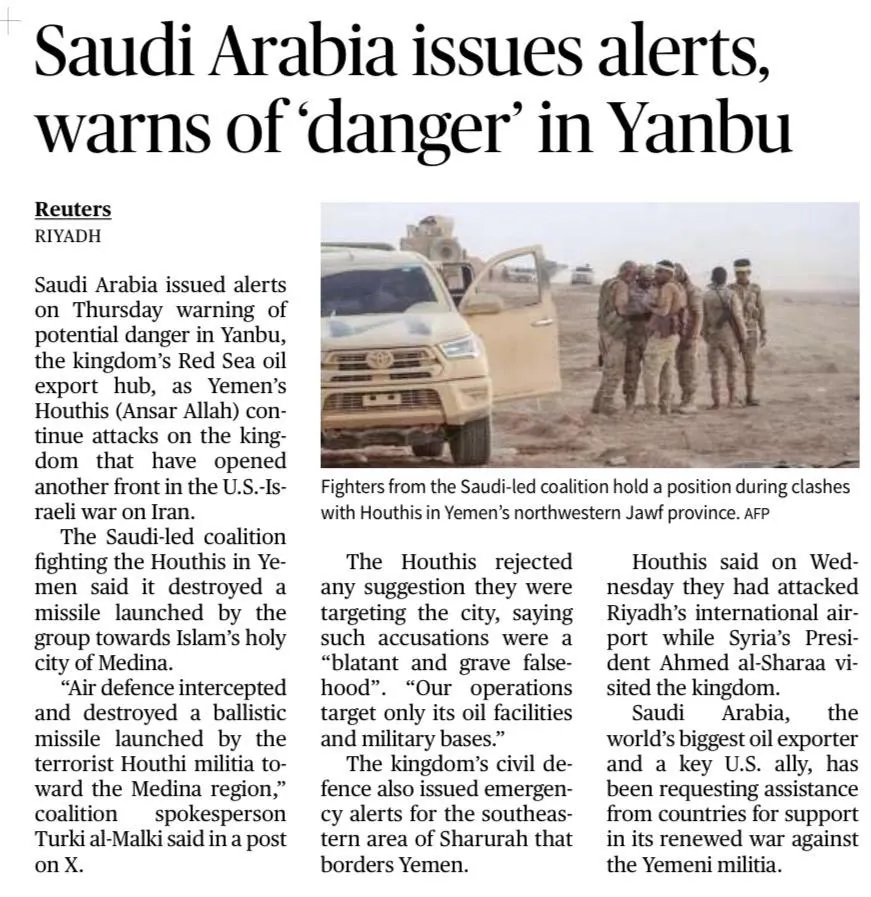
Saudi Arabia Issues Alerts, Warns of 'Danger' in Yanbu

Context: Saudi Arabia issued security alerts over possible Houthi attacks on Yanbu, its major oil-export port on the Red Sea, as tensions in West Asia escalate.

Saudi Arabia issues alerts, warns of danger in Yanbu amid Houthi threats (The Hindu, Reuters)
Saudi Arabia warns of danger to Yanbu on the Red Sea coast. Source: The Hindu
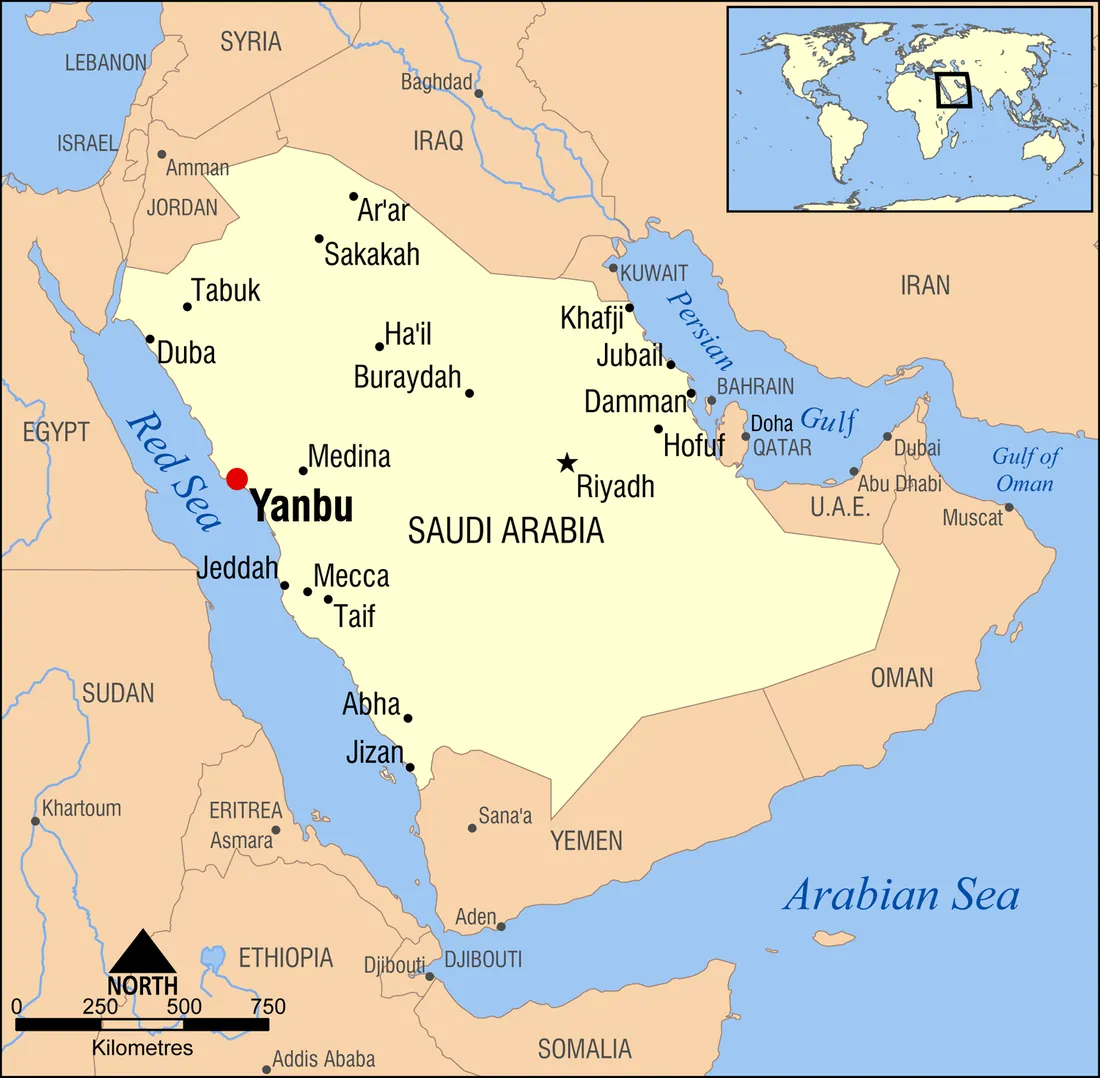
Map of Saudi Arabia showing Yanbu on the Red Sea, Riyadh, Persian Gulf and Arabian Sea
Yanbu on the Red Sea lets Saudi oil bypass the Strait of Hormuz. Source: The Hindu

Why Yanbu Matters

Oil hub
Key crude export terminal on Saudi Arabia's Red Sea coast.
Hormuz bypass
The ~1,200 km East–West Pipeline (Petroline) carries oil from the east to Yanbu, avoiding the Strait of Hormuz.
Sea routes
Access to the Suez Canal (north) and Bab-el-Mandeb (south).

Implications

Global oil
Attacks could hit supplies and raise prices.
India
Large share of crude from the Gulf; shipping costs, Indian seafarers and diaspora at risk.
Houthis
Yemen-based group backed by Iran; has targeted Red Sea shipping.

Map Facts for Prelims

Strait of Hormuz
Links Persian Gulf to Gulf of Oman — exit for Bahrain, Qatar, Kuwait, Iraq, UAE (part).
Bab-el-Mandeb
Links Red Sea to Gulf of Aden — between Yemen and Djibouti/Eritrea.
UPSC Prelims 2026
Ships from Bahrain and Qatar must cross Hormuz to reach the Indian Ocean. Answer: (b) 1 and 3.
Key Takeaway: Yanbu is Saudi Arabia's insurance policy against a closed Hormuz. If the Red Sea route is threatened too, both of the Gulf's escape routes for oil come under pressure — a direct risk for import-dependent India.

Prelims Practice MCQ

+2 correct • −0.66 wrong

With reference to Yanbu, consider the following statements:
1. It is located on the Persian Gulf coast of Saudi Arabia.
2. The East–West Pipeline allows Saudi crude to reach Yanbu, bypassing the Strait of Hormuz.
3. From Yanbu, ships can reach the Indian Ocean through the Bab-el-Mandeb Strait.
Which of the statements given above are correct?

Explanation: Statements 2 and 3 are correct. Yanbu is on the Red Sea coast, not the Persian Gulf.

UPSC Mains Question

10 Marks • 150 Words

Maritime chokepoints in West Asia are critical to India's energy security. Discuss with reference to recent threats to Red Sea shipping and oil infrastructure.

Attempt before opening the value-addition tab.
Accepted: JPG, JPEG, PNG, WEBP or PDF. The standalone file previews your answer locally; connect the API hook for real server submission.
Use after attempting the Mains answer
  • Chokepoints — Hormuz, Bab-el-Mandeb, Suez; Petroline to Yanbu.
  • India — ~85% crude imported; Gulf supply; SPR (Visakhapatnam, Mangaluru, Padur).
  • Response — Op Sankalp, Navy deployments, diversification (Russia, U.S., Guyana).
  • Actors — Houthis, Iran, Saudi-led coalition.
  • Way forward — expand SPR, renewables, IMEC, maritime security cooperation.
NEWS 4 GS2 • Polity, Governance & Vulnerable Sections Source: The Hindu (Audrey D'Mello)

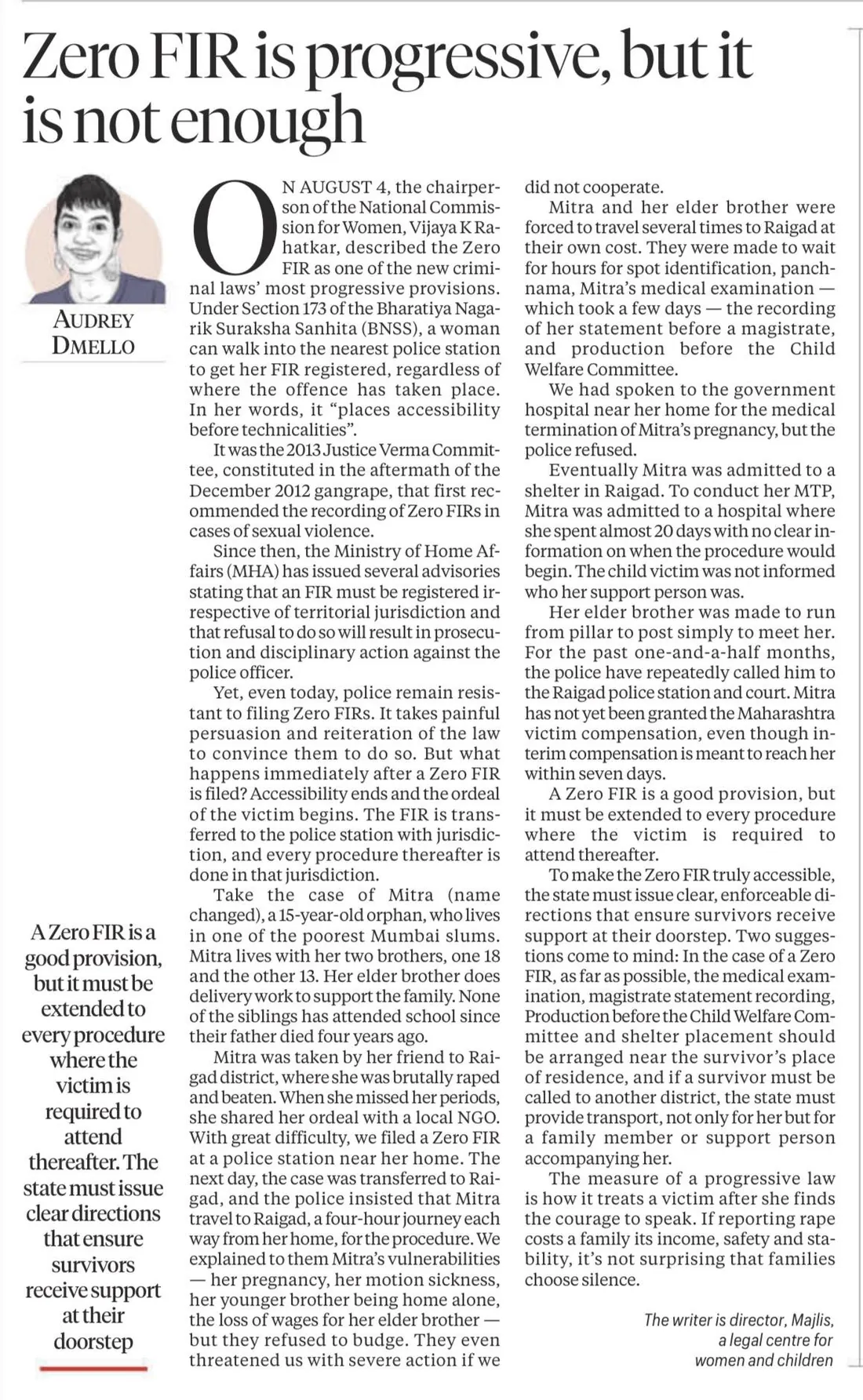
Zero FIR Is Progressive, but It Is Not Enough

Context: Section 173(1) of the BNSS, 2023 lets a person register an FIR for a cognizable offence at any police station, wherever the crime took place. An op-ed shows how survivors still face travel, delays and insensitivity after the FIR is filed.

Zero FIR is progressive, but it is not enough – BNSS Section 173 and survivor-centric justice (The Hindu op-ed)
A Zero FIR is a good provision, but survivors still face hurdles. Source: The Hindu

What Is a Zero FIR?

Law
Section 173(1), BNSS 2023 — FIR at any police station, irrespective of jurisdiction.
Then
The case is transferred to the police station that has jurisdiction.
e-FIR
BNSS also allows information to be given electronically (optional, not mandatory).
Preliminary enquiry
Sec. 173(3) — for offences punishable with 3–7 years, with permission of a DSP-rank officer.

Gaps on the Ground

Travel
Survivors still go to distant police stations for later steps.
Delays
Medical exams and statements before a magistrate can take days.
Attitude
Police insensitivity adds to trauma.
Support
No transport, shelter or timely compensation.

Way Forward

Local procedures
Medical exam and statements near the survivor's home.
Coordination
Police, hospitals, Child Welfare Committees, shelters.
Support
Travel aid, quick victim compensation, gender-sensitive policing.
Key Takeaway: Zero FIR removed the first barrier — getting a case registered. But justice is a chain, and survivors still lose time, money and dignity at every later link.

Prelims Practice MCQ

+2 correct • −0.66 wrong

With reference to Zero FIR under the Bharatiya Nagarik Suraksha Sanhita (BNSS), 2023, consider the following statements:
1. It can be registered at any police station even if the cognizable offence occurred outside its jurisdiction.
2. It is mandatory for the informant to give the information only through electronic means.
Which of the statements given above is/are correct?

Explanation: Only statement 1 is correct. BNSS allows information to be given orally, in writing or electronically; electronic submission is an option, not a requirement.

UPSC Mains Question

10 Marks • 150 Words

Zero FIR has removed territorial barriers to registering a complaint, but access to justice for survivors remains difficult. Examine and suggest a survivor-centric approach.

Attempt before opening the value-addition tab.
Accepted: JPG, JPEG, PNG, WEBP or PDF. The standalone file previews your answer locally; connect the API hook for real server submission.
Use after attempting the Mains answer
  • Law — BNSS Sec. 173(1) Zero FIR, e-FIR; Sec. 173(3) preliminary enquiry; Justice Verma Committee (2013) origin.
  • Gaps — travel, delays, insensitivity, poor coordination, delayed compensation.
  • Schemes — One Stop Centres, Nirbhaya Fund, Victim Compensation (Sec. 396 BNSS).
  • Reforms — local procedures, police training, women help desks, fast-track courts.
  • Ethics — dignity, empathy, accountability of public servants.
NEWS 5 GS3 • Science & Technology | Cybersecurity Source: The Hindu

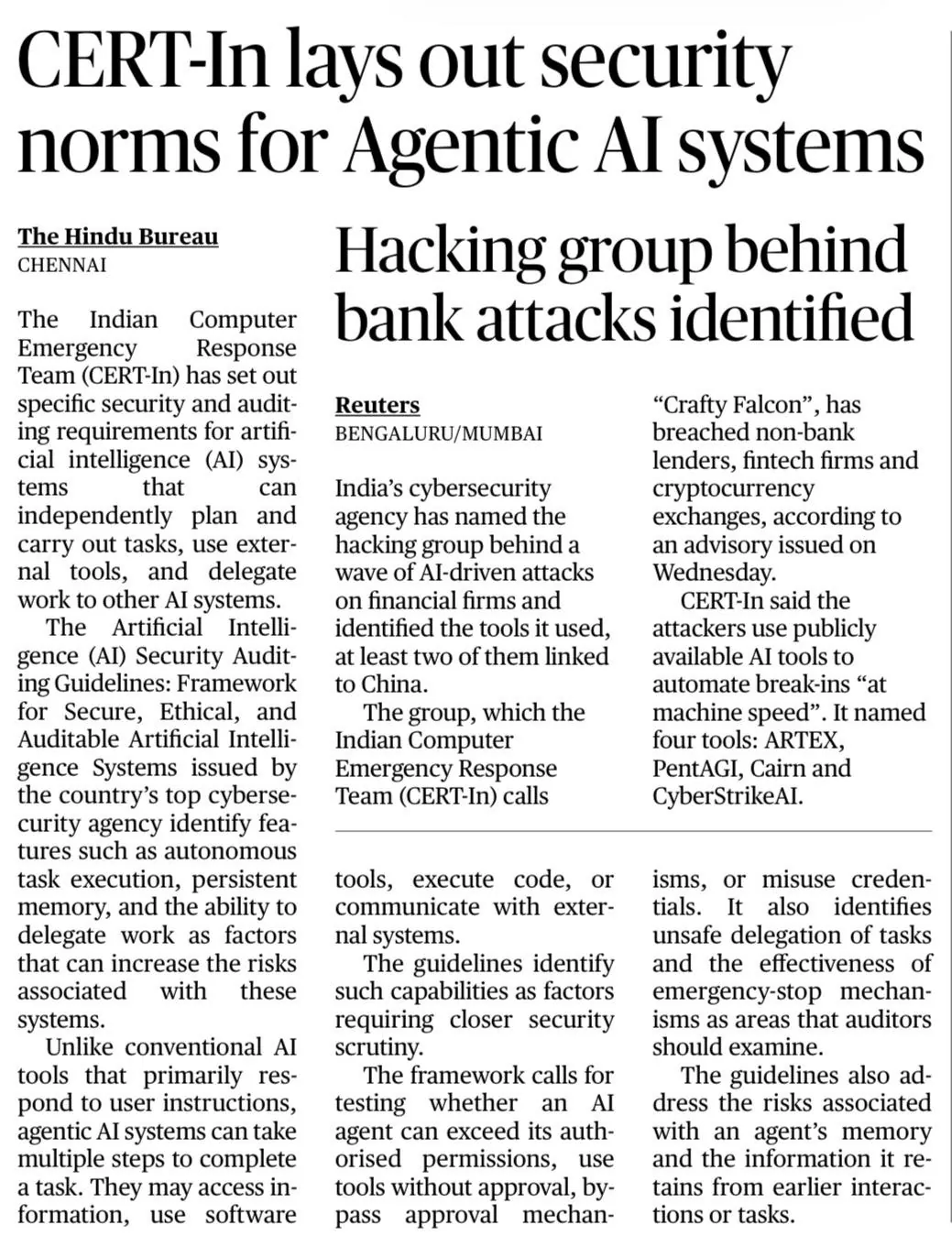
CERT-In Lays Out Security Norms for Agentic AI Systems

Context: CERT-In has issued AI Security Auditing Guidelines that set security and audit requirements for 'agentic' AI systems, and separately flagged a hacking group using AI tools to attack financial firms.

CERT-In lays out security norms for agentic AI systems – AI Security Auditing Guidelines (The Hindu)
CERT-In also flagged a hacking group targeting banks and fintechs. Source: The Hindu

What Is Agentic AI?

Meaning
AI that can plan and carry out multi-step tasks with little human input.
Abilities
Uses external tools, keeps memory, can delegate tasks to other agents.

Key Risks

Access
Exceeding permissions, misusing credentials.
Control
Running code or tools without approval; bypassing checks.
Memory
Leaking sensitive data from earlier tasks.
Shutdown
Weak emergency-stop controls.

CERT-In Requirements

Audits
Check autonomous execution, memory and delegation.
Controls
Permission tests, approval gates for tools/code, kill switch.
Threat alert
Group 'Crafty Falcon' targeted NBFCs, fintechs and crypto exchanges using AI tools (ARTEX, PentAGI, Cairn, CyberStrikeAI).

Prelims Facts

CERT-In
National nodal agency for cyber incidents under Section 70B, IT Act 2000; under MeitY.
Related
NCIIPC protects critical information infrastructure (Sec. 70A).

Previous-Year Question

UPSC Mains 2022 — GS III
What are the different elements of cyber security? Examine how far India has developed a comprehensive National Cyber Security Strategy.
Key Takeaway: When AI can act on its own, security is no longer just about protecting systems from people but also about controlling what the AI is allowed to do. CERT-In's norms bring that idea into India's cyber rules.

Prelims Practice MCQ

+2 correct • −0.66 wrong

With reference to CERT-In, consider the following statements:
1. It functions under the Ministry of Electronics and Information Technology.
2. It is the national nodal agency for responding to cybersecurity incidents under the IT Act, 2000.
3. It is the agency designated to protect Critical Information Infrastructure under Section 70A of the IT Act.
Which of the statements given above are correct?

Explanation: Statements 1 and 2 are correct. Critical Information Infrastructure is protected by NCIIPC (Section 70A), which functions under the NTRO.

UPSC Mains Question

10 Marks • 150 Words

Agentic AI systems bring new cybersecurity risks. Discuss these risks and evaluate India's approach to governing AI security.

Attempt before opening the value-addition tab.
Accepted: JPG, JPEG, PNG, WEBP or PDF. The standalone file previews your answer locally; connect the API hook for real server submission.
Use after attempting the Mains answer
  • Agentic AI — autonomy, tool use, memory, delegation.
  • Risks — privilege misuse, unauthorised execution, data leakage, AI-driven attacks.
  • Institutions — CERT-In (70B), NCIIPC (70A), I4C, DPDP Act 2023, IndiaAI Mission.
  • Global — EU AI Act, NIST AI RMF.
  • Way forward — audits, human-in-the-loop, kill switch, sectoral regulators (RBI, SEBI).
NEWS 6 GS2 • Education & Social Justice Source: The Indian Express

UGC Equity Regulations, 2026: Government Considers Review Committee

Context: The Centre told a three-judge Bench of the Supreme Court that it may set up a committee to revisit the UGC (Promotion of Equity in Higher Education Institutions) Regulations, 2026, which were stayed after objections from several social groups.

Looking at forming a committee to revisit UGC equity rules – Government tells Supreme Court (The Indian Express)
The regulations were notified on 13 January 2026 and later stayed. Source: The Indian Express

Background

Notified
UGC equity regulations notified on 13 January 2026; later stayed by the Supreme Court.
Now
Centre considering a committee to revisit them.

The Controversy

Definition
Regulation 3(1)(c) defines caste-based discrimination as that against SCs and STs.
Objections
General category groups and sections of OBCs say the definition is not inclusive.
Core question
Protect every student from discrimination while addressing historical disadvantage.

Constitutional Basis

Article 15
No discrimination; 15(4) and 15(5) allow special provisions incl. in education.
Article 46
Promote educational interests of weaker sections (DPSP).

Way Forward

Clarity
Precise, unambiguous definitions.
Grievances
Transparent, time-bound redressal in campuses.
Consultation
Students, universities, social groups and legal experts.
Key Takeaway: Equity rules must protect those who have historically faced discrimination without making others feel excluded. Clear definitions and fair grievance systems matter more than the label of the rule.

Prelims Practice MCQ

+2 correct • −0.66 wrong

Which Article of the Constitution enables the State to make special provisions for the advancement of socially and educationally backward classes, SCs and STs relating to their admission to educational institutions, including private institutions?

Explanation: Article 15(5), added by the 93rd Amendment (2005), enables such special provisions in educational institutions, including private ones (except minority institutions).

UPSC Mains Question

10 Marks • 150 Words

Ensuring equity in higher education requires balancing protection against discrimination with equal dignity for all students. Discuss in the context of the UGC Equity Regulations, 2026.

Attempt before opening the value-addition tab.
Accepted: JPG, JPEG, PNG, WEBP or PDF. The standalone file previews your answer locally; connect the API hook for real server submission.
Use after attempting the Mains answer
  • Facts — notified 13 Jan 2026; stayed by SC; review committee proposed.
  • Issue — Reg. 3(1)(c) definition (SC/ST only) vs OBC/general concerns.
  • Constitution — Art. 14, 15(4), 15(5), 17, 46; 93rd Amendment.
  • Context — campus discrimination cases (Rohith Vemula, Payal Tadvi); earlier UGC 2012 rules.
  • Way forward — inclusive definitions, equal opportunity cells, data and accountability.

Copyright © 2026 USARAMBHA EDUCATION (UnderStand UPSC). All Rights Reserved.

MAD-X Orientation

Talk to Our Counsellor

Share your details and our counselling team will call you back in 10 minutes.

Please enter your name.
+91
Please enter a valid 10-digit mobile number.
When do you plan to enroll in MAD-X?
Please select an option.

Thank you, !

Our counselling team will call you within 10 minutes.
Please keep your phone handy.