NEWS 1
GS3 • Science & Technology | Space
Source: The Indian Express
Voyager 1 & 2: Humanity's Farthest Reach
Context: Voyager 1 is reaching the milestone of one light-day from Earth (about 25.9 billion km). Launched in 1977, it is still sending scientific data from interstellar space nearly five decades later.
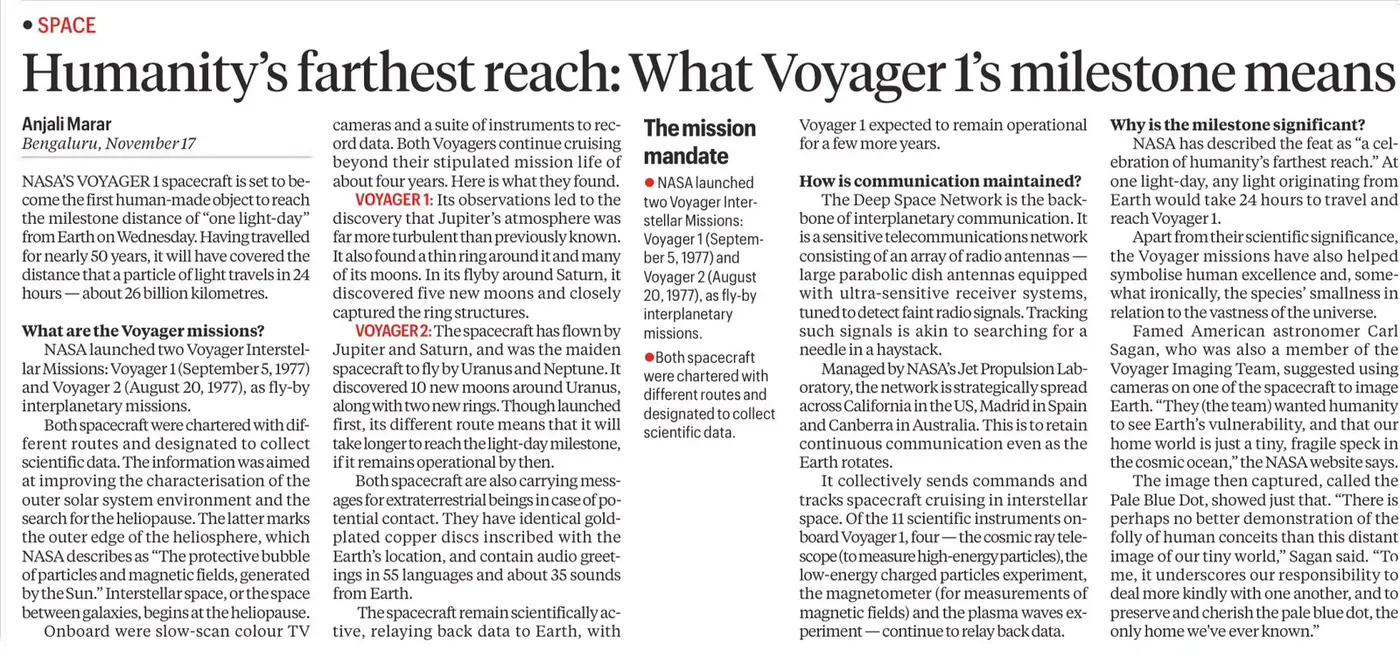
Voyager Missions
Voyager 1
Launched 5 September 1977; explored Jupiter and Saturn; entered interstellar space in 2012.
Launched 5 September 1977; explored Jupiter and Saturn; entered interstellar space in 2012.
Voyager 2
Launched 20 August 1977; explored Jupiter, Saturn, Uranus and Neptune; entered interstellar space in 2018.
Launched 20 August 1977; explored Jupiter, Saturn, Uranus and Neptune; entered interstellar space in 2018.
Unique record
Voyager 2 is the only spacecraft to have visited Uranus and Neptune up close.
Voyager 2 is the only spacecraft to have visited Uranus and Neptune up close.
Still working
Both run far beyond their original mission life.
Both run far beyond their original mission life.
Scientific Contributions
Jupiter
Found active volcanism on Io – the first active volcanoes seen beyond Earth.
Found active volcanism on Io – the first active volcanoes seen beyond Earth.
Saturn
Revealed complex ring structures, new moons; studied Titan.
Revealed complex ring structures, new moons; studied Titan.
Uranus (1986)
First flyby; new moons and rings; unusual magnetic field.
First flyby; new moons and rings; unusual magnetic field.
Neptune (1989)
First flyby; observed the Great Dark Spot.
First flyby; observed the Great Dark Spot.
Interstellar space
Measured cosmic rays, plasma waves and magnetic fields beyond the heliosphere.
Measured cosmic rays, plasma waves and magnetic fields beyond the heliosphere.
Important Concepts
Light-day
Distance light travels in 24 hours (~25.9 billion km); signals take ~a day to reach Earth.
Distance light travels in 24 hours (~25.9 billion km); signals take ~a day to reach Earth.
Heliosphere
Bubble created by the solar wind; its outer boundary is the heliopause.
Bubble created by the solar wind; its outer boundary is the heliopause.
Pale Blue Dot
Voyager 1's 1990 photo of Earth from ~6 billion km, popularised by Carl Sagan.
Voyager 1's 1990 photo of Earth from ~6 billion km, popularised by Carl Sagan.
Deep Space Network
NASA antennas at Goldstone (USA), Madrid (Spain) and Canberra (Australia).
NASA antennas at Goldstone (USA), Madrid (Spain) and Canberra (Australia).
Significance
Science
Direct observations of interstellar space and cosmic radiation.
Direct observations of interstellar space and cosmic radiation.
Engineering
Proof of long-duration spacecraft design and deep-space communication.
Proof of long-duration spacecraft design and deep-space communication.
Perspective
Reinforces Earth's uniqueness and the need to protect it.
Reinforces Earth's uniqueness and the need to protect it.
Key Takeaway: Nearly 50 years on, Voyager 1 is humanity's farthest messenger – still sending data from beyond the Sun's bubble and reminding us how small and precious Earth is.
Prelims Practice MCQ
+2 correct • −0.66 wrongUPSC Prelims PYQ 2014: Which of the following pairs is/are correctly matched?
1. Cassini-Huygens : Orbiting Venus and transmitting data to Earth
2. MESSENGER : Mapping and investigating Mercury
3. Voyager 1 and 2 : Exploring the outer Solar System
Explanation: Cassini-Huygens explored Saturn, not Venus. MESSENGER studied Mercury, and Voyager 1 and 2 explored the outer Solar System. So only pairs 2 and 3 are correct.
UPSC Mains Question
GS3 • 10 Marks • 150 WordsThe Voyager missions have redefined our understanding of the outer Solar System and interstellar space. Discuss their scientific significance and lessons for India's deep-space ambitions.
Accepted: JPG, JPEG, PNG, WEBP or PDF. The standalone file previews your answer locally; connect the API hook for real server submission.
Use after attempting the Mains answer
- India links — Chandrayaan-3 (2023), Aditya-L1 (studies the Sun and solar wind), ISRO's Indian Deep Space Network at Byalalu.
- Concepts — heliosphere, heliopause, interstellar medium, light-year vs light-day.
- Facts — Voyager 1 in interstellar space since 2012, Voyager 2 since 2018.
- PYQ link — Prelims 2014 (Cassini-Huygens, MESSENGER, Voyager).