Delimitation & Women’s Reservation: 4-Day Special Sitting of Parliament
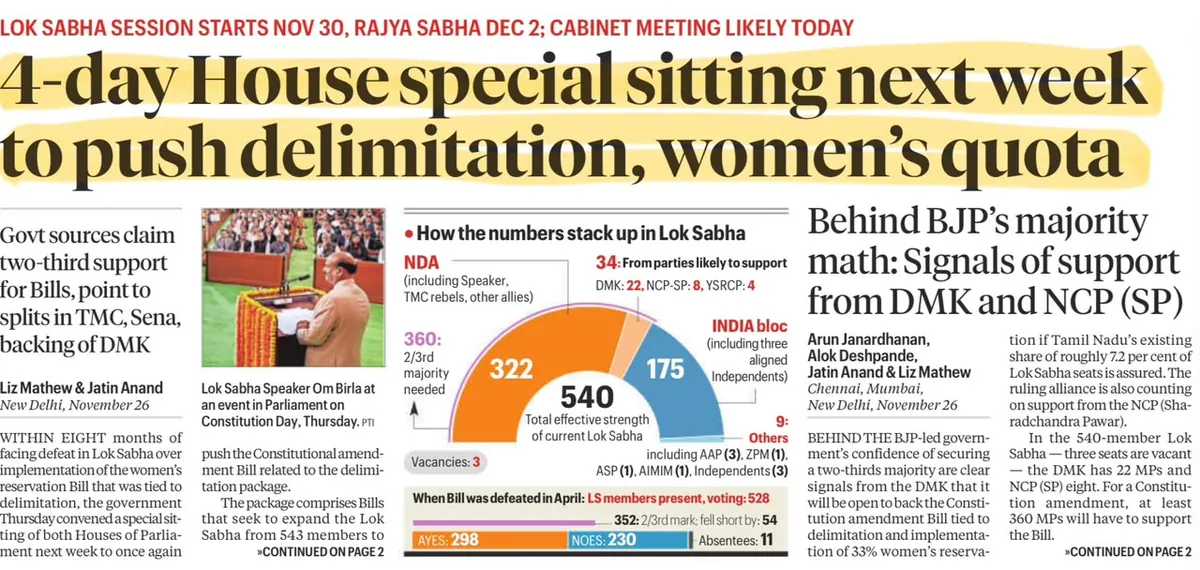
Context: The government has convened a special sitting of Parliament (Lok Sabha from 30 November, Rajya Sabha from 2 December) to push the delimitation package and 33% women’s reservation, so that both can take effect before the 2029 General Elections.
Proposed Changes
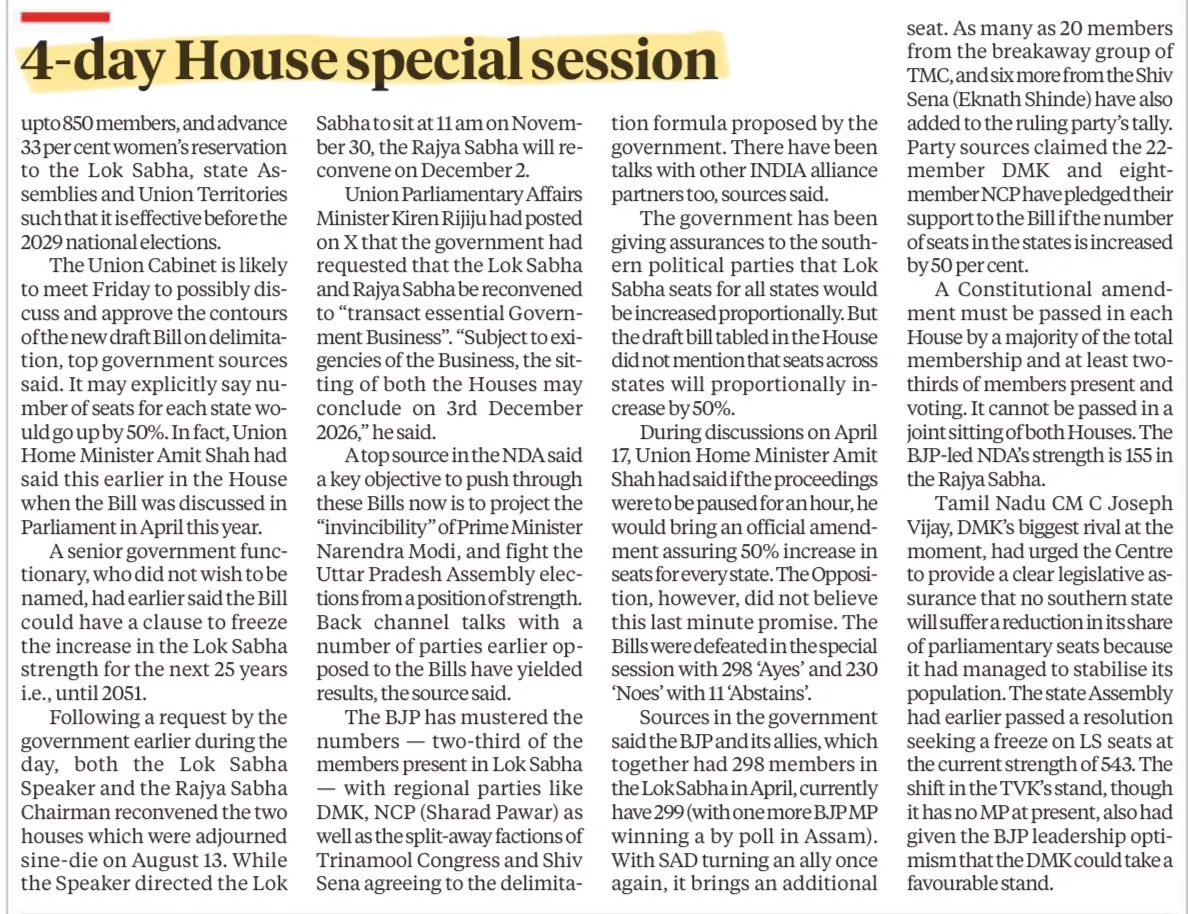
From 543 to a maximum of 850 seats.
Draft Bill may explicitly provide a 50% increase in seats for every state.
33% seats for women in the Lok Sabha, State Assemblies and UTs, effective before 2029.
Increased Lok Sabha strength may be frozen for 25 years, till 2051.
Why the April 2026 Attempt Failed
298 Ayes vs 230 Noes; 11 abstained, with 528 members present and voting.
Two-thirds mark was 352, so the Bills fell short by 54 votes.
The Opposition rejected the oral promise of a 50% increase for every state because it was not written into the Bills.
Numbers Now (Effective Strength 540)
322, including the Speaker, TMC rebels and other allies.
34 – DMK (22), NCP-SP (8), YSRCP (4).
175; Others: 9. Two-thirds mark is 360.
Protect relative share; Tamil Nadu wants its ~7.2% share of Lok Sabha seats assured.
Constitutional Provisions
Composition of the Lok Sabha and readjustment after every Census.
Composition of the State Legislative Assemblies.
Reservation for SCs/STs in the Lok Sabha and Assemblies.
Women’s reservation takes effect after the first Census and delimitation that follow the 106th Amendment (2023).
The President summons each House, on the advice of the Council of Ministers.
Majority of total membership + two-thirds of members present and voting in each House; no joint sitting.
Major Concerns
Southern states fear a smaller relative share despite stabilising their population.
States that controlled population growth may lose political weight.
Women’s quota stays tied to Census and delimitation, so its rollout depends on both.
A special majority in both Houses needs cross-party agreement.
UPSC Prelims PYQ Link
Delimitation Commissions constituted till Dec 2023: Four – 1952, 1963, 1973 and 2002.
Delimitation Commission orders cannot be challenged in court and cannot be modified by Parliament or State Legislatures – both correct.
Prelims Practice MCQ
+2 correct • −0.66 wrongWith reference to the Constitution (106th Amendment) Act, 2023, consider the following statements:
1. It reserves one-third of seats for women in the Lok Sabha and State Legislative Assemblies.
2. The reservation comes into effect immediately after the Act is notified, without waiting for delimitation.
3. A Constitutional amendment of this kind can be passed in a joint sitting of both Houses if they disagree.
Which of the statements given above is/are correct?
UPSC Mains Question
GS2 • 15 Marks • 250 WordsDelimitation based on population may reward states that failed to control population growth. Critically examine this concern and suggest a framework that balances democratic equality with federal fairness.
- Articles — 81, 82, 170, 330, 332, 334A, 368; 42nd Amendment (1976) froze seat allocation on the 1971 Census, 84th (2001) extended it till the first Census after 2026.
- Institutions — Delimitation Commission (1952, 1963, 1973, 2002); orders have force of law.
- Concepts — one person one vote, federal balance, special majority, sunset/freeze clause.
- Keywords — Nari Shakti Vandan Adhiniyam, North–South divide, cooperative federalism.