11 Dec, 2025 | Daily Current Affairs

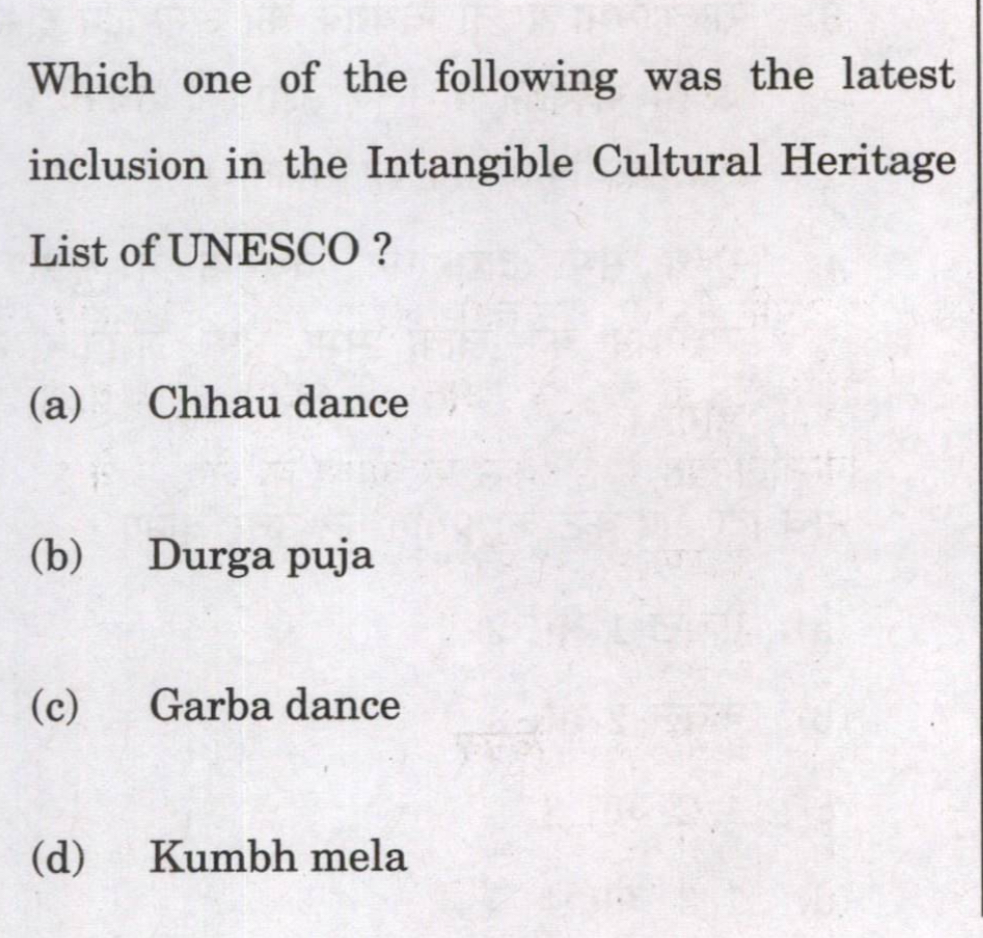
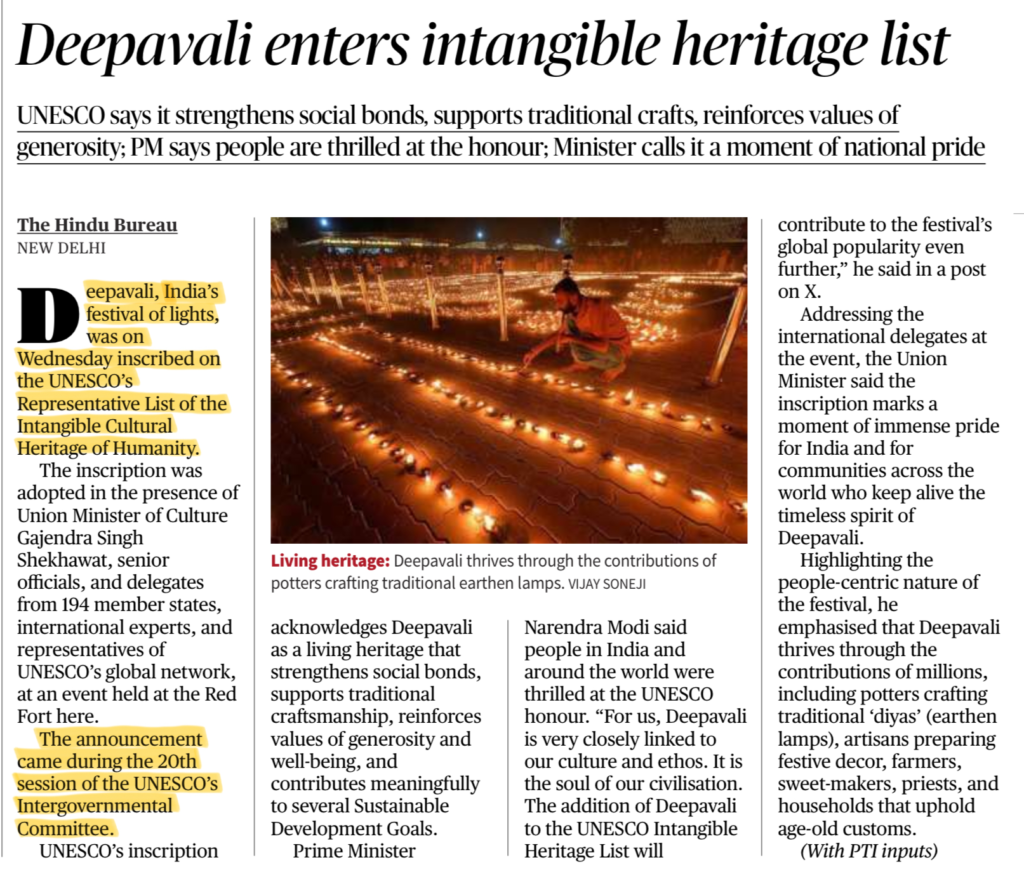
Deepavali Intangible Cultural Heritage | UNESCO List Explained for UPSC

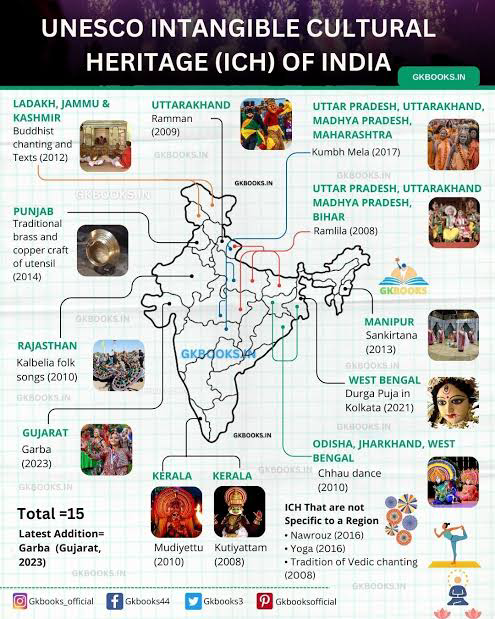
UNESCO Intangible Cultural Heritage (ICH)
• Under UNESCO 2003 Convention.
• Protects living traditions (rituals, performing arts, craftsmanship, social practices).
• Lists: Representative List, Urgent Safeguarding List, Good Safeguarding Practices.
• Aim: Safeguard, promote, ensure community participation.
• India is a signatory (2005).

Deepavali Addition
Deepavali added to UNESCO ICH Representative List due to its:
• Social significance (strengthens bonds)
• Cultural significance (civilisational ethos)
• Craft significance (traditional diya-making)
• Community-driven nature (practised by millions)
India Oman FTA Talks | PM Modi Oman Visit Explained for UPSC

Context
• PM Modi and Commerce Minister Goyal expected to visit Oman to sign a Free Trade Agreement (FTA).
• India–Oman negotiations began in Nov 2023 for a Comprehensive Economic Partnership Agreement (CEPA).
• Five rounds completed; all aspects agreed; final signing awaits formal approvals.
• India is also in final-stage FTA talks with New Zealand and the EU.

Prelims Notes:
What is a Free Trade Agreement (FTA)?
• Agreement between countries to reduce or eliminate tariffs on goods.
• Focus: Trade in goods, limited coverage of services.
• Aim: Cheaper imports/exports, increased trade flow.

What is a Comprehensive Economic Partnership Agreement (CEPA)?
• A broader, deeper trade pact.
• Covers: Goods, services, investments, IPR, digital trade, standards, regulatory cooperation.
• Aim: Long-term economic integration beyond just tariff cuts.

Marine Protected Areas India | Offshore Mining Exclusion Explained

Context
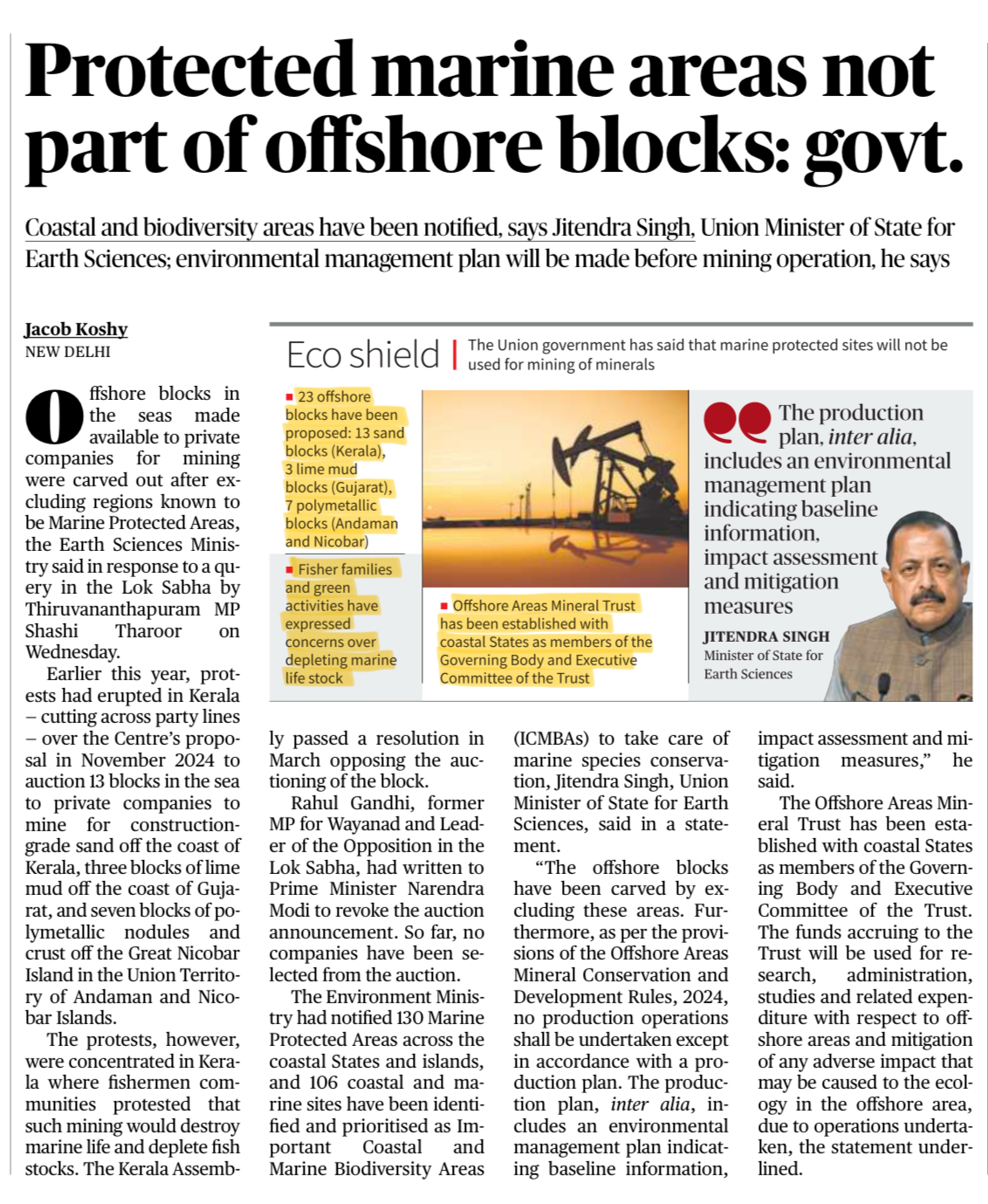
The government clarified in Lok Sabha that offshore mining blocks offered for auction do NOT overlap with Marine Protected Areas (MPAs). This comes after major protests in Kerala and concerns that offshore sand and mineral mining could harm marine biodiversity and fish stocks.

Marine Protected Areas (MPAs) — Prelims Notes
• Definition: MPAs are clearly defined marine zones where human activities are regulated to conserve biodiversity, ecosystems, and cultural resources.
• Legal Basis in India: Notified under the Wildlife Protection Act, 1972 (as National Parks, Wildlife Sanctuaries, Conservation Reserves, etc.).
• Purpose:
• Protect marine species, coral reefs, fish breeding grounds.
• Prevent over-extraction and habitat destruction.

India’s MPAs:
• 130 Marine Protected Areas notified across coastal States and islands.
• Part of India’s broader Coastal Regulation Zone (CRZ) and marine biodiversity conservation efforts.

Russian Su-57 Fighter Jet | India’s Defence Response Explained

Context
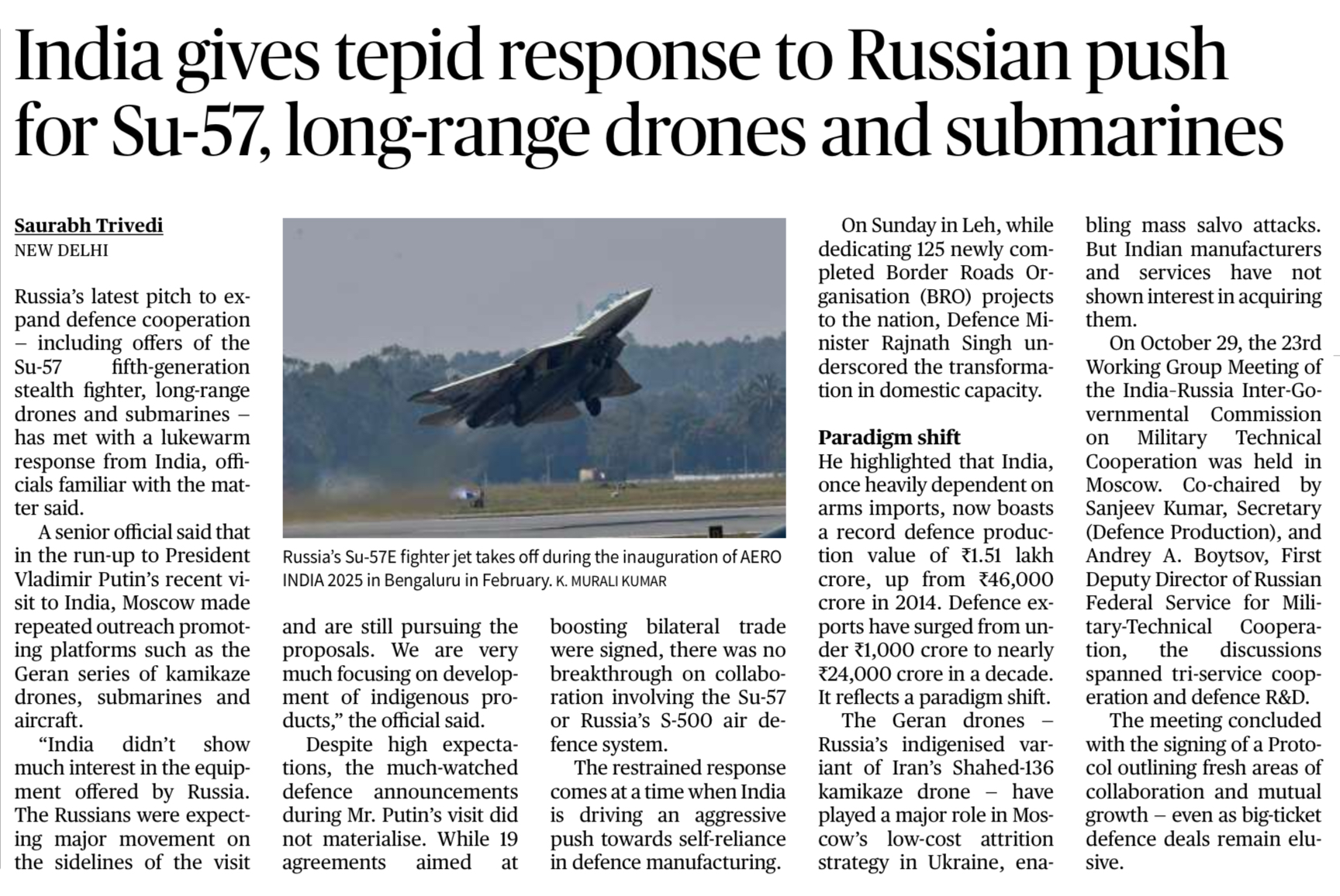
• Russia has again pushed India to consider buying Su-57 fifth-generation fighters, long-range drones, and submarines.
• India has shown a lukewarm response, prioritising indigenous defence production and self-reliance (Atmanirbhar Bharat).
• Despite 19 agreements signed during President Putin’s visit, no breakthrough occurred on Su-57 or S-500 collaboration.
• India is now focusing heavily on domestic capability, defence production rising to ₹1.51 lakh crore (from ₹46,000 crore in 2014).
• Russia expected interest in platforms like the Geran kamikaze drones, but India has not shown strong intent.

What is the Su-57?
• Russia’s fifth-generation stealth multirole fighter.
• Designed by Sukhoi for air superiority + strike missions.

What are Kamikaze Drones?
• Also called loitering munitions.
• They loiter over an area, identify a target, and then self- destruct on impact, acting as both drone and missile.

ASEAN Regional Dispute | Truce Breakdown and Regional Impact

  1. Context
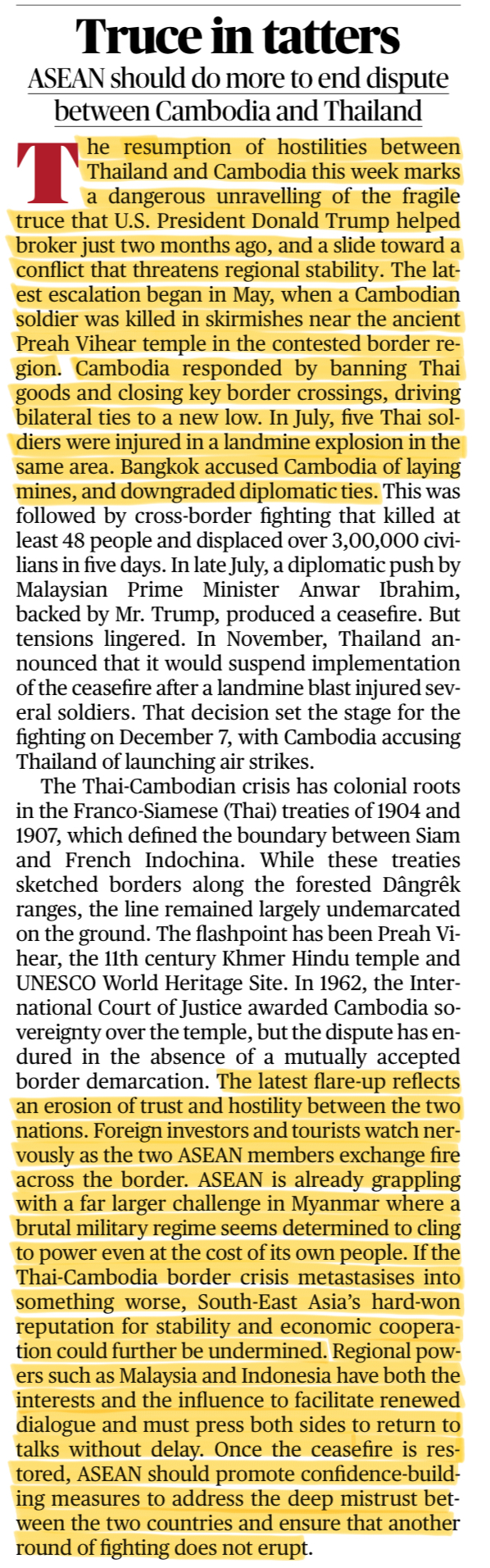
    • Fighting has resumed between Thailand and Cambodia near the Preah Vihear temple area.
    • Recent clashes killed soldiers, injured civilians, and displaced thousands.
    • The ceasefire brokered earlier collapsed, increasing hostility and mistrust.
    • The dispute threatens regional stability and adds pressure on ASEAN, which is already dealing with the Myanmar crisis.
  2. About ASEAN
    11 members (2025): Indonesia, Malaysia, Singapore, Thailand, Philippines, Vietnam, Laos, Cambodia, Myanmar, Brunei, Timor-Leste.
    • Founded: 1967 (Bangkok Declaration).
    • HQ: Jakarta, Indonesia.

Core Principles:
• Non-interference
• Consensus-based decisions
• Regional peace and stability

  1. Solutions Mentioned
    • Regional powers Malaysia and Indonesia must take the lead
    → They have the influence to bring both sides back to negotiation.

• Immediate return to dialogue
→ ASEAN should push Thailand and Cambodia to talk without delay.

• Restore the ceasefire quickly
→ Ending active fighting is the first necessary step.

• Promote confidence-building measures
→ ASEAN must help reduce deep mistrust between the two countries.

• Prevent escalation that harms regional stability
→ ASEAN should ensure the crisis does not spread and damage Southeast Asia’s image of stability and cooperation.

About the UPSC Civil Services Examination (UPSC CSE)

The UPSC Civil Services Examination (CSE) is one of the most competitive and esteemed examinations in India, conducted by the Union Public Service Commission to recruit officers for services such as the Indian Administrative Service (IAS), Indian Police Service (IPS), Indian Foreign Service (IFS), and others. The exam comprises three stages — Prelims, Mains, and the Personality Test (Interview) — designed to test a candidate’s knowledge, aptitude, decision-making, and leadership skills.


How to Prepare Effectively for UPSC CSE

Cracking the UPSC CSE requires a deep understanding of the syllabus, consistent revision, structured answer writing, and smart test-taking strategies. The Prelims test analytical and conceptual clarity, the Mains focuses on critical thinking, articulation, and subject mastery, while the Interview assesses presence of mind, ethical judgment, and personality traits relevant to public service.

At Understand UPSC, we empower aspirants with a personalized and focused approach to each stage of the exam.


Why Choose Understand UPSC?

Understand UPSC is a mentorship-driven platform offering a clear, clutter-free strategy to tackle the Civil Services Examination. Our programs like Transform (for beginners and intermediate learners) and Conquer (for advanced mains preparation) provide structured study plans, syllabus-wise video content, interactive live sessions, and answer writing support.

We emphasize:

  • Concept clarity through topic-wise lectures

  • Test series designed around real UPSC standards

  • Personalized mentorship in small groups

  • Regular performance tracking and peer benchmarking

  • Doubt-clearing sessions, current affairs analysis, and monthly magazines


Join the Understand UPSC Learning Community

Our mission is to make UPSC preparation less overwhelming and more strategic. We combine mentorship, discipline, and academic rigor to help you clear CSE with confidence. Whether you’re preparing from Delhi, Mumbai, Bangalore, or a remote village — our online-first model ensures quality guidance reaches every corner of India.

Join the thousands of aspirants who trust Understand UPSC to guide their journey toward becoming civil servants.

Stay connected with us through our Telegram, YouTube, and Instagram channels for daily tips, strategies, and updates.

Copyright © 2025 USARAMBHA EDUCATION (UnderStand UPSC). All Rights Reserved.

Join the Success Journey!