- Context
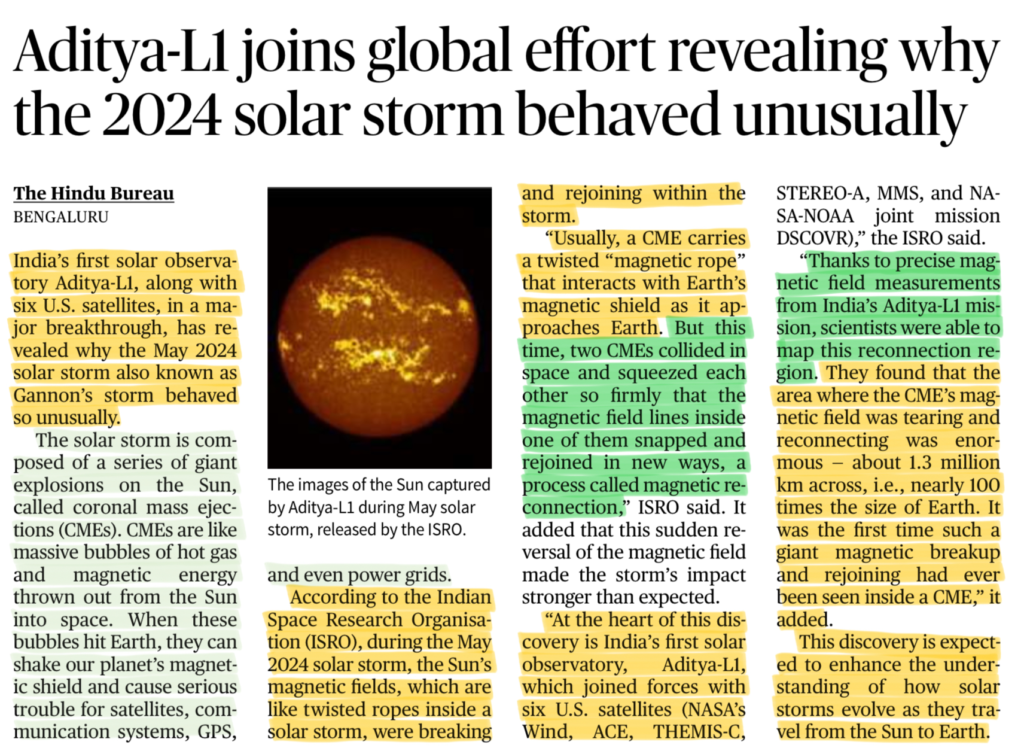
• May 2024 Solar Storm (Gannon’s Storm) showed unusually strong behaviour.
• India’s Aditya–L1, along with U.S. satellites, has identified the exact reason. - Normal Behaviour of a CME (Coronal Mass Ejection)
- A CME normally carries a stable, twisted magnetic rope (flux rope).
- This magnetic structure remains intact as the CME travels through space.
- Any magnetic reconnection typically occurs near Earth, when the CME interacts with Earth’s magnetic field.
- The internal magnetic field of a CME does not usually break or reorganise during transit.
- Therefore, storm intensity is usually determined only when the CME approaches Earth.
What Was Different in the 2024 Solar Storm (Aditya–L1 Discovery)
(a) Collision of Two CMEs
• Two coronal mass ejections collided and compressed each other in space.
(b) Magnetic Breakup Inside the CME
• Magnetic field lines inside one CME snapped and rejoined
→ a process known as magnetic reconnection.
• This happened inside the CME, not near Earth — first observation of its kind.
(c) Massive Reconnection Region
• Size: ~1.3 million km (about 100 times Earth’s diameter).
• Such a large internal magnetic reconfiguration has never been recorded before.
(d) Result → Stronger Storm
• This internal magnetic disturbance intensified the CME earlier than expected, making the May 2024 solar storm exceptionally strong.