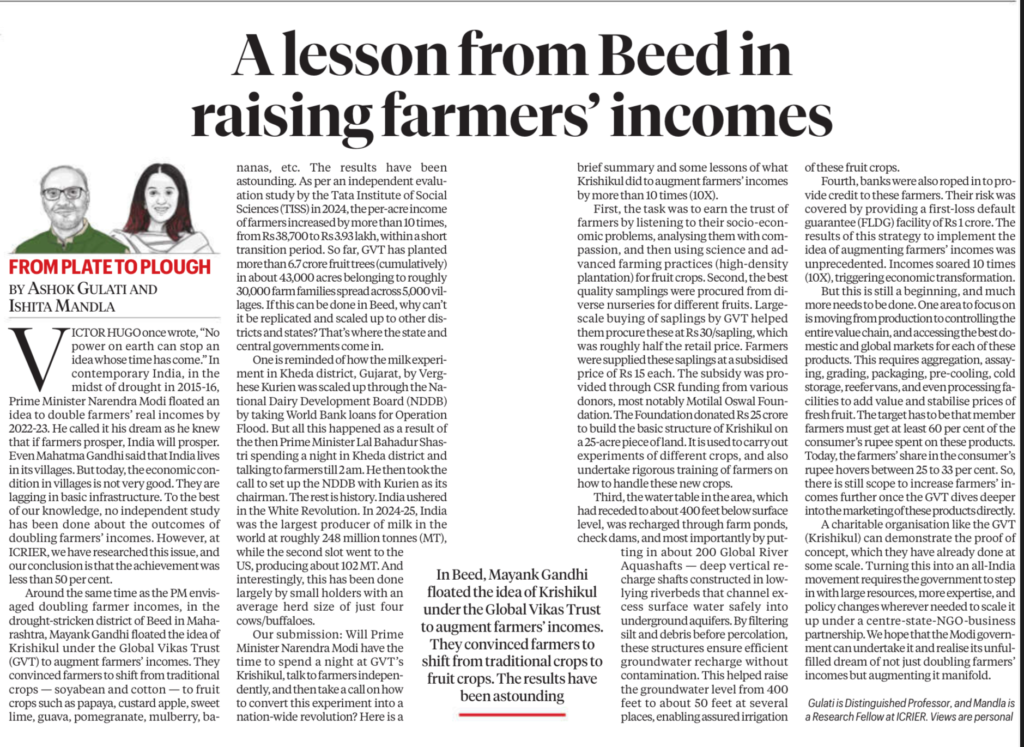
Case Study: Beed, Maharashtra
Context • India’s objective of doubling farmers’ incomes has achieved limited success at the national level.
• Beed district in drought-prone Maharashtra presents a replicable local model based on institutional innovation and value-chain intervention.
Intervention • The Krishikul model was implemented by Global Vikas Trust under CSR support.
• Farmers shifted from low-value traditional crops such as soybean and cotton to high-value fruit crops including papaya, custard apple, guava, pomegranate, mulberry, and banana.
• The initiative focused on small and marginal farmers.
Key Outcomes • Per-acre farmer income increased more than tenfold, from about ₹38,700 to around ₹3.9 lakh.
• Over 6.7 crore fruit trees were planted across 43,000 acres, benefiting nearly 30,000 farm families.
• The case demonstrated that income augmentation, not just productivity enhancement, is critical.
Success Factors
- Continuous trust-building and engagement with farmers.
- Adoption of scientific farming practices and quality inputs.
- Cost reduction through bulk procurement.
- Risk mitigation using First Loss Default Guarantee for credit access.
- Improved water security through ponds, check dams, and recharge structures.
- Institutional support via Krishikul as a knowledge and experimentation hub.