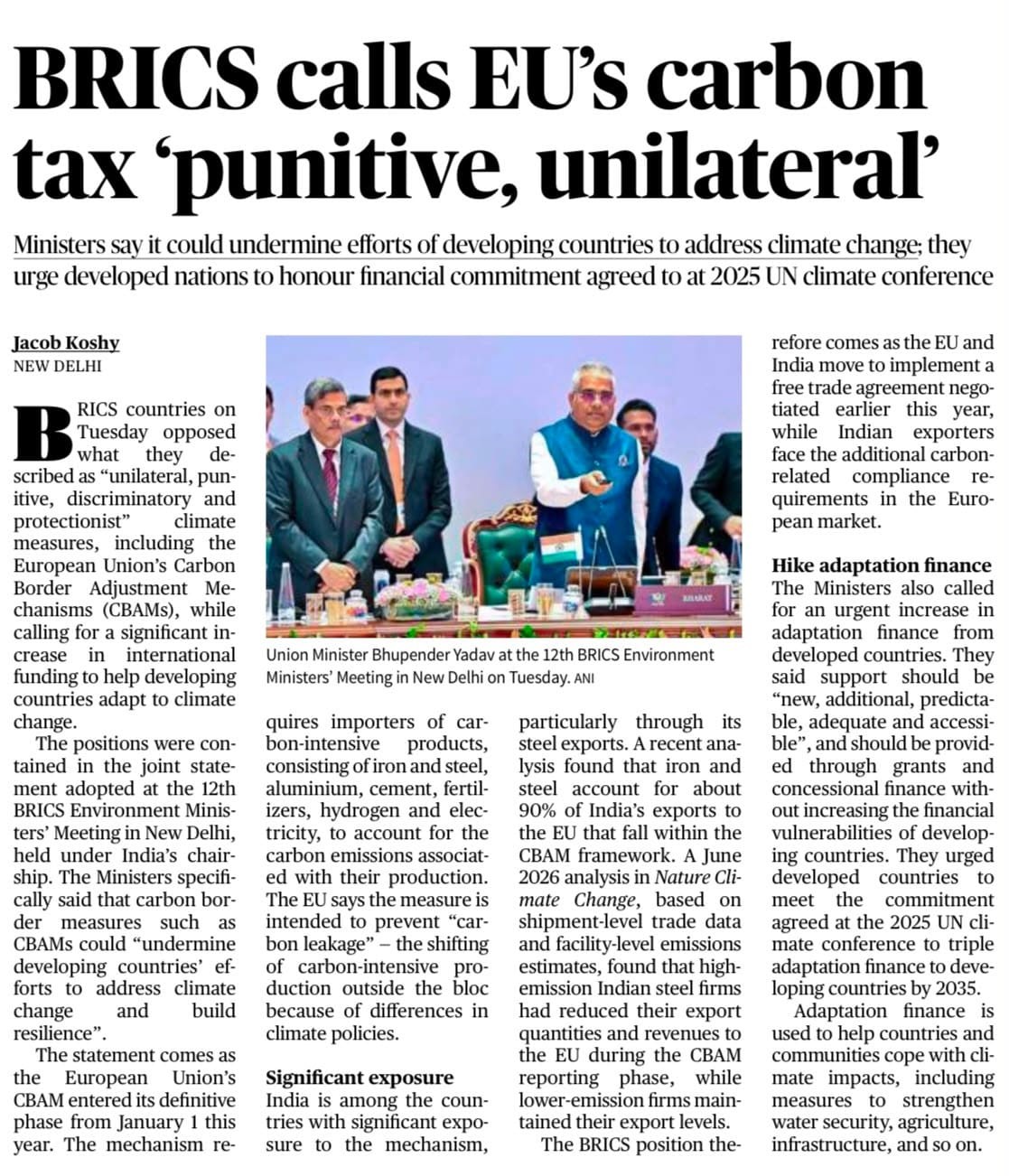
Context: BRICS opposition to EU CBAM
The 12th BRICS Environment Ministers’ Meeting, held in New Delhi under India’s 2026 BRICS Chairship, opposed unilateral carbon-border measures, especially the European Union’s Carbon Border Adjustment Mechanism.
BRICS Environment Ministers’ Meeting
India is the BRICS Chair for 2026 and host of the 18th BRICS Summit.
The meeting focused on:
- Climate action
- Environmental sustainability
- Climate resilience
- International cooperation
BRICS opposed carbon-border measures that could become discriminatory or protectionist trade barriers.
The ministers emphasised:
- Climate equity
- Common but Differentiated Responsibilities and Respective Capabilities
- Climate finance
- Technology transfer
European Union’s Carbon Border Adjustment Mechanism
Meaning:
The Carbon Border Adjustment Mechanism, or CBAM, is a carbon cost imposed by the European Union on embedded emissions in specified imported goods.
Objective:
Its stated goal is to prevent carbon leakage.
Carbon leakage happens when carbon-intensive production shifts to countries with weaker climate regulations.
Timeline:
- October 2023 — Transitional reporting phase
- January 2026 — Definitive regime
Sectors covered:
- Iron and steel
- Aluminium
- Cement
- Fertilisers
- Electricity
- Hydrogen
Why India and BRICS Oppose CBAM
Export competitiveness:
CBAM raises the effective cost of carbon-intensive exports to the European Union.
Climate equity:
Developing countries have different historical responsibilities, capabilities and development needs.
Protectionism concern:
There is a risk that environmental measures may become disguised trade barriers.
Capacity constraints:
Developing economies need greater finance, technology and capacity-building for decarbonisation.
Way Forward
India should accelerate industrial decarbonisation in CBAM-exposed sectors.
Domestic carbon measurement, reporting and verification systems should be strengthened.
India and BRICS should use platforms such as:
These platforms can be used to push for equitable implementation.
Developing economies should also seek technology transfer and climate finance.
Key Takeaway
BRICS sees CBAM as a climate-linked trade measure that may hurt developing countries. India’s response should combine international negotiation with faster domestic industrial decarbonisation.