Context: China International Order Strategy
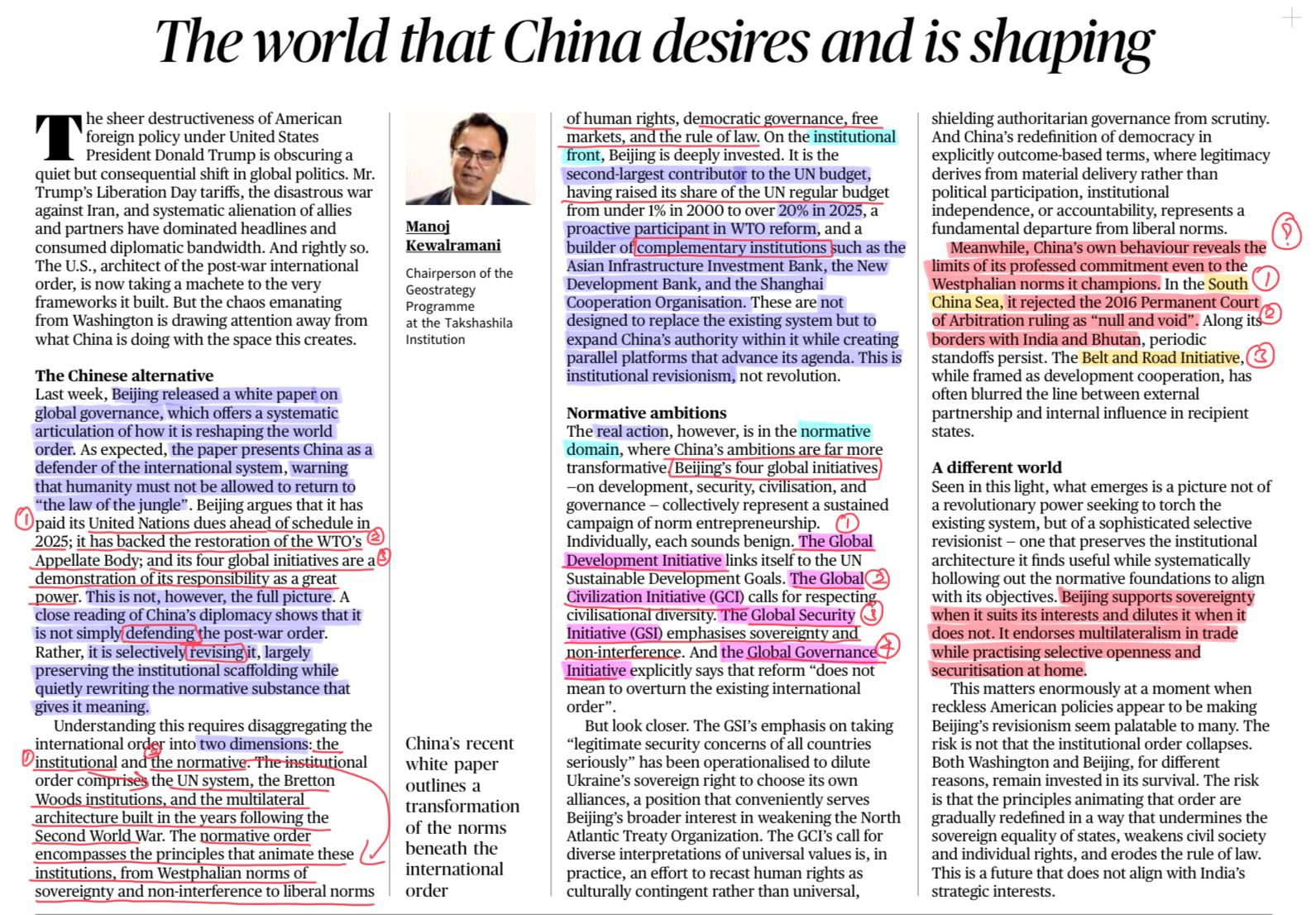
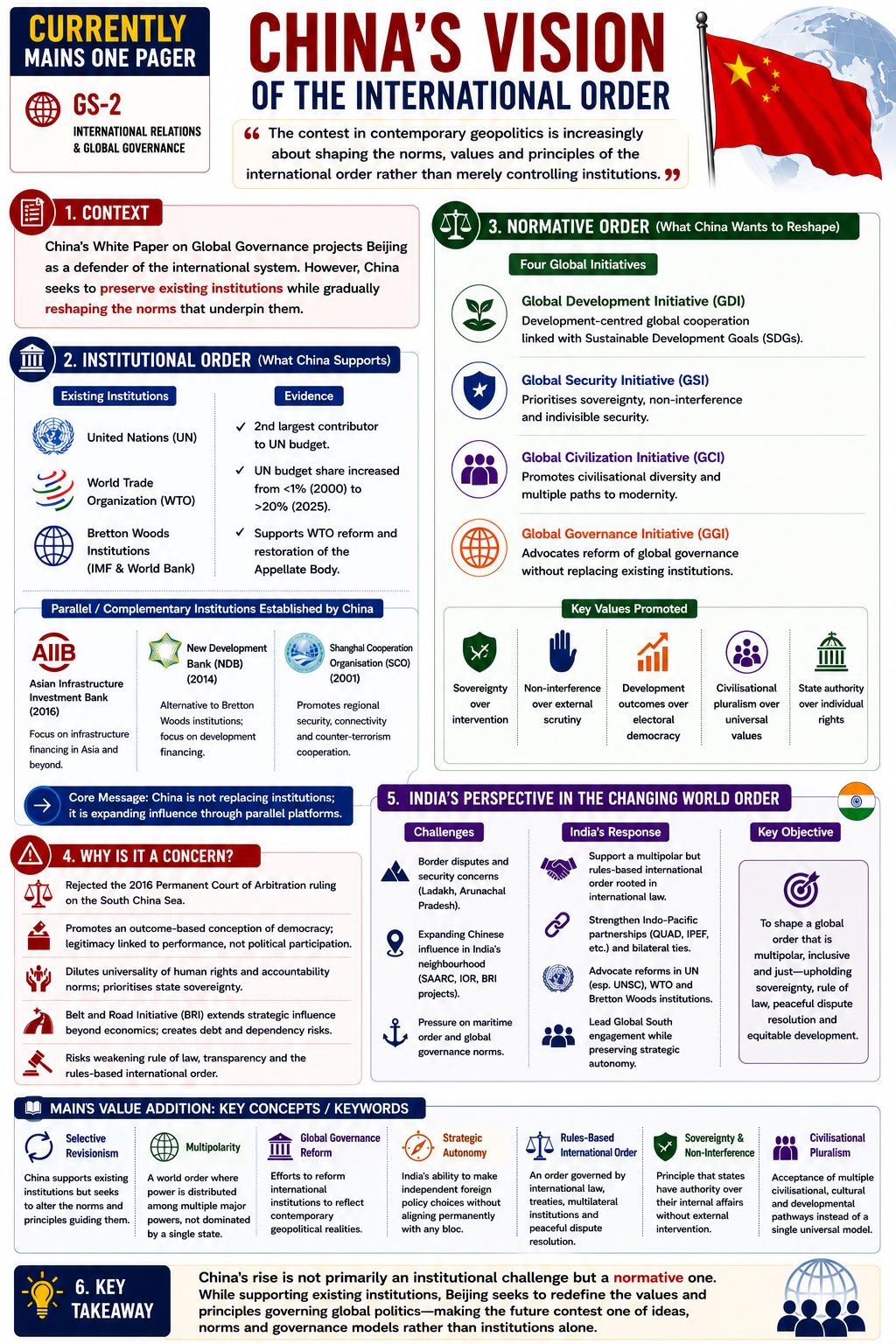
The article analyses China’s attempt to reshape the international order. China does not openly seek to destroy existing institutions, but it tries to preserve them while gradually reshaping norms, power distribution and institutional influence in its favour.
China’s Broad Approach
China’s strategy is not primarily institutional replacement.
It is based on:
- Reshaping global norms
- Expanding influence within existing institutions
- Creating parallel institutions
- Promoting sovereignty-first governance
- Reducing Western dominance in global rule-making
Existing Institutions China Supports and Uses
China actively participates in:
- United Nations
- World Trade Organization
- World Bank
- International Monetary Fund
- Bretton Woods institutions
Evidence of China’s Institutional Role
- Second-largest contributor to UN budget.
- Increased WTO share.
- Supports WTO reform and restoration of appellate body functions.
Parallel / Complementary Institutions Created or Supported by China
Asian Infrastructure Investment Bank
- Founded in 2015.
- Focuses on infrastructure financing in Asia and beyond.
New Development Bank
- Established by BRICS in 2014.
- Provides development finance to emerging economies.
Shanghai Cooperation Organisation
- Promotes regional security, connectivity and cooperation.
China’s Four Global Initiatives
1. Global Development Initiative
Linked with development-centred global cooperation and Sustainable Development Goals.
2. Global Security Initiative
Promotes security through state sovereignty, non-interference and opposition to bloc politics.
3. Global Civilisation Initiative
Promotes civilisational diversity and opposes Western universalism.
4. Global Governance Initiative
Advocates reform of global governance without replacing existing institutions.
Key Values Promoted by China
- Sovereignty over intervention
- Non-interference over external scrutiny
- Development outcomes over democracy
- Civilisational pluralism over universal values
- State authority over individual rights
Why Is This a Concern?
1. South China Sea
China rejected the 2016 Permanent Court of Arbitration ruling on the South China Sea.
2. Human Rights
China promotes a state-centric view of human rights where sovereignty and development are prioritised over individual freedoms.
3. Belt and Road Initiative
BRI extends China’s strategic and economic influence through connectivity, infrastructure and debt diplomacy.
4. Institutional Capture
China seeks greater influence in rule-making bodies and standard-setting institutions.
5. Normative Challenge
China challenges the liberal international order based on democracy, human rights and open political systems.
India’s Perspective
Challenges for India
- Border disputes and security concerns.
- Expanding Chinese influence in India’s neighbourhood.
- Pressure on maritime routes and global supply chains.
- China’s close partnership with Pakistan.
- Chinese influence in multilateral institutions.
India’s Response
- Support a multipolar but rules-based international order.
- Strengthen strategic partnerships with the U.S., France, Japan, Australia and Europe.
- Use platforms like Quad, BRICS, SCO and G20 carefully.
- Lead Global South engagement.
- Push for UNSC reform.
- Protect strategic autonomy.
Key Objective for India
India seeks a global order that is:
- Multipolar
- Rules-based
- Inclusive
- Respectful of sovereignty
- Supportive of development
- Resistant to domination by any one power