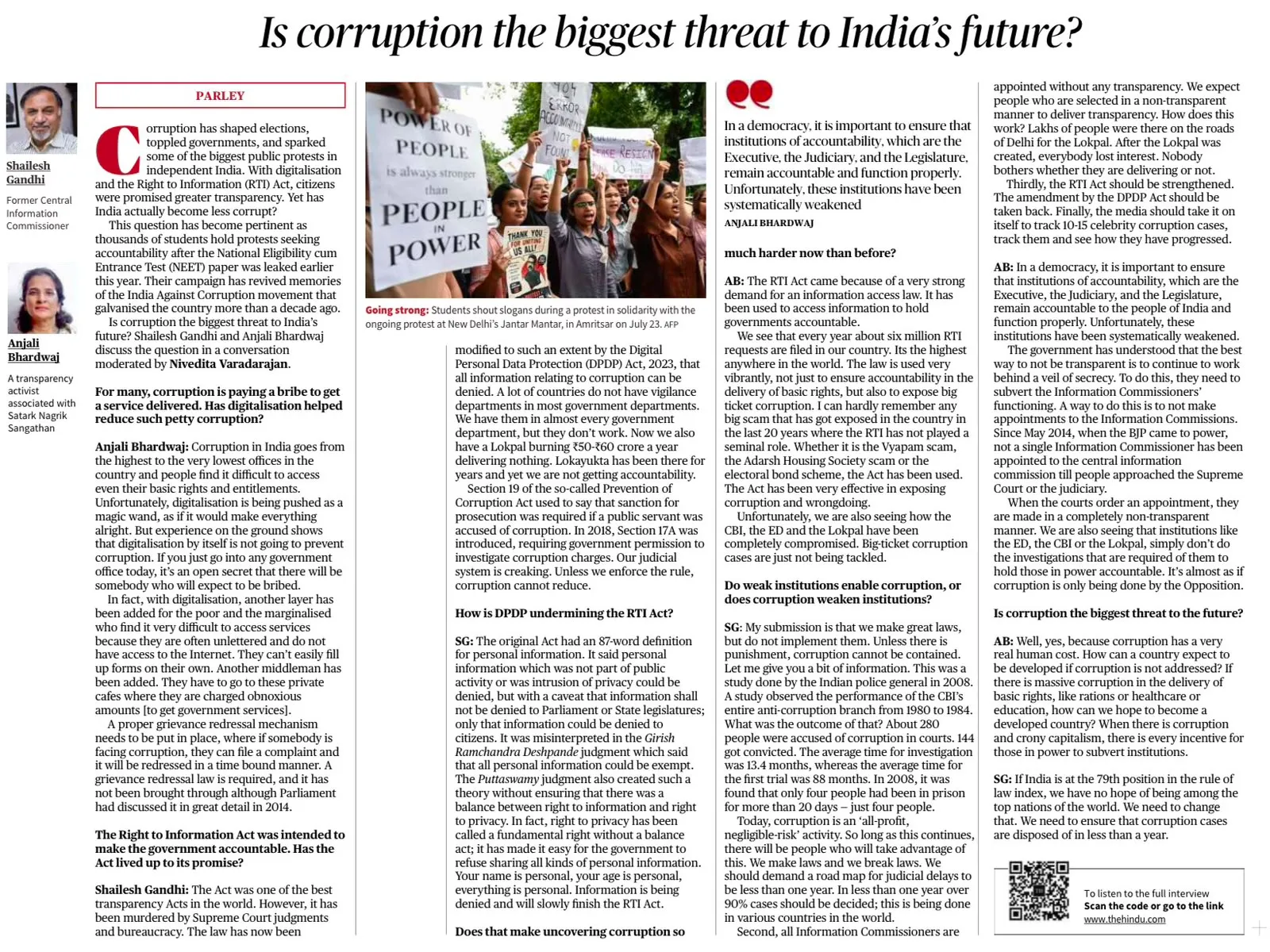
Context: Corruption governance challenges India
The article discusses India’s larger governance challenge around corruption, transparency and accountability.
Recent debates around the RTI regime, Lokpal, Information Commissions and investigative agencies show that anti-corruption laws are useful only when backed by strong institutions, timely enforcement and public accountability.
Core Issue
India has several laws and institutions to fight corruption.
However, the real challenge lies in implementation, institutional independence and timely action.
Digitalisation has reduced some forms of petty corruption, but systemic and high-level corruption remains a major governance concern.
Key Challenges in Tackling Corruption
1. Weakening of Accountability Mechanisms
Transparency and accountability mechanisms have become weaker in practice.
Institutions must not only exist on paper but also function independently and effectively.
2. Declining Institutional Effectiveness
The effectiveness of institutions such as the RTI framework, Lokpal, Information Commissions and investigative agencies has come under question.
This affects public trust in governance.
3. Delays in Investigation and Trial
Delays in investigation, prosecution and judicial disposal reduce the deterrent effect of anti-corruption laws.
If punishment comes too late, the law loses much of its impact.
4. Weak Implementation
India has a robust legal framework, but implementation gaps often weaken the fight against corruption.
5. Digitalisation Is Not Enough
Digital governance has reduced some petty corruption by limiting direct contact between citizens and officials.
However, it has not fully addressed systemic and high-level corruption.
6. Lack of Transparency in Appointments
Opaque appointments and weak institutional processes affect public confidence.
Transparency in appointments is necessary for institutional credibility.
Strengthening the Anti-Corruption Framework
India needs to safeguard the independence and autonomy of accountability institutions.
The RTI framework must be reinforced so that citizens can access information effectively.
Corruption cases should be investigated, prosecuted and disposed of within a time-bound framework.
Public appointments and decision-making should be made more transparent.
Grievance redressal, social accountability and citizen participation must be strengthened.
Ethics Angle
For GS4, this issue can be linked with:
- Integrity
- Probity in governance
- Transparency
- Accountability
- Rule of law
- Citizen-centric administration
- Institutional ethics
Key Takeaway
Corruption is not only a legal problem. It is an institutional and ethical governance problem. Strong laws need strong institutions, timely enforcement and a culture of public accountability.