Batch 2 Starts 16 Nov: Admissions Open! Enroll Now
US
UnderStand UPSC Daily Current Affairs Practice
0.00Score / 14
0 / 7MCQs Attempted
0%Accuracy
18 November 2026 • UPSC CSE

Read the news. Test the concept. Write the Mains answer.

This interactive edition converts each current-affairs item into one Prelims-level MCQ, one Mains-level question, and a compact value-addition section for revision.

+2 correct −0.66 incorrect Explanation after attempt Image/PDF answer upload
NEWS 1 GS2 • International Relations Source: The Hindu

World Needs Peace and Predictability, Says Modi

Context: At the Quad, ASEAN–India and East Asia Summits in Manila, India called for peace, stability and predictability amid rising geopolitical tensions, economic coercion and maritime insecurity.
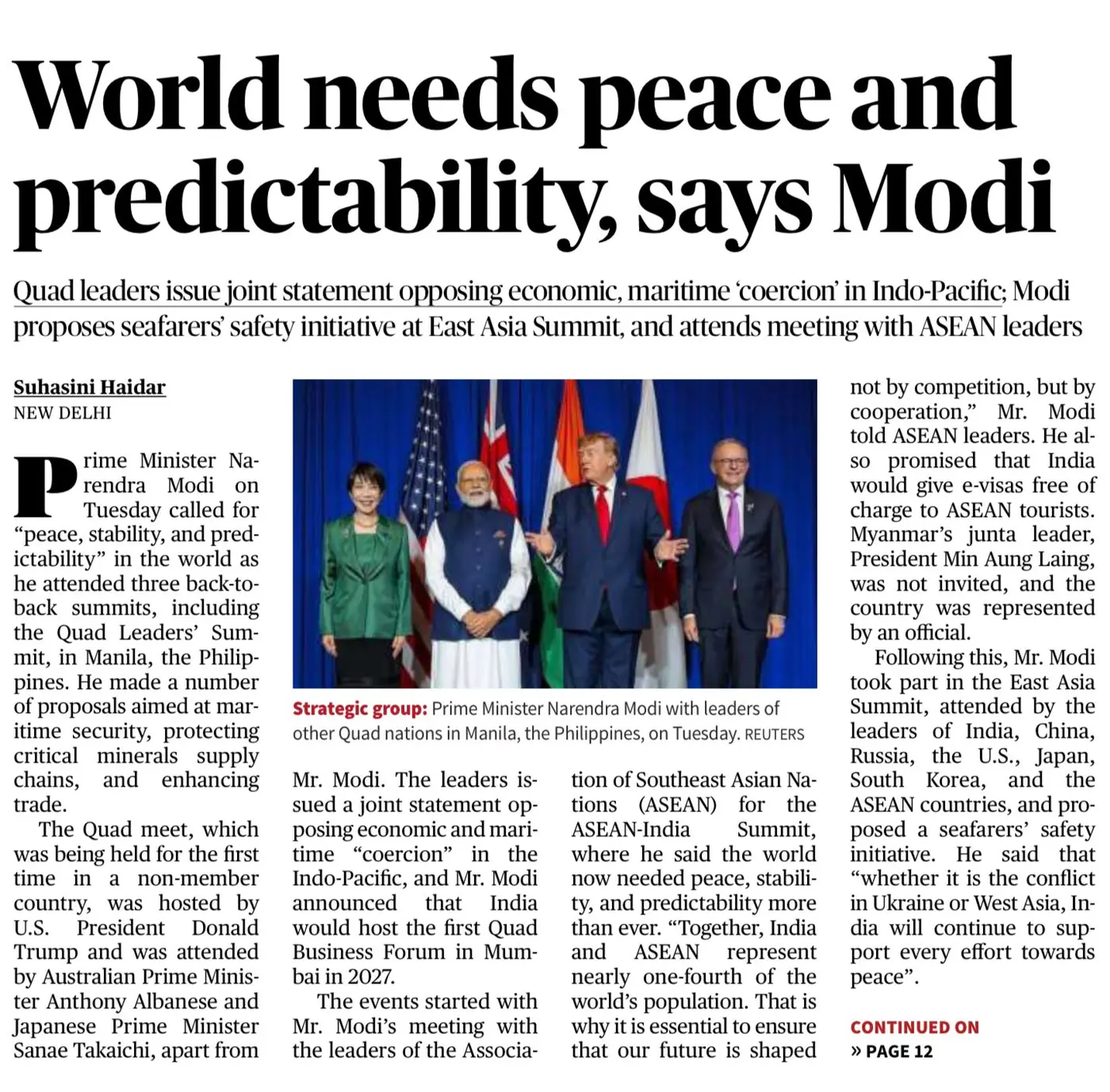
World needs peace and predictability, says Modi – Quad, ASEAN and East Asia Summits in Manila (The Hindu)
World needs peace and predictability, says Modi. Source: The Hindu

Key Developments

Quad
Opposed economic and maritime coercion and unilateral attempts to change the status quo.
Supply chains
Raised concerns over critical mineral and strategic equipment export restrictions.
ASEAN
Proposed a Seafarers' Safety Initiative; free e-visas for ASEAN tourists.
New initiatives
Quad Business Forum in Mumbai (2027); cybercrime summit at NFSU, Gandhinagar; EAS University Heads Conclave at Nalanda.

India's Membership in Regional Groupings

ASEAN
Dialogue Partner – not a member.
East Asia Summit (EAS)
Member.
Quad
Member – India, U.S., Japan, Australia.
APEC
Not a member.

Significance for India

Strategic balancing
Counterbalance China's growing influence in the Indo-Pacific.
Maritime security
Protect sea lanes, trade routes and Indian seafarers.
Economic resilience
Diversify critical mineral and technology supply chains.
Regional influence
Strengthen the Act East Policy.
Rules-based order
Freedom of navigation and peaceful dispute resolution.

Challenges

China
Expanding military and economic footprint in the Indo-Pacific.
Sea routes
Maritime disruptions along critical trade routes.
Dependence
Concentrated global supply chains for minerals and technology.
Partners
Divergent strategic interests among regional partners.
New threats
Cybercrime, online fraud and transnational security threats.

Way Forward

Maritime
Strengthen maritime domain awareness and naval cooperation.
Supply chains
Diversify critical mineral and technology sources.
Balance
Deepen Quad cooperation without undermining ASEAN centrality.
Cyber
Better intelligence-sharing and cross-border cybercrime coordination.
Diplomacy
Dialogue and confidence-building measures to prevent escalation.
Key Takeaway: India is using the Quad, ASEAN and EAS together to push a rules-based, coercion-free Indo-Pacific while keeping ASEAN at the centre of regional engagement.

Prelims Practice MCQ

+2 correct • −0.66 wrong

UPSC Prelims PYQ 2015: India is a member of which among the following?
1. Asia-Pacific Economic Cooperation (APEC)
2. Association of South-East Asian Nations (ASEAN)
3. East Asia Summit (EAS)

Explanation: India is a full member of the East Asia Summit. It is only a Dialogue Partner of ASEAN (not a member) and is not a member of APEC.

UPSC Mains Question

GS2 • 15 Marks • 250 Words

The Quad and ASEAN centrality are often seen as competing ideas in the Indo-Pacific. How is India balancing the two? Discuss.

Attempt before opening the value-addition tab.
Accepted: JPG, JPEG, PNG, WEBP or PDF. The standalone file previews your answer locally; connect the API hook for real server submission.
Use after attempting the Mains answer
  • Policies — Act East Policy (2014), Indo-Pacific Oceans Initiative (2019), MAHASAGAR vision.
  • Facts — ASEAN–India Comprehensive Strategic Partnership (2022); Quad revived in 2017.
  • Keywords — economic coercion, ASEAN centrality, freedom of navigation, critical minerals.
  • PYQ link — Prelims 2015 (APEC / ASEAN / EAS membership).
NEWS 2 GS3 • Economy | Financial Inclusion Source: The Hindu – Explainer

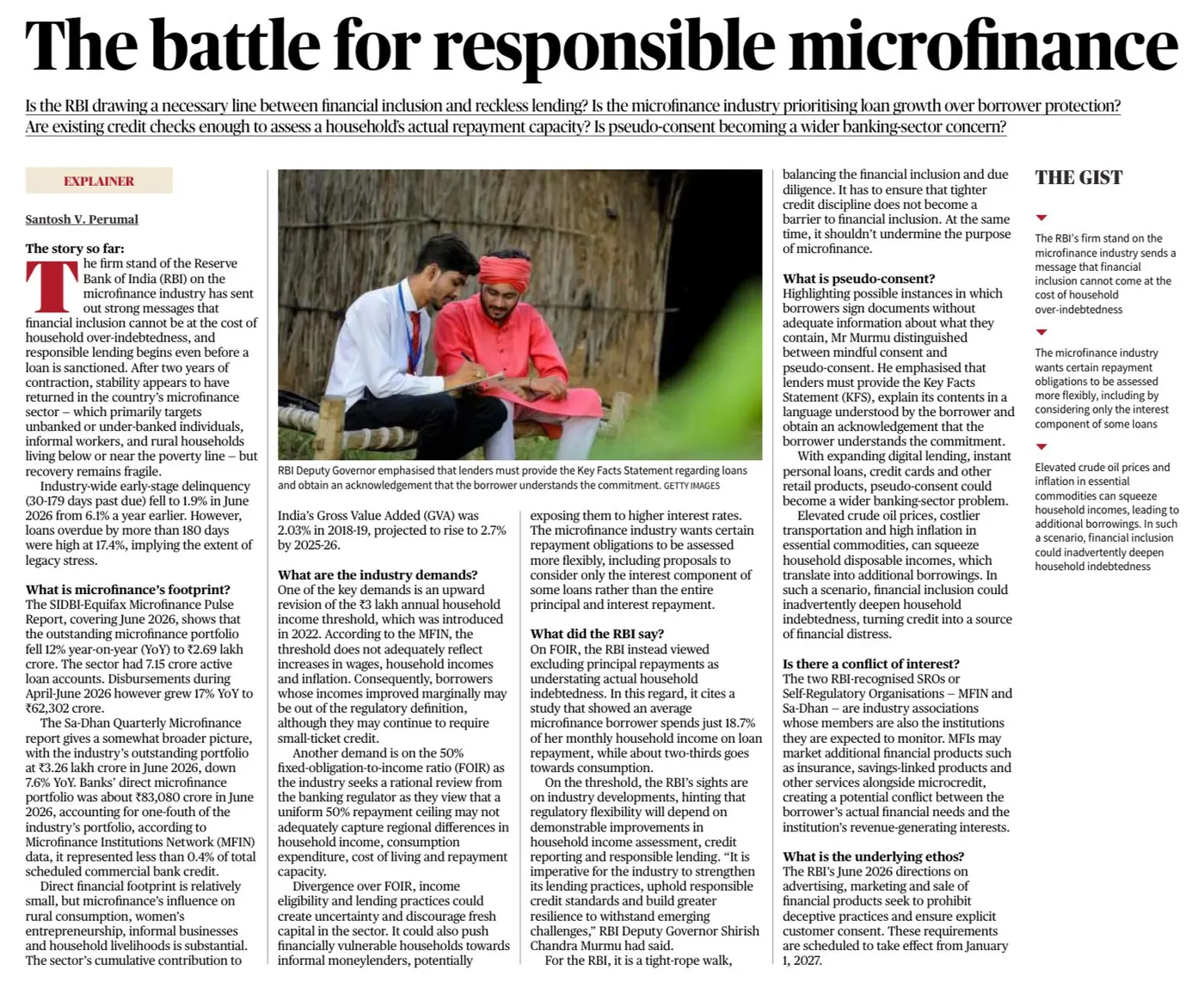
The Battle for Responsible Microfinance

Context: The RBI is tightening oversight of microfinance so that credit-led financial inclusion does not lead to over-indebtedness, irresponsible lending and exploitation of vulnerable borrowers.

The battle for responsible microfinance – RBI, over-indebtedness and pseudo-consent (The Hindu)
The battle for responsible microfinance. Source: The Hindu

Growth and Emerging Stress

Microfinance
Small collateral-free loans to low-income households, mostly women.
Portfolio
₹3.26 lakh crore (June 2026), down 7.6% year-on-year.
Early delinquency
Loans overdue 30–179 days fell to 1.9%.
Severe stress
Loans overdue 180+ days still high at 17.4%.
Concern
Multiple borrowing, rising expenses and weak repayment capacity.

RBI vs Industry: The Debate

Income threshold
Industry wants the ₹3 lakh annual household income limit revised for inflation.
FOIR
Industry seeks flexibility in the 50% Fixed Obligation to Income Ratio; RBI looks at actual debt burden.
Repayment
RBI: principal repayment cannot be ignored while assessing indebtedness.
Credit checks
Bureau checks alone are not enough – assess income, loans and expenses.
Objective
Balance credit access with borrower protection and stability.

Major Concerns

Over-indebtedness
Loans from many lenders create debt traps.
Pseudo-consent
Borrowers sign without understanding interest, charges and terms.
Conflict of interest
Cross-selling insurance may put revenue over borrower welfare.
Inflation
Rising essential costs weaken repayment capacity.
Inclusion paradox
Credit without affordability checks can deepen distress.

Way Forward

Responsible lending
Household-level assessment beyond credit scores.
Borrower protection
Clear Key Facts Statement (KFS) and genuine informed consent.
Multiple lending
Stronger credit information sharing across lenders.
Literacy
Financial literacy and better grievance redressal.
Regulation
Flexibility with prudent lending standards.
Key Takeaway: Microfinance is meant to reduce poverty, not create debt traps. The RBI's line is clear: inclusion must come with real affordability checks and informed consent.

Prelims Practice MCQ

+2 correct • −0.66 wrong

With reference to RBI's regulatory framework for microfinance loans, consider the following statements:
1. A microfinance loan is a loan to a household with an annual income of up to ₹3 lakh.
2. Monthly loan repayment obligations of a household are capped at 50% of its monthly income.
3. Microfinance loans must be backed by collateral.
Which of the statements given above are correct?

Explanation: Under the RBI's 2022 framework, microfinance loans go to households earning up to ₹3 lakh a year, and total repayment obligations are capped at 50% of monthly household income (FOIR). Microfinance loans are collateral-free, so Statement 3 is wrong.

UPSC Mains Question

GS3 • 15 Marks • 250 Words

Financial inclusion without responsible lending can deepen household distress. Examine this statement in the context of the RBI's recent stance on microfinance.

Attempt before opening the value-addition tab.
Accepted: JPG, JPEG, PNG, WEBP or PDF. The standalone file previews your answer locally; connect the API hook for real server submission.
Use after attempting the Mains answer
  • Schemes — SHG–Bank Linkage Programme (NABARD, 1992), DAY-NRLM, PM-SVANidhi.
  • Committee — Malegam Committee (2011) on MFI regulation after the Andhra Pradesh crisis (2010).
  • PYQs — Mains 2021, 2020, 2017, 2015, 2014, 2013 on microfinance and SHGs.
  • Keywords — over-indebtedness, FOIR, pseudo-consent, Key Facts Statement, debt trap.
NEWS 3 GS3 • Environment | Climate Change Source: The Hindu

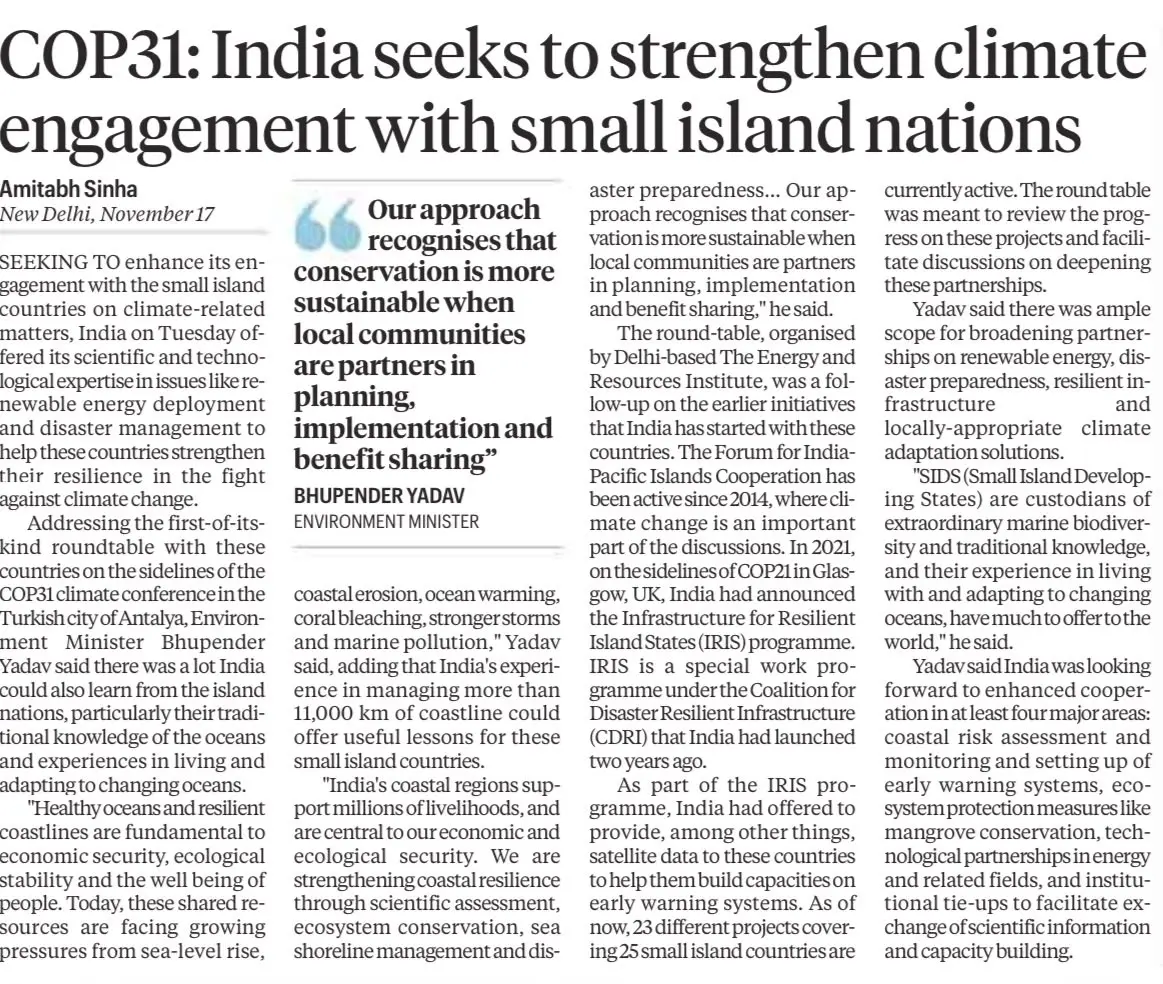
COP31: India's Climate Engagement with Small Island Nations

Context: On the sidelines of COP31 in Antalya, India offered its scientific and technological expertise to Small Island Developing States (SIDS) in renewable energy, coastal resilience and disaster preparedness.

COP31: India seeks to strengthen climate engagement with small island nations (The Hindu)
COP31: India and Small Island Developing States. Source: The Hindu

Key Developments

Offer
Scientific and technological help in renewable energy and disaster management.
Two-way learning
India to learn from islands' traditional ocean knowledge.
Coastline
India's experience of managing 11,000+ km of coastline.
IRIS projects
23 projects across 25 island countries are active.

India's Existing Initiatives

FIPIC
Forum for India–Pacific Islands Cooperation, set up in 2014.
IRIS
Infrastructure for Resilient Island States, launched at COP26 (2021).
CDRI
Coalition for Disaster Resilient Infrastructure – IRIS is its special programme.

Areas of Cooperation

Coastal risk
Assessment, monitoring and early-warning systems.
Ecosystems
Mangrove conservation and nature-based protection.
Energy
Renewable energy and climate technologies.
Capacity
Scientific exchange, institutional ties and capacity-building.

Significance & Challenges

Climate justice
Helps nations hit hardest despite low emissions.
Blue economy
Protects fisheries, marine resources and coastal livelihoods.
Strategic
Strengthens India's Indo-Pacific outreach.
Challenges
Sea-level rise, cyclones, limited finance and fragmented climate funding.

Way Forward

Finance
More climate finance and technology transfer.
Warning systems
Regional early warning and climate data-sharing.
Nature-based
Mangrove and coral restoration.
Institutions
Use FIPIC, IRIS and CDRI with community participation.
Key Takeaway: India is positioning itself as a development and climate partner for island states, combining its technology and coastal experience with their traditional knowledge of the oceans.

Prelims Practice MCQ

+2 correct • −0.66 wrong

Consider the following statements:
1. The Infrastructure for Resilient Island States (IRIS) initiative was launched at COP26 in Glasgow.
2. IRIS is a programme under the Coalition for Disaster Resilient Infrastructure (CDRI).
3. CDRI was launched by India at COP21 in Paris.
Which of the statements given above are correct?

Explanation: IRIS was launched at COP26 (Glasgow, 2021) as a CDRI programme. CDRI itself was launched by India in 2019 at the UN Climate Action Summit in New York, not at COP21, so Statement 3 is wrong.

UPSC Mains Question

GS3 • 10 Marks • 150 Words

Small Island Developing States are on the frontline of climate change. Discuss how India's partnerships can strengthen their climate resilience while advancing India's Indo-Pacific interests.

Attempt before opening the value-addition tab.
Accepted: JPG, JPEG, PNG, WEBP or PDF. The standalone file previews your answer locally; connect the API hook for real server submission.
Use after attempting the Mains answer
  • Initiatives — FIPIC (2014), CDRI (2019), IRIS (2021), International Solar Alliance, Mission LiFE.
  • Concepts — climate justice, CBDR-RC, loss and damage, nature-based solutions.
  • Facts — India's coastline 11,000+ km; 23 IRIS projects in 25 island states.
  • Keywords — SIDS, blue economy, coastal resilience, early-warning systems.
NEWS 4 GS2 • International Relations | GS3 • Science & Technology Source: The Hindu

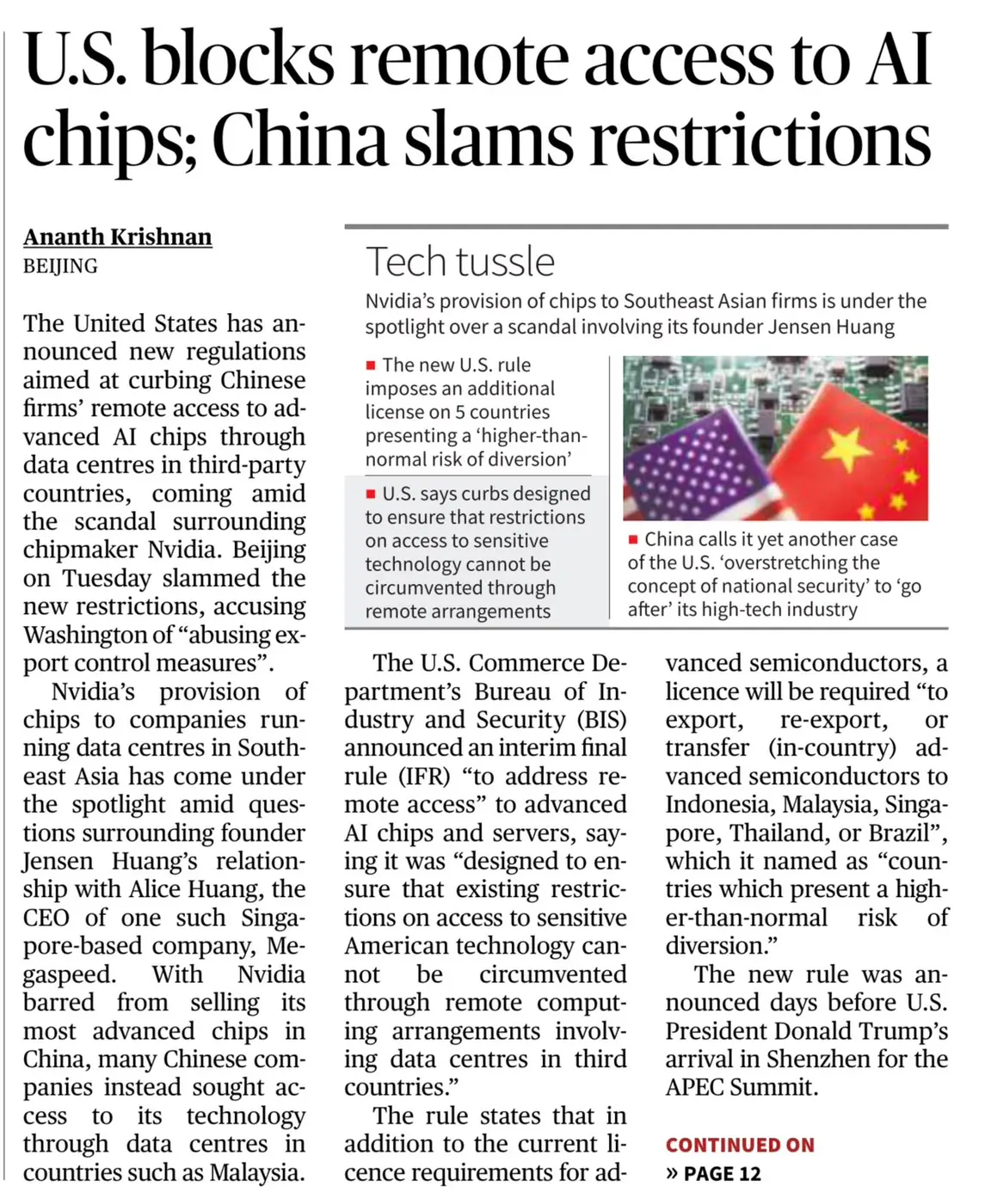
U.S. Restricts China's Remote Access to Advanced AI Chips

Context: The U.S. has tightened export controls to stop Chinese firms from remotely using restricted advanced AI chips through data centres in third countries, closing a loophole in its technology curbs.

U.S. blocks remote access to AI chips; China slams restrictions (The Hindu)
U.S. blocks remote access to AI chips; China slams restrictions. Source: The Hindu

What Has Changed?

New rule
U.S. Bureau of Industry and Security (BIS) issued an interim final rule on remote access.
Loophole
Chinese firms used overseas data centres, mainly in Southeast Asia.
Licence
Extra licences for chips to Indonesia, Malaysia, Singapore, Thailand and Brazil.
Trigger
Scrutiny of Nvidia's chip supply to Southeast Asian firms.

Why the U.S. Did This

Circumvention
Block access via third-country data centres and remote computing.
National security
Limit China's high-performance computing for AI and military use.
Tech lead
Keep the U.S. advantage in semiconductors and AI.
Diversion
Stop restricted tech moving through intermediary countries.

China's Reaction & Global Impact

China
Calls it abuse of export controls and economic coercion.
Rivalry
Chips are now a central tool of U.S.–China competition.
Third countries
Southeast Asia must balance trade with compliance.
Fragmentation
Could create two rival tech ecosystems.

Way Forward

Monitoring
Track cloud access and chip diversion.
Coordination
Common export-control standards among producers and transit states.
Proportionality
Target genuine security risks, not civilian trade.
Dialogue
Prevent tech curbs from becoming a wider economic confrontation.
Key Takeaway: Export controls now cover not just where chips are shipped but who can use them remotely. Tech access has become a frontline of U.S.–China rivalry, with third countries caught in between.

Prelims Practice MCQ

+2 correct • −0.66 wrong

Consider the following statements regarding the recent U.S. rule on advanced AI chips:
1. It was issued by the Bureau of Industry and Security under the U.S. Department of Commerce.
2. It requires additional licences for advanced semiconductors going to countries such as Malaysia and Singapore.
3. India is among the countries named as a higher-than-normal risk of diversion.
Which of the statements given above are correct?

Explanation: BIS, under the U.S. Commerce Department, issued the rule, which names Indonesia, Malaysia, Singapore, Thailand and Brazil. India is not on the list, so Statement 3 is wrong.

UPSC Mains Question

GS2 • 15 Marks • 250 Words

Technology has become an instrument of geopolitics. Analyse the implications of U.S.–China competition over semiconductors for India's technology and strategic interests.

Attempt before opening the value-addition tab.
Accepted: JPG, JPEG, PNG, WEBP or PDF. The standalone file previews your answer locally; connect the API hook for real server submission.
Use after attempting the Mains answer
  • India links — India Semiconductor Mission, PLI for semiconductors, iCET/TRUST with the U.S.
  • Facts — India joined the Wassenaar Arrangement in 2017 (export-control regime).
  • Concepts — techno-nationalism, friend-shoring, dual-use technology, supply-chain diversion.
  • Keywords — export controls, remote access, strategic autonomy, tech decoupling.
NEWS 5 GS3 • Science & Technology | Security Source: The Hindu – Opinion

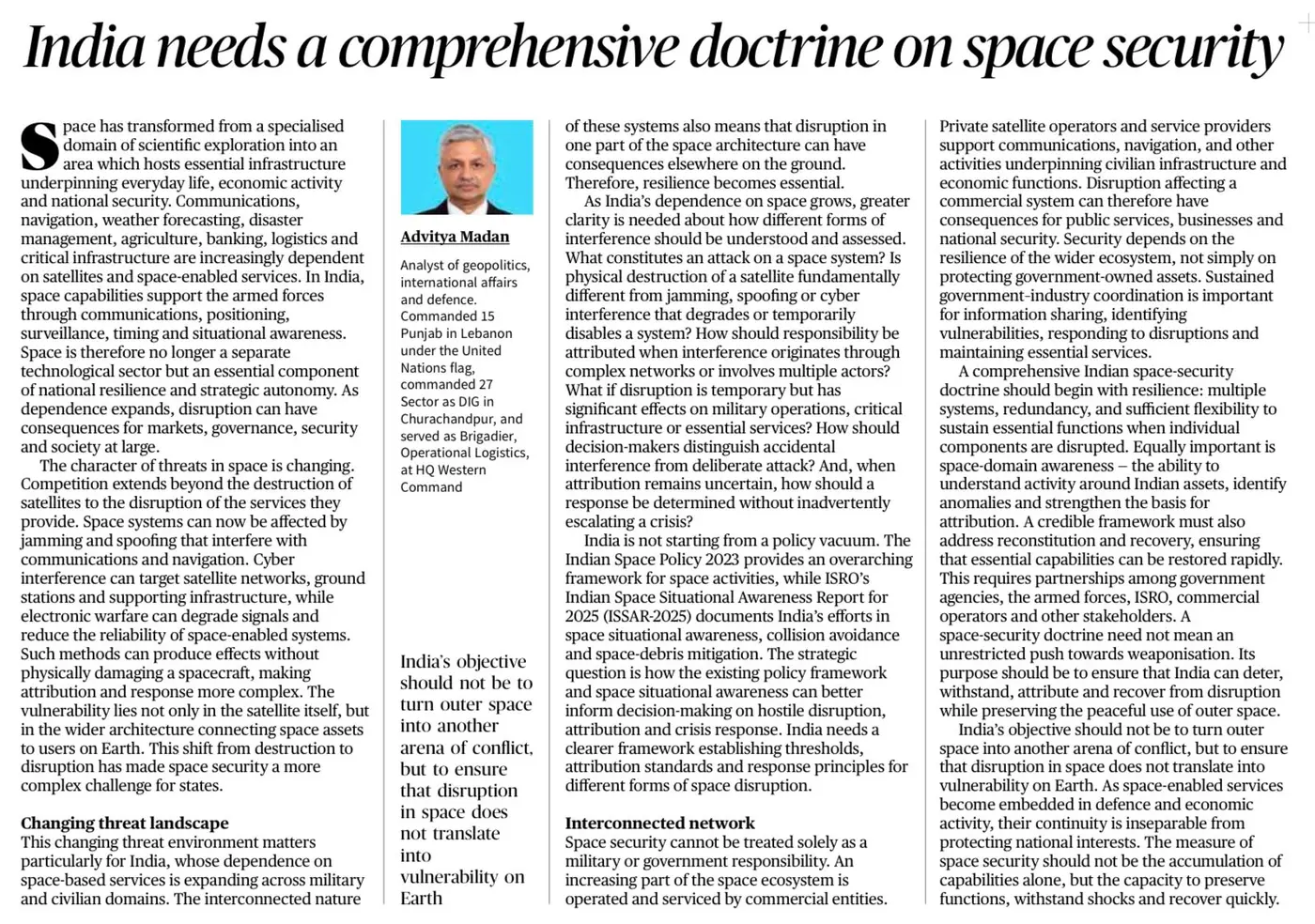
India Needs a Comprehensive Doctrine on Space Security

Context: India's growing dependence on space-based infrastructure, and new threats of satellite disruption, call for a clear space-security doctrine to protect strategic, military and economic interests.

India needs a comprehensive doctrine on space security (The Hindu)
India needs a comprehensive doctrine on space security. Source: The Hindu

Why Space Matters Now

Defence
Communication, navigation, surveillance and situational awareness.
Economy
Banking, agriculture, logistics and weather forecasting.
Infrastructure
Civilian and military services depend on satellites.
Autonomy
Uninterrupted space capability = strategic autonomy.

Changing Threat Landscape

ASAT attacks
Physically destroy satellites and create space debris.
Jamming
Disrupts communication and navigation signals.
Spoofing
Sends fake signals to mislead positioning.
Cyberattacks
Target satellite networks and ground stations.
Cascade risk
Disruption spreads across systems, making attribution difficult.

Existing Framework & Gap

Indian Space Policy 2023
Overarching framework for space activities.
ISSAR
ISRO's report on space situational awareness and debris mitigation.
Gap
No clear doctrine on hostile interference, attribution and response.

What a Doctrine Must Do

Assess
Tell accidental interference from deliberate attack.
Attribute
Fix responsibility when multiple actors are involved.
Respond
Set thresholds for different kinds of interference.
De-escalate
Avoid miscalculation during crises.
Ecosystem
Include private operators and ground stations, not just government assets.

Way Forward

Resilience
Redundancy and backup systems by design.
Awareness
Stronger space-domain awareness and anomaly detection.
Coordination
Info-sharing among government, Armed Forces, ISRO and industry.
Recovery
Rapid restoration of essential services.
Key Takeaway: The aim is not to weaponise space but to ensure disruption in space does not become vulnerability on Earth – through deterrence, resilience, attribution and quick recovery.

Prelims Practice MCQ

+2 correct • −0.66 wrong

Consider the following statements:
1. Jamming disrupts satellite communication and navigation signals.
2. Spoofing manipulates signals to mislead positioning and navigation systems.
3. The Indian Space Situational Awareness Report (ISSAR) is published by DRDO.
How many of the above statements are correct?

Explanation: Jamming blocks signals and spoofing sends false signals to mislead users. ISSAR is published by ISRO, not DRDO, so only two statements are correct.

UPSC Mains Question

GS3 • 15 Marks • 250 Words

The threat to space assets has shifted from destruction to disruption. Discuss why India needs a comprehensive space-security doctrine.

Attempt before opening the value-addition tab.
Accepted: JPG, JPEG, PNG, WEBP or PDF. The standalone file previews your answer locally; connect the API hook for real server submission.
Use after attempting the Mains answer
  • India links — Mission Shakti ASAT test (2019), Defence Space Agency (2019), IN-SPACe, NavIC.
  • Law — Outer Space Treaty (1967): peaceful use of outer space.
  • Concepts — space-domain awareness, counter-space capabilities, Kessler syndrome.
  • Keywords — jamming, spoofing, attribution, resilience, strategic autonomy.
NEWS 6 GS2 • Health | GS3 • Science & Technology Source: The Hindu

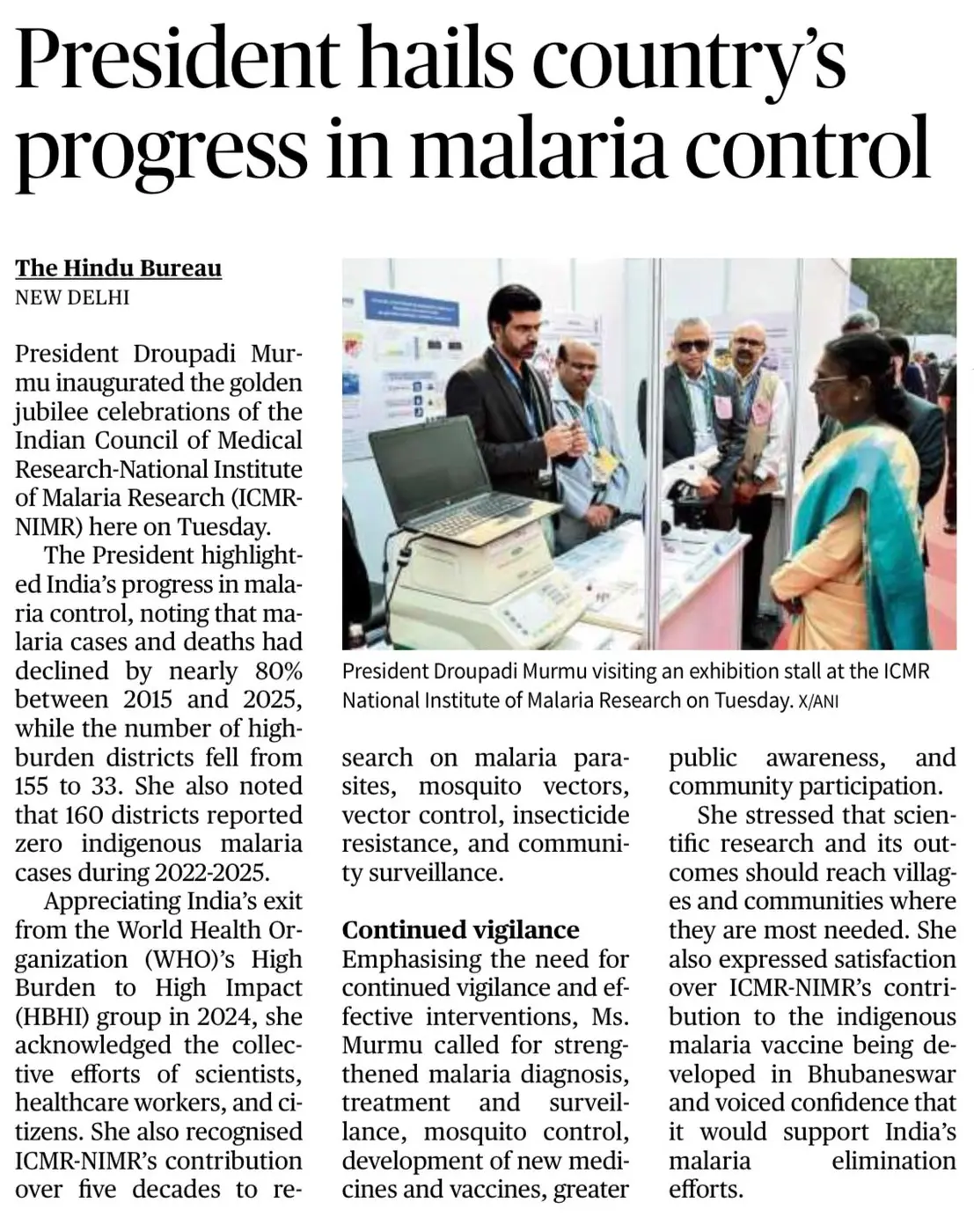
Malaria in India: Elimination Strategy and Disease Burden

Context: Inaugurating ICMR-NIMR's golden jubilee, President Droupadi Murmu highlighted India's progress in malaria control and called for continued vigilance, surveillance and research.

President hails country's progress in malaria control – ICMR-NIMR golden jubilee (The Hindu)
President hails country's progress in malaria control. Source: The Hindu

Malaria: Basics

Cause
Plasmodium parasites, spread by infected female Anopheles mosquitoes.
Main species in India
P. falciparum and P. vivax.
Symptoms
Fever, chills, headache; severe cases can cause organ failure.

India's Progress

Decline
Cases and deaths down nearly 80% (2015–2025).
High-burden districts
Fell from 155 to 33.
Zero cases
160 districts reported zero indigenous cases (2022–2025).
WHO HBHI
India exited the High Burden to High Impact group in 2024.
Target
Zero indigenous cases by 2027; elimination by 2030.

Control Framework & Strategy

NFME (2016–2030)
National Framework for Malaria Elimination.
NSP (2023–2027)
Surveillance, diagnosis, treatment and vector control.
Diagnosis
Microscopy and Rapid Diagnostic Tests (RDTs).
Vector control
LLINs, Indoor Residual Spraying and breeding-site control.
Research
ICMR-NIMR work on vectors, resistance and an indigenous vaccine.

Challenges

Resistance
Insecticide resistance and changing mosquito behaviour.
Access
Remote and tribal areas with weak healthcare.
Hidden cases
Asymptomatic infections go undetected.
Climate
Changing climate affects transmission; risk of resurgence.

Way Forward

Surveillance
Case investigation and rapid response.
Vectors
Integrated vector control with resistance monitoring.
Focus
Prioritise tribal and hard-to-reach populations.
Vigilance
Prevent resurgence in malaria-free areas.
Key Takeaway: India has cut malaria sharply and left the WHO high-burden group, but the last mile – tribal areas, hidden infections and insecticide resistance – will decide the 2030 elimination goal.

Prelims Practice MCQ

+2 correct • −0.66 wrong

Consider the following statements:
1. Malaria is caused by Plasmodium parasites and spread by infected female Anopheles mosquitoes.
2. India's National Framework for Malaria Elimination targets elimination by 2030.
3. India exited the WHO's High Burden to High Impact (HBHI) group in 2024.
Which of the statements given above are correct?

Explanation: All three are correct: Plasmodium is spread by female Anopheles mosquitoes, the NFME (2016–2030) targets elimination by 2030, and India exited the HBHI group in 2024.

UPSC Mains Question

GS2 • 10 Marks • 150 Words

India has made significant progress in malaria control, yet elimination by 2030 remains challenging. Discuss the key challenges and suggest measures to sustain the gains.

Attempt before opening the value-addition tab.
Accepted: JPG, JPEG, PNG, WEBP or PDF. The standalone file previews your answer locally; connect the API hook for real server submission.
Use after attempting the Mains answer
  • Programmes — NFME 2016–2030, National Strategic Plan 2023–27, NCVBDC.
  • Facts — ~80% fall in cases and deaths (2015–25); high-burden districts 155 → 33.
  • Science — WHO-recommended vaccines RTS,S and R21; World Malaria Day on 25 April.
  • Keywords — vector control, LLINs, IRS, insecticide resistance, last-mile delivery.
NEWS 7 GS3 • Agriculture | Economy Source: The Hindu

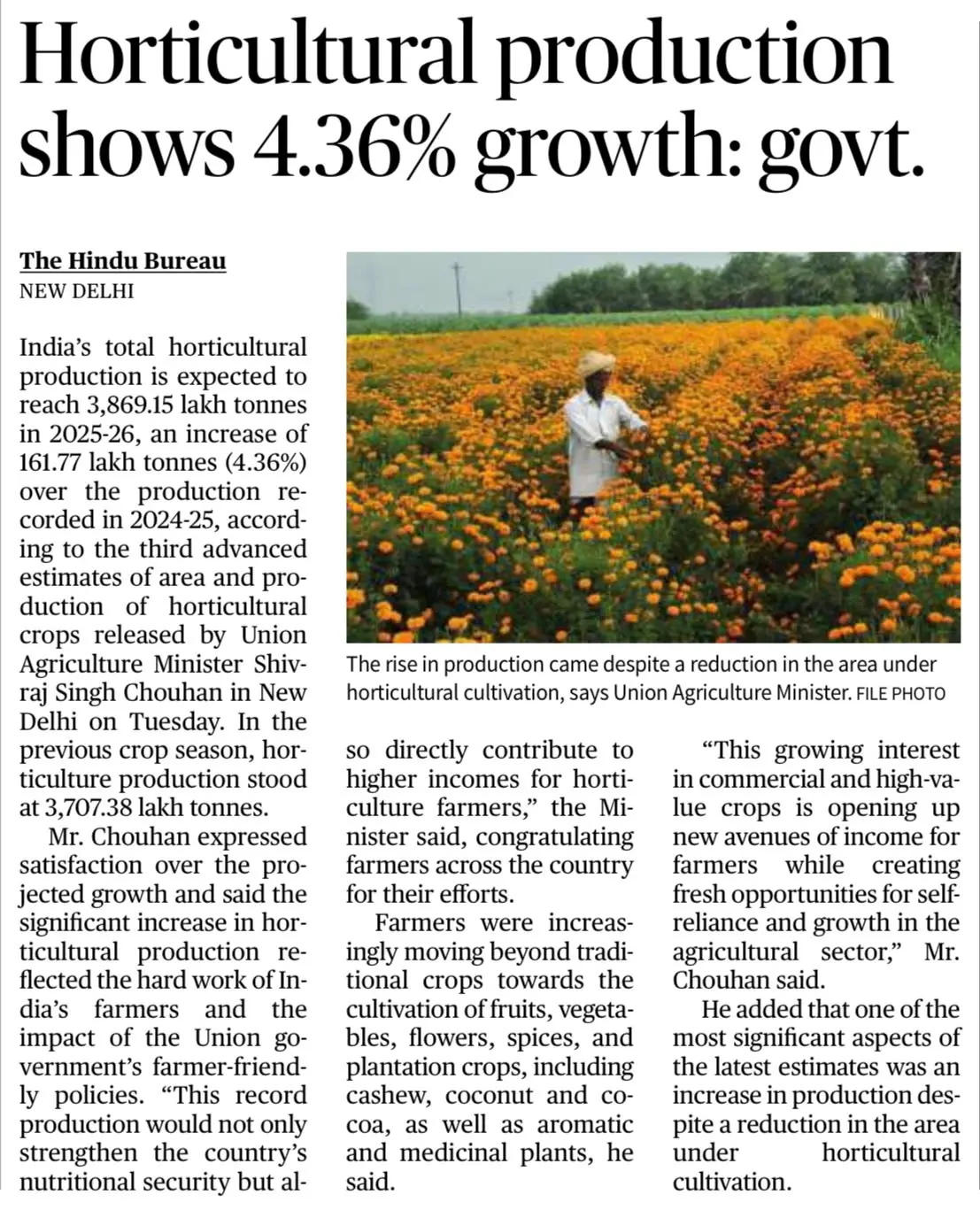
Horticulture Production Rises 4.36% Despite Smaller Area

Context: India's horticulture production is estimated to grow in 2025–26 even though the area under cultivation fell, showing better productivity and a shift towards high-value crops.

Horticultural production shows 4.36% growth: govt. (The Hindu)
Horticultural production shows 4.36% growth. Source: The Hindu

Key Data (3rd Advance Estimates)

Production 2025–26
3,869.15 lakh tonnes (about 387 million tonnes).
Growth
Up 161.77 lakh tonnes (4.36%) over 2024–25.
Area
Fell from 301.36 to 297.21 lakh hectares.
Fastest growth
Flowers 14.45%, plantation crops 7.56%, fruits 4.60%, vegetables 4.35%.
Potato
655.70 lakh tonnes, up 11.95%.

India's Position

Global
Second-largest producer of fruits and vegetables.
Top state
Uttar Pradesh.
Other leaders
Madhya Pradesh, West Bengal, Maharashtra, Andhra Pradesh.

Why Horticulture Matters

Farm income
Higher returns per unit of land.
Nutrition
More micronutrient-rich food.
Diversification
Less dependence on cereals.
Jobs
Employment in processing, storage, logistics and exports.

Challenges

Losses
High post-harvest losses – weak cold storage and transport.
Prices
Price volatility for perishables.
Land
Fragmented holdings and uneven technology access.
Markets
Limited processing and organised market linkages.

Way Forward

Cold chain
Expand cold storage and refrigerated transport.
Value addition
Food processing and FPOs.
Inputs
Quality planting material, credit and extension services.
Markets
Export infrastructure and price-risk management.
Key Takeaway: Horticulture is growing on less land – a sign of rising productivity. Gains will last only if cold chains, processing and market links keep pace.

Prelims Practice MCQ

+2 correct • −0.66 wrong

With reference to horticulture in India, consider the following statements:
1. Horticulture production in 2025–26 is estimated to rise despite a fall in the area under cultivation.
2. India is the world's largest producer of fruits and vegetables.
3. Uttar Pradesh is the largest horticulture-producing state.
Which of the statements given above are correct?

Explanation: Production rose 4.36% even as area fell, and Uttar Pradesh leads among states. India is the second-largest producer of fruits and vegetables (after China), so Statement 2 is wrong.

UPSC Mains Question

GS3 • 10 Marks • 150 Words

Horticulture can drive both farmers' income and nutritional security in India. Discuss the challenges in the sector and suggest measures to address them.

Attempt before opening the value-addition tab.
Accepted: JPG, JPEG, PNG, WEBP or PDF. The standalone file previews your answer locally; connect the API hook for real server submission.
Use after attempting the Mains answer
  • Schemes — MIDH, Cluster Development Programme, Operation Greens (TOP), PMKSY, Agriculture Infrastructure Fund.
  • Data — 3,869.15 lakh tonnes (2025–26), +4.36%; area down to 297.21 lakh ha.
  • Concepts — crop diversification, post-harvest losses, value chain, FPOs.
  • Keywords — high-value agriculture, cold chain, productivity, nutritional security.

Copyright © 2026 USARAMBHA EDUCATION (UnderStand UPSC). All Rights Reserved.