Batch 1 Starts 23 Nov: UPSC GS Foundation 2028/29 Enroll Now
US
UnderStand UPSC Daily Current Affairs Practice
0.00Score / 12
0 / 6MCQs Attempted
0%Accuracy
19 November 2026 • UPSC CSE

Read the news. Test the concept. Write the Mains answer.

This interactive edition converts each current-affairs item into one Prelims-level MCQ, one Mains-level question, and a compact value-addition section for revision.

+2 correct −0.66 incorrect Explanation after attempt Image/PDF answer upload
NEWS 1 GS3 • Science & Technology | Space Source: The Indian Express

Voyager 1 & 2: Humanity's Farthest Reach

Context: Voyager 1 is reaching the milestone of one light-day from Earth (about 25.9 billion km). Launched in 1977, it is still sending scientific data from interstellar space nearly five decades later.
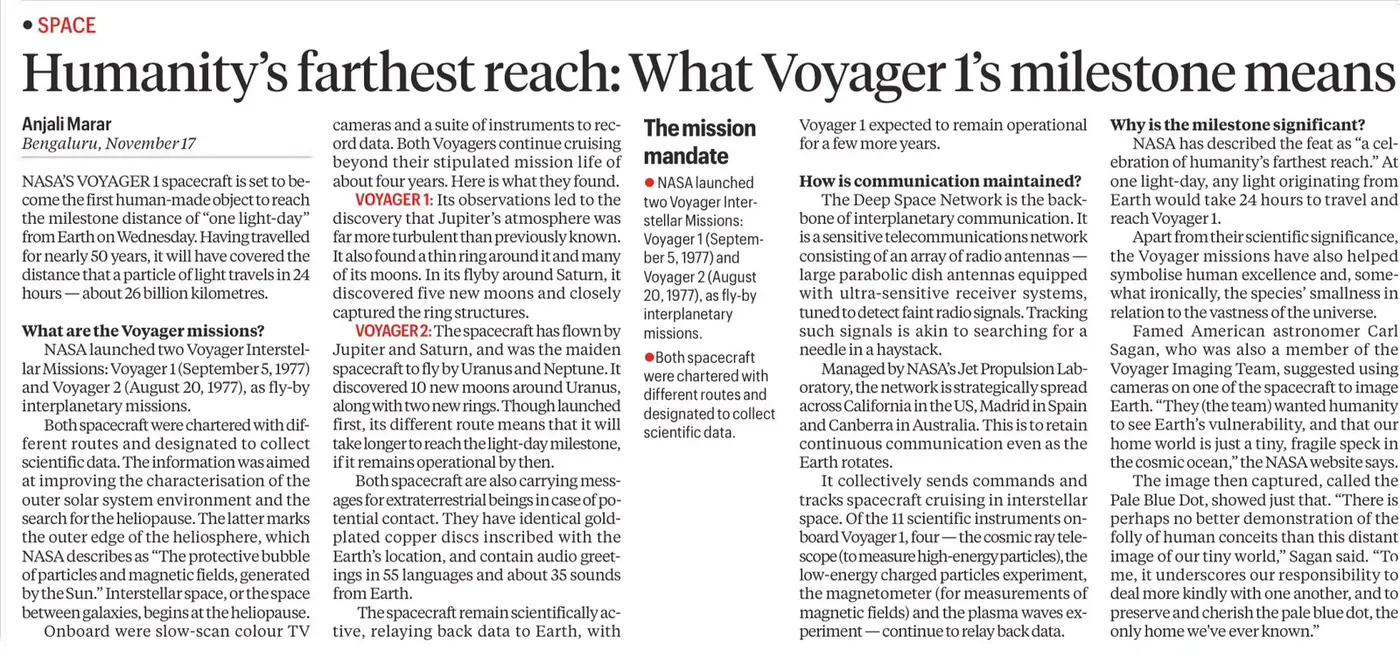
Humanity's farthest reach: what Voyager 1's milestone means (The Indian Express)
Voyager 1's one light-day milestone. Source: The Indian Express

Voyager Missions

Voyager 1
Launched 5 September 1977; explored Jupiter and Saturn; entered interstellar space in 2012.
Voyager 2
Launched 20 August 1977; explored Jupiter, Saturn, Uranus and Neptune; entered interstellar space in 2018.
Unique record
Voyager 2 is the only spacecraft to have visited Uranus and Neptune up close.
Still working
Both run far beyond their original mission life.

Scientific Contributions

Jupiter
Found active volcanism on Io – the first active volcanoes seen beyond Earth.
Saturn
Revealed complex ring structures, new moons; studied Titan.
Uranus (1986)
First flyby; new moons and rings; unusual magnetic field.
Neptune (1989)
First flyby; observed the Great Dark Spot.
Interstellar space
Measured cosmic rays, plasma waves and magnetic fields beyond the heliosphere.

Important Concepts

Light-day
Distance light travels in 24 hours (~25.9 billion km); signals take ~a day to reach Earth.
Heliosphere
Bubble created by the solar wind; its outer boundary is the heliopause.
Pale Blue Dot
Voyager 1's 1990 photo of Earth from ~6 billion km, popularised by Carl Sagan.
Deep Space Network
NASA antennas at Goldstone (USA), Madrid (Spain) and Canberra (Australia).

Significance

Science
Direct observations of interstellar space and cosmic radiation.
Engineering
Proof of long-duration spacecraft design and deep-space communication.
Perspective
Reinforces Earth's uniqueness and the need to protect it.
Key Takeaway: Nearly 50 years on, Voyager 1 is humanity's farthest messenger – still sending data from beyond the Sun's bubble and reminding us how small and precious Earth is.

Prelims Practice MCQ

+2 correct • −0.66 wrong

UPSC Prelims PYQ 2014: Which of the following pairs is/are correctly matched?
1. Cassini-Huygens : Orbiting Venus and transmitting data to Earth
2. MESSENGER : Mapping and investigating Mercury
3. Voyager 1 and 2 : Exploring the outer Solar System

Explanation: Cassini-Huygens explored Saturn, not Venus. MESSENGER studied Mercury, and Voyager 1 and 2 explored the outer Solar System. So only pairs 2 and 3 are correct.

UPSC Mains Question

GS3 • 10 Marks • 150 Words

The Voyager missions have redefined our understanding of the outer Solar System and interstellar space. Discuss their scientific significance and lessons for India's deep-space ambitions.

Attempt before opening the value-addition tab.
Accepted: JPG, JPEG, PNG, WEBP or PDF. The standalone file previews your answer locally; connect the API hook for real server submission.
Use after attempting the Mains answer
  • India links — Chandrayaan-3 (2023), Aditya-L1 (studies the Sun and solar wind), ISRO's Indian Deep Space Network at Byalalu.
  • Concepts — heliosphere, heliopause, interstellar medium, light-year vs light-day.
  • Facts — Voyager 1 in interstellar space since 2012, Voyager 2 since 2018.
  • PYQ link — Prelims 2014 (Cassini-Huygens, MESSENGER, Voyager).
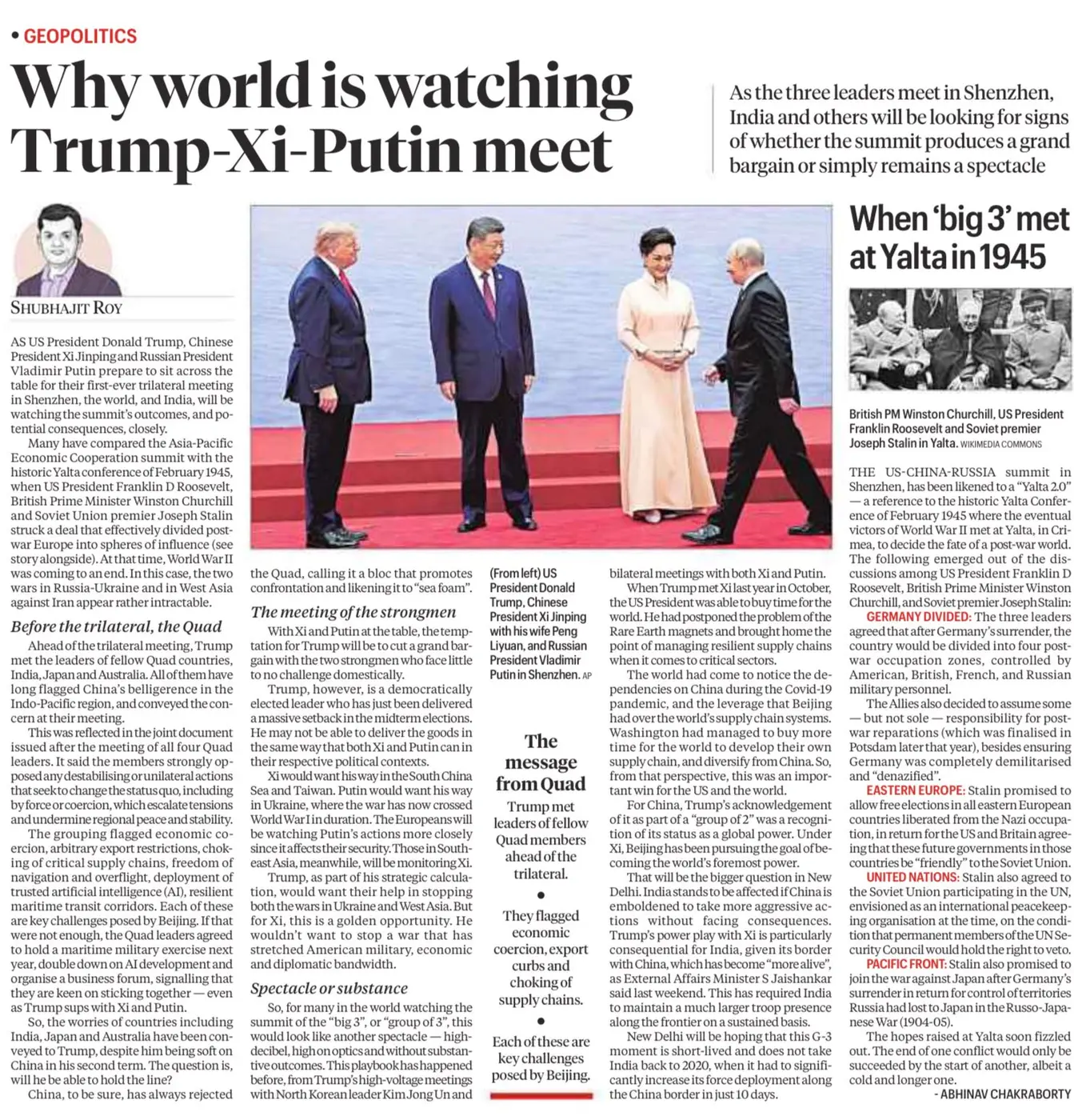
NEWS 2 GS2 • International Relations Source: The Indian Express

Trump–Xi–Putin Meeting: Global Power Equations

Context: The first trilateral meeting of U.S. President Trump, Chinese President Xi Jinping and Russian President Putin in Shenzhen is being watched closely for its impact on geopolitics, trade and security – and is being compared to the Yalta Conference of 1945.

Why the world is watching the Trump-Xi-Putin meet in Shenzhen (The Indian Express)
Why world is watching Trump-Xi-Putin meet. Source: The Indian Express

What Each Power Wants

United States
Economic and strategic gains; manage competition with China; options on Ukraine and West Asia.
China
Recognition as a global power; more space in the Indo-Pacific; less U.S. pressure.
Russia
Diplomatic legitimacy and bargaining power amid the Ukraine war.

Major Issues on the Table

Conflicts
Possible diplomacy on Ukraine and West Asia.
Economy
Trade curbs, critical minerals, semiconductors, tech controls.
Indo-Pacific
China's actions on Taiwan and the South China Sea.
Global order
Real grand bargain or just a spectacle?

History Link: Yalta Conference (1945)

Leaders
Roosevelt (U.S.), Churchill (U.K.), Stalin (USSR).
Decisions
Germany divided into four occupation zones; future of Eastern Europe; Soviet entry into the war against Japan.
UN
Agreed on the veto for permanent members of the UN Security Council.
Relevance
Big powers deciding the world order – but today's context is very different.

Implications for India

Strategic autonomy
Keep balanced ties with all three powers.
Border
Watch China's calculations along the LAC.
Indo-Pacific
Strengthen the Quad and maritime cooperation.
Economy
Diversify critical minerals and technology supply chains.
World order
Support a multipolar, rules-based order.
Key Takeaway: A 'big three' deal could redraw global power equations. India's answer is strategic autonomy – strong partnerships with all, dependence on none.

Prelims Practice MCQ

+2 correct • −0.66 wrong

With reference to the Yalta Conference (1945), consider the following statements:
1. It was attended by Roosevelt, Churchill and Stalin.
2. It agreed that post-war Germany would be divided into occupation zones.
3. It was held in Potsdam, Germany.
Which of the statements given above are correct?

Explanation: Yalta (February 1945) brought together Roosevelt, Churchill and Stalin and agreed to divide Germany into occupation zones. It was held at Yalta in Crimea; the later Potsdam Conference was a separate meeting.

UPSC Mains Question

GS2 • 15 Marks • 250 Words

Great-power summits can reshape the global order. Discuss how closer understanding among the U.S., China and Russia could affect India's strategic interests.

Attempt before opening the value-addition tab.
Accepted: JPG, JPEG, PNG, WEBP or PDF. The standalone file previews your answer locally; connect the API hook for real server submission.
Use after attempting the Mains answer
  • Concepts — strategic autonomy, multipolarity, G-2, grand bargain, spheres of influence.
  • Groupings — Quad, BRICS, SCO, RIC (Russia-India-China).
  • History — Yalta (Feb 1945) and Potsdam (Jul–Aug 1945) conferences.
  • Keywords — economic coercion, supply-chain resilience, rules-based order.
NEWS 3 GS2 • Education | Social Justice Source: The Indian Express

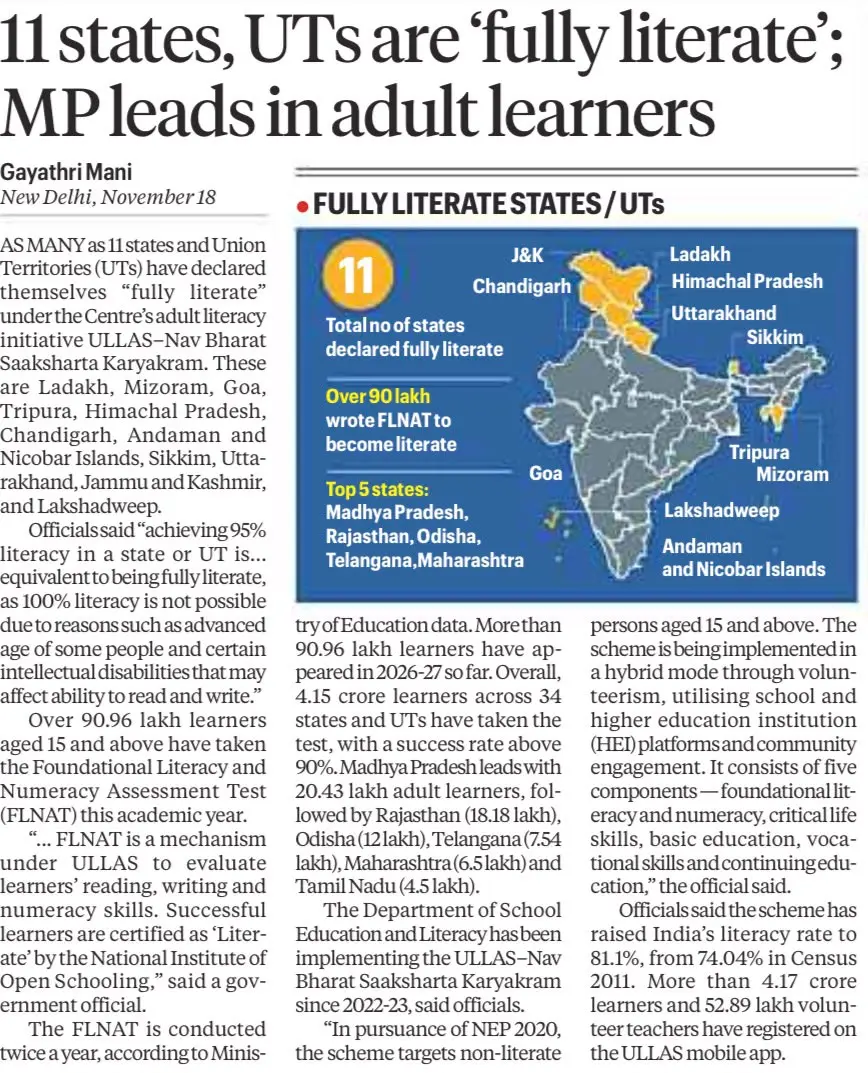
11 States/UTs Declared Fully Literate under ULLAS

Context: Eleven States and UTs have declared themselves fully literate under the Centre's ULLAS–Nav Bharat Saaksharta Karyakram, the adult literacy programme aligned with NEP 2020.

11 states and UTs are fully literate; MP leads in adult learners – ULLAS (The Indian Express)
11 States/UTs fully literate under ULLAS. Source: The Indian Express

ULLAS Scheme

Full form
Understanding of Lifelong Learning for All in Society – New India Literacy Programme (2022–27).
Ministry
Ministry of Education; aligned with NEP 2020.
Target
Non-literate persons aged 15 years and above.
Five components
Foundational literacy & numeracy, critical life skills, basic education, vocational skills, continuing education.
Mode
Volunteer-based, with the ULLAS app.

What 'Fully Literate' Means

Benchmark
95% literacy or above = fully literate.
Assessment
FLNAT – Foundational Literacy and Numeracy Assessment Test, held twice a year.
Certificate
Successful learners certified by NIOS.

The 11 Fully Literate States/UTs

States (6)
Mizoram, Goa, Tripura, Himachal Pradesh, Sikkim, Uttarakhand.
UTs (5)
Ladakh, Chandigarh, Andaman & Nicobar, Jammu & Kashmir, Lakshadweep.

Progress

Learners
4.15 crore took FLNAT across 34 States/UTs; success rate 90%+.
Top state
Madhya Pradesh (20.43 lakh learners), then Rajasthan and Odisha.
Literacy rate
Reported at 81.1%, up from 74.04% (Census 2011).

Significance

Inclusion
Lifelong learning and women's empowerment.
Livelihood
Better employability through vocational skills.
Digital
Supports digital and financial inclusion.
SDG
Advances SDG 4 – Quality Education.
Key Takeaway: Adult literacy is moving from 'signing your name' to functional literacy – reading, writing, numeracy and life skills – with 11 States/UTs already crossing the 95% mark.

Prelims Practice MCQ

+2 correct • −0.66 wrong

With reference to ULLAS – Nav Bharat Saaksharta Karyakram, consider the following statements:
1. It targets non-literate persons aged 15 years and above.
2. A State/UT with 95% or more literacy is treated as fully literate.
3. Successful learners are certified by the National Institute of Open Schooling (NIOS).
How many of the above statements are correct?

Explanation: All three are correct: ULLAS targets non-literates aged 15+, 95% literacy is treated as full literacy, and learners who clear FLNAT are certified as literate by NIOS.

UPSC Mains Question

GS2 • 10 Marks • 150 Words

Functional literacy is a prerequisite for inclusive development. Evaluate the role of ULLAS in achieving universal adult literacy in India.

Attempt before opening the value-addition tab.
Accepted: JPG, JPEG, PNG, WEBP or PDF. The standalone file previews your answer locally; connect the API hook for real server submission.
Use after attempting the Mains answer
  • History — National Literacy Mission (1988), Saakshar Bharat (2009), Padhna Likhna Abhiyan (2020).
  • Data — literacy 74.04% (Census 2011); Kerala highest, Bihar lowest in Census 2011.
  • Concepts — functional literacy, lifelong learning, Each One Teach One.
  • Keywords — FLNAT, NEP 2020, SDG 4, adult education.
NEWS 4 GS1 • Ancient History | Art & Culture Source: The Indian Express

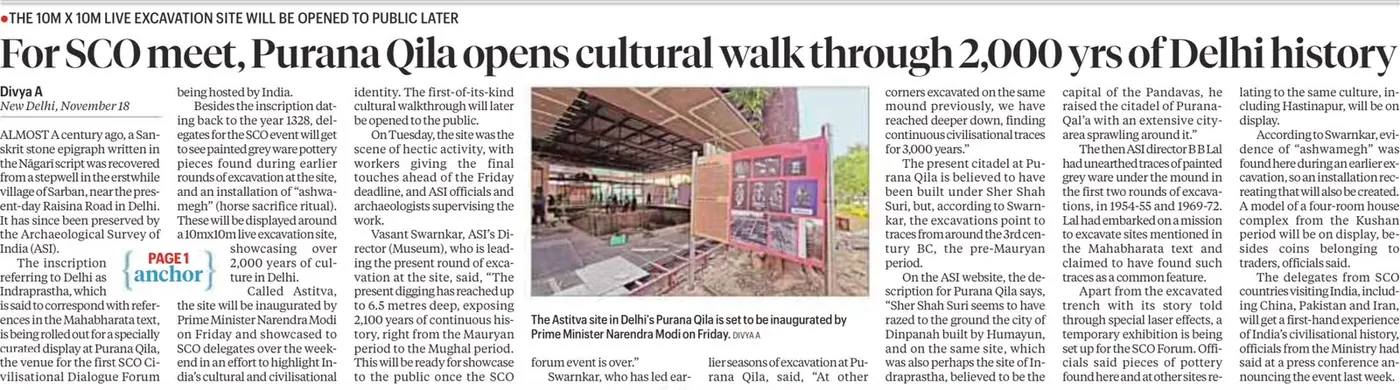
Purana Qila: Tracing 2,000 Years of Delhi's History

Context: For the first SCO Civilisational Dialogue Forum, the ASI is showcasing excavations at Delhi's Purana Qila through 'Astitva', a cultural walk through more than 2,000 years of Delhi's history.

For SCO meet, Purana Qila opens cultural walk through 2,000 years of Delhi history (The Indian Express)
Purana Qila's Astitva excavation site. Source: The Indian Express

Historical Background

Indraprastha
Traditionally linked to the Pandavas' capital; archaeology has not conclusively proved it.
Humayun (1533)
Founded Dinpanah (Refuge of the Faith).
Sher Shah Suri (1540–45)
Took Delhi and built the fort complex, linked to Shergarh.
Humayun (1555)
Regained Delhi; died in 1556 after falling from the steps of Sher Mandal.

Key Monuments

Qila-i-Kuhna Mosque (1541)
Built by Sher Shah Suri; fine Afghan, transitional Indo-Islamic style.
Sher Mandal
Octagonal double-storey pavilion, believed to be Humayun's library.
Gateways
Bada Darwaza and Humayun Darwaza.

Excavations & Findings

B.B. Lal
First major excavation in 1954–55, again in 1969–72.
Layers
Continuous habitation from pre-Mauryan to Mughal period.
PGW
Painted Grey Ware – early Iron Age pottery, often linked to the Mahabharata period.
Other finds
Coins, terracotta and a Kushan-period four-room house complex.
Depth
Digging reached ~6.5 metres, exposing ~2,100 years of history.

'Astitva' Showcase

Live site
A 10 m × 10 m live excavation site for SCO delegates.
Exhibits
Pottery, coins and an Ashvamedha (horse sacrifice) installation.
Public
To open to the public after the SCO event.

Significance

Continuity
Shows Delhi's civilisational continuity.
Heritage
Value of scientific excavation and conservation.
Diplomacy
Showcases India's heritage – cultural soft power.
Key Takeaway: Purana Qila is a vertical timeline of Delhi – layer upon layer from the pre-Mauryan age to the Mughals – now being used for India's cultural diplomacy at the SCO.

Prelims Practice MCQ

+2 correct • −0.66 wrong

UPSC Prelims PYQ 1993: Which one of the following is a monument constructed by Sher Shah?

Explanation: The Qila-i-Kuhna Mosque (1541) inside Purana Qila was built by Sher Shah Suri. Atala Masjid was built under the Sharqi rulers, Bara Sona Masjid under Bengal's Husain Shahi rulers, and Quwwat-ul-Islam by Qutbuddin Aibak.

UPSC Mains Question

GS1 • 10 Marks • 150 Words

Archaeological sites like Purana Qila show the continuity of Indian civilisation. Discuss the significance of such excavations for understanding India's past.

Attempt before opening the value-addition tab.
Accepted: JPG, JPEG, PNG, WEBP or PDF. The standalone file previews your answer locally; connect the API hook for real server submission.
Use after attempting the Mains answer
  • Seven cities of Delhi — Lal Kot, Siri, Tughlaqabad, Jahanpanah, Ferozabad, Dinpanah/Shergarh, Shahjahanabad.
  • Concepts — Painted Grey Ware culture, Indo-Islamic architecture, stratigraphy.
  • Institutions — ASI (1861, Alexander Cunningham); SCO Civilisational Dialogue Forum.
  • PYQ link — Prelims 1993 (Qila-i-Kuhna Mosque).
NEWS 5 GS1 • Indian Culture | Languages Source: The Indian Express

Saraiki: Folk Song Revives a Language

Context: The old Saraiki folk song 'Chhalrey Chhalrey Waal' has become a cross-border social media hit through a new acoustic version, bringing attention to the Saraiki language and its cultural heritage.

Saraiki: language of folk song seeing surge in popularity (The Indian Express)
Saraiki: language of folk song. Source: The Indian Express

Language Families of India

Indo-Aryan
Hindi, Bengali, Punjabi, Marathi, Gujarati, Sindhi, Saraiki.
Dravidian
Tamil, Telugu, Kannada, Malayalam.
Austroasiatic
Santali, Mundari, Khasi, Ho.
Sino-Tibetan
Bodo, Manipuri (Meitei), many Northeast languages.

Stages of Indo-Aryan

Old Indo-Aryan
Vedic and Classical Sanskrit.
Middle Indo-Aryan
Pali, Prakrit, Apabhramsha.
New Indo-Aryan
Modern languages, including Saraiki.

Saraiki: Origin & Spread

Core region
Southern Punjab, Pakistan – Multan, Bahawalpur, Dera Ghazi Khan.
Pakistan
Spoken by about 12% of the population (2023 Census).
India
Spoken by migrant communities from western Punjab (post-Partition); not an official language.
Relatives
Close to Punjabi and Sindhi; part of 'Lahnda'; earlier called Multani.

Literary & Musical Heritage

Khwaja Ghulam Farid
19th-century Sufi poet known for kafis.
Pathanay Khan
Folk singer who recorded the song in 1989.
Tradition
Sufi poetry and folk music kept the language alive.

Cultural Significance

Diversity
Preserves South Asia's linguistic diversity.
Shared heritage
Culture shared across India and Pakistan.
Revival
Digital platforms help regional languages reach new audiences.
Key Takeaway: A viral folk song shows how music and digital media can revive minority languages and the shared Sufi heritage of the subcontinent.

Prelims Practice MCQ

+2 correct • −0.66 wrong

Consider the following pairs:
1. Saraiki : Indo-Aryan
2. Santali : Dravidian
3. Bodo : Sino-Tibetan
How many of the pairs given above are correctly matched?

Explanation: Saraiki is Indo-Aryan and Bodo is Sino-Tibetan (Tibeto-Burman). Santali belongs to the Austroasiatic family, not Dravidian, so only two pairs are correct.

UPSC Mains Question

GS1 • 10 Marks • 150 Words

Language is a vehicle of culture. Discuss how folk traditions and digital media can help preserve endangered and minority languages in India.

Attempt before opening the value-addition tab.
Accepted: JPG, JPEG, PNG, WEBP or PDF. The standalone file previews your answer locally; connect the API hook for real server submission.
Use after attempting the Mains answer
  • Constitution — Eighth Schedule (22 languages), Article 29 (protection of minority culture and language), Article 350A (mother-tongue instruction).
  • Classical languages — 11 in India (Marathi, Pali, Prakrit, Assamese, Bengali added in 2024).
  • Concepts — Sufi tradition, kafi, Lahnda, linguistic diversity.
  • Keywords — endangered languages, oral tradition, syncretic culture.
NEWS 6 GS3 • Science & Technology | Health Source: The Hindu

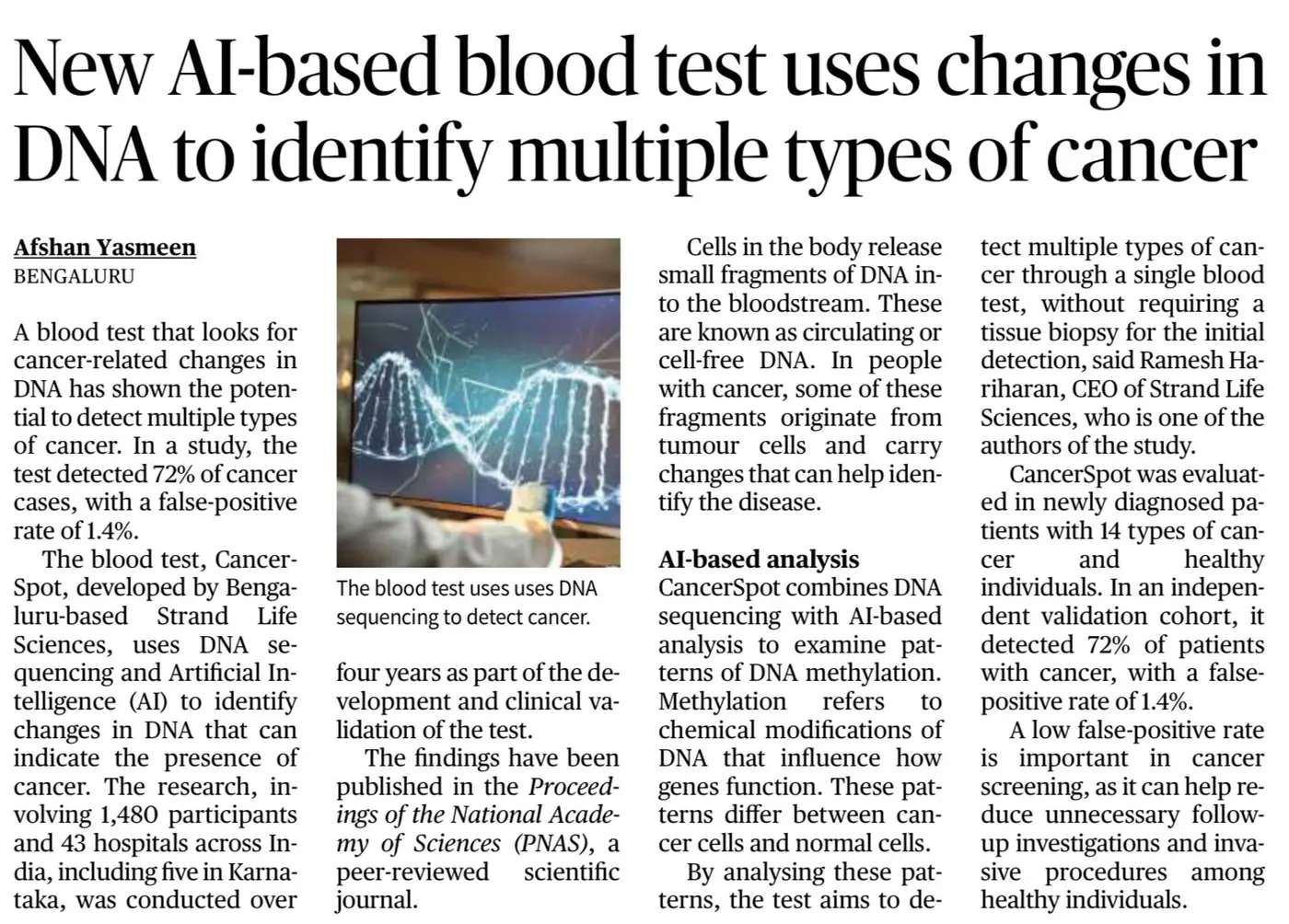
CancerSpot: AI Blood Test for Multiple Cancers

Context: Bengaluru-based Strand Life Sciences has developed CancerSpot, a blood test that uses DNA sequencing and AI to detect multiple types of cancer from changes in circulating DNA.

New AI-based blood test uses changes in DNA to identify multiple types of cancer (The Hindu)
AI-based blood test for multiple cancers. Source: The Hindu

How It Works

Cell-free DNA
Small DNA fragments released into blood; tumour cells release altered fragments too.
DNA methylation
Chemical change that controls gene activity without changing the DNA sequence.
AI analysis
Spots abnormal methylation patterns that signal cancer.

Study & Results

Scale
1,480 participants, 43 hospitals, 14 cancer types.
Detection
Found 72% of cancer cases.
False positives
Only 1.4% – important for screening.
Published in
PNAS (Proceedings of the National Academy of Sciences).

Significance

Early detection
Many cancers from one blood test.
Non-invasive
Less need for tissue biopsy in initial detection.
Access
Could widen cancer screening in India.

Limitations

Screening only
Not a replacement for confirmatory diagnosis.
Validation
Needs larger clinical trials.
Cost & access
Affordability and lab infrastructure remain challenges.
Key Takeaway: Liquid biopsy plus AI could make cancer screening simpler and earlier, but it is a screening aid – confirmation and wider validation are still essential.

Prelims Practice MCQ

+2 correct • −0.66 wrong

UPSC Prelims PYQ 2019: With reference to recent developments in science, which one of the following statements is NOT correct?

Explanation: Artificial DNA can be synthesised, DNA can be replicated outside cells (PCR), and cells can be cultured in Petri dishes. Creating functional chromosomes by joining DNA from different species is not established, so (a) is NOT correct.

UPSC Mains Question

GS3 • 15 Marks • 250 Words

Artificial Intelligence is transforming disease diagnosis. Discuss the opportunities and challenges of AI-based diagnostics in India's public health system.

Attempt before opening the value-addition tab.
Accepted: JPG, JPEG, PNG, WEBP or PDF. The standalone file previews your answer locally; connect the API hook for real server submission.
Use after attempting the Mains answer
  • Concepts — liquid biopsy, cell-free DNA, epigenetics, sensitivity vs specificity.
  • India links — National Programme for NCDs (NP-NCD), Ayushman Bharat screening, IndiaAI Mission.
  • Data — 72% detection, 1.4% false positives, 14 cancer types.
  • PYQ link — Prelims 2019 (DNA, chromosomes, cell culture).

Copyright © 2026 USARAMBHA EDUCATION (UnderStand UPSC). All Rights Reserved.