New Batch Starts 30 Nov: UPSC GS Foundation 2028/29 Enroll Now
US
UnderStand UPSC Daily Current Affairs Practice
0.00Score / 14
0 / 6MCQs Attempted
0%Accuracy
27 November 2026 • UPSC CSE

Read the news. Test the concept. Write the Mains answer.

This interactive edition converts each current-affairs item into one Prelims-level MCQ, one Mains-level question, and a compact value-addition section for revision.

+2 correct −0.66 incorrect Explanation after attempt Image/PDF answer upload
NEWS 1 GS2 • Parliament, Federalism and Constitutional Amendments Source: The Indian Express

Delimitation & Women’s Reservation: 4-Day Special Sitting of Parliament

Context: The government has convened a special sitting of Parliament (Lok Sabha from 30 November, Rajya Sabha from 2 December) to push the delimitation package and 33% women’s reservation, so that both can take effect before the 2029 General Elections.
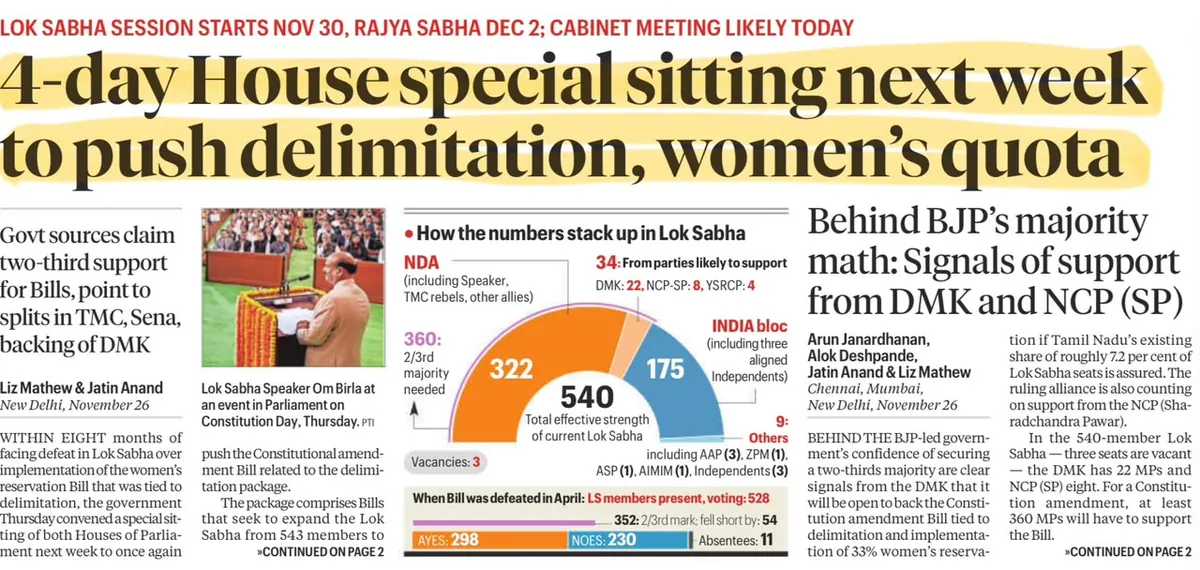
4-day House special sitting next week to push delimitation and women’s quota – how the numbers stack up in Lok Sabha (The Indian Express)
How the numbers stack up in the Lok Sabha. Source: The Indian Express
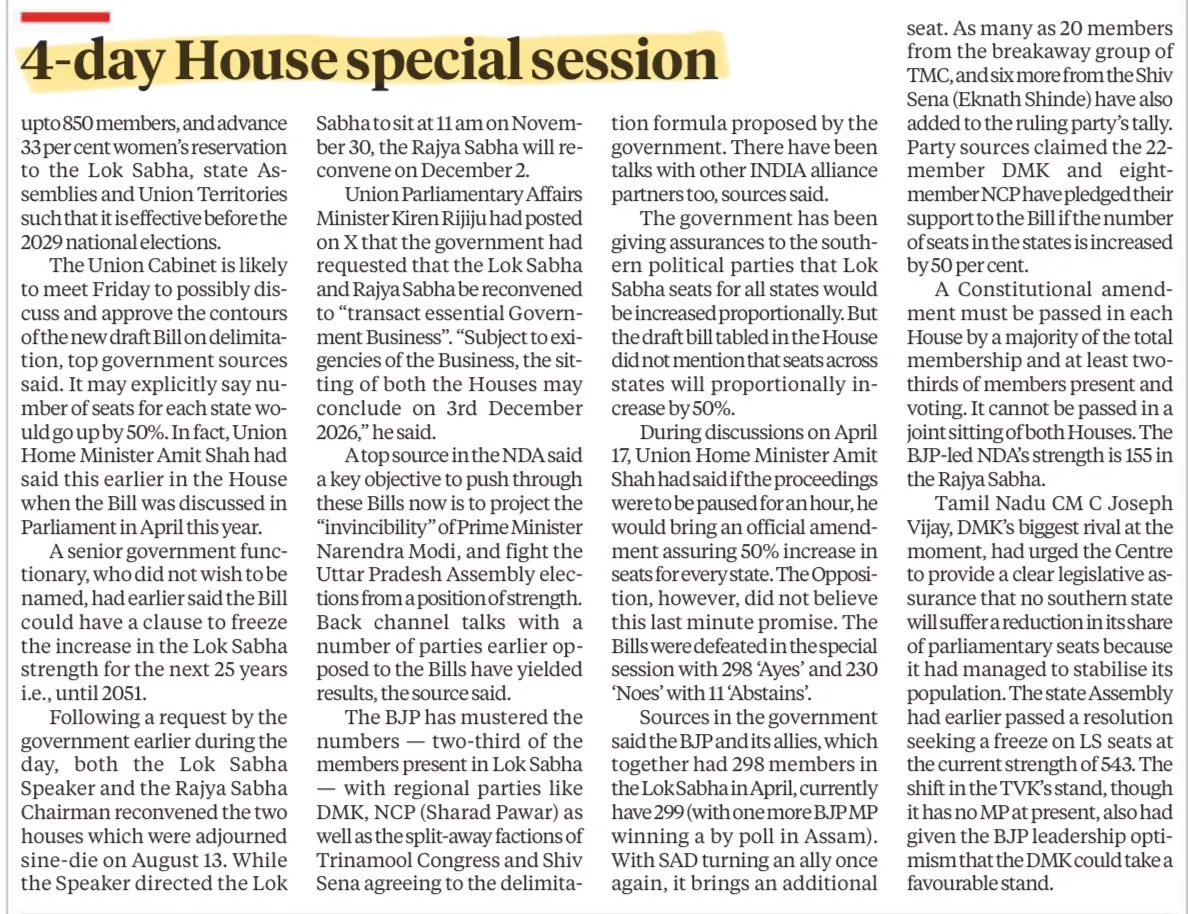
4-day House special session: draft delimitation Bill, 50% seat increase and two-thirds majority math (The Indian Express)
Draft Bill, 50% seat increase and the majority math. Source: The Indian Express

Proposed Changes

Lok Sabha size
From 543 to a maximum of 850 seats.
State-wise increase
Draft Bill may explicitly provide a 50% increase in seats for every state.
Women’s reservation
33% seats for women in the Lok Sabha, State Assemblies and UTs, effective before 2029.
Freeze clause
Increased Lok Sabha strength may be frozen for 25 years, till 2051.

Why the April 2026 Attempt Failed

Voting
298 Ayes vs 230 Noes; 11 abstained, with 528 members present and voting.
Shortfall
Two-thirds mark was 352, so the Bills fell short by 54 votes.
Trust gap
The Opposition rejected the oral promise of a 50% increase for every state because it was not written into the Bills.

Numbers Now (Effective Strength 540)

NDA
322, including the Speaker, TMC rebels and other allies.
Likely support
34 – DMK (22), NCP-SP (8), YSRCP (4).
INDIA bloc
175; Others: 9. Two-thirds mark is 360.
Southern demand
Protect relative share; Tamil Nadu wants its ~7.2% share of Lok Sabha seats assured.

Constitutional Provisions

Art. 81 & 82
Composition of the Lok Sabha and readjustment after every Census.
Art. 170
Composition of the State Legislative Assemblies.
Art. 330 & 332
Reservation for SCs/STs in the Lok Sabha and Assemblies.
Art. 334A
Women’s reservation takes effect after the first Census and delimitation that follow the 106th Amendment (2023).
Art. 85(1)
The President summons each House, on the advice of the Council of Ministers.
Art. 368
Majority of total membership + two-thirds of members present and voting in each House; no joint sitting.

Major Concerns

Federal balance
Southern states fear a smaller relative share despite stabilising their population.
Population vs performance
States that controlled population growth may lose political weight.
Delay for women
Women’s quota stays tied to Census and delimitation, so its rollout depends on both.
Consensus
A special majority in both Houses needs cross-party agreement.

UPSC Prelims PYQ Link

PYQ 2024
Delimitation Commissions constituted till Dec 2023: Four – 1952, 1963, 1973 and 2002.
PYQ 2012
Delimitation Commission orders cannot be challenged in court and cannot be modified by Parliament or State Legislatures – both correct.
Key Takeaway: Delimitation is no longer only about numbers; it is about balancing democratic equality (one person, one vote) with federal fairness, while women’s reservation waits on both.

Prelims Practice MCQ

+2 correct • −0.66 wrong

With reference to the Constitution (106th Amendment) Act, 2023, consider the following statements:
1. It reserves one-third of seats for women in the Lok Sabha and State Legislative Assemblies.
2. The reservation comes into effect immediately after the Act is notified, without waiting for delimitation.
3. A Constitutional amendment of this kind can be passed in a joint sitting of both Houses if they disagree.
Which of the statements given above is/are correct?

Explanation: The 106th Amendment reserves one-third of seats for women (Art. 330A, 332A, 239AA). Under Art. 334A it takes effect only after the first Census and delimitation that follow the Act. Constitutional amendments under Art. 368 must pass each House separately; there is no joint sitting.

UPSC Mains Question

GS2 • 15 Marks • 250 Words

Delimitation based on population may reward states that failed to control population growth. Critically examine this concern and suggest a framework that balances democratic equality with federal fairness.

Attempt before opening the value-addition tab.
Accepted: JPG, JPEG, PNG, WEBP or PDF. The standalone file previews your answer locally; connect the API hook for real server submission.
Use after attempting the Mains answer
  • Articles — 81, 82, 170, 330, 332, 334A, 368; 42nd Amendment (1976) froze seat allocation on the 1971 Census, 84th (2001) extended it till the first Census after 2026.
  • Institutions — Delimitation Commission (1952, 1963, 1973, 2002); orders have force of law.
  • Concepts — one person one vote, federal balance, special majority, sunset/freeze clause.
  • Keywords — Nari Shakti Vandan Adhiniyam, North–South divide, cooperative federalism.
NEWS 2 GS2 • Health, Nutrition and Human Development Source: The Hindu

Two-Thirds of Indian Adolescents Deficient in Vitamin B12: ICMR Survey

Context: ICMR’s national survey (2023–25) finds Vitamin B12 deficiency in about two-thirds of Indian adolescents, raising concerns about brain development, nerve health and nutrition passed across generations.

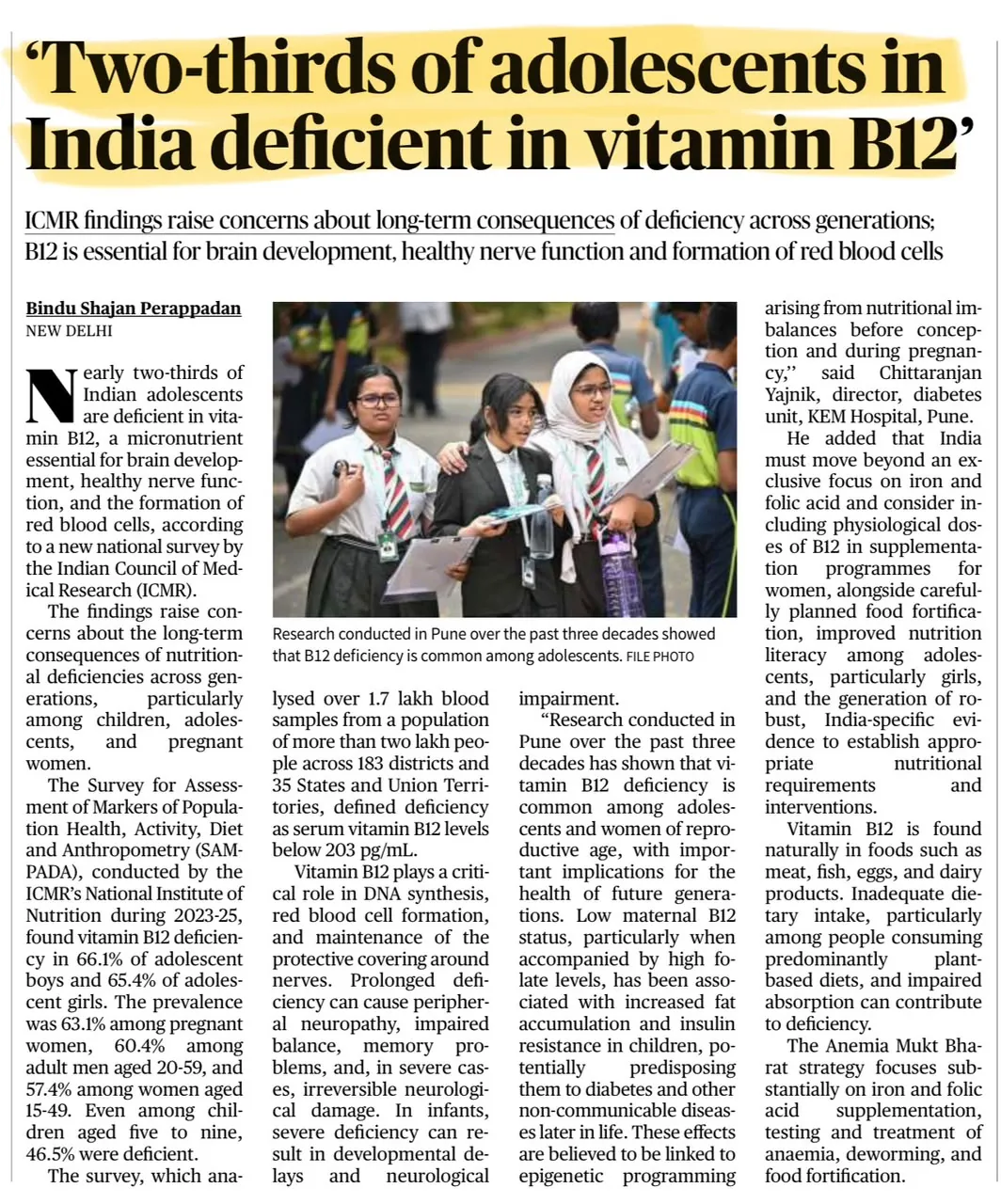
Two-thirds of adolescents in India deficient in vitamin B12 – ICMR SAMPADA survey findings (The Hindu)
Two-thirds of adolescents in India deficient in vitamin B12. Source: The Hindu

Key Findings – SAMPADA Survey

Survey
Survey for Assessment of Markers of Population Health, Activity, Diet and Anthropometry by ICMR–National Institute of Nutrition.
Adolescents
66.1% boys and 65.4% girls are deficient.
Other groups
Pregnant women 63.1%, adult men 60.4%, women 15–49 57.4%, children 5–9 46.5%.
Scale
Over 1.7 lakh blood samples from 183 districts in 35 States/UTs.
Cut-off
Deficiency defined as serum B12 below 203 pg/mL.

Why Vitamin B12 Matters

Brain
Supports brain development, memory and cognition.
Nerves
Maintains the myelin sheath; deficiency causes neuropathy and poor balance.
Blood
Needed for DNA synthesis and red blood cells; deficiency causes megaloblastic anaemia.
Infants
Severe deficiency can cause developmental delays and lasting neurological damage.

Causes and Intergenerational Impact

Diet
B12 comes naturally from meat, fish, eggs and dairy, so plant-based diets are at higher risk.
Absorption
Gut conditions can reduce absorption even when intake is adequate.
Mothers to children
Low maternal B12 with high folate is linked to fat accumulation and insulin resistance in children.
Long-term risk
This epigenetic programming raises later risk of diabetes and other NCDs.

Policy Gap and Way Forward

Current focus
Anaemia Mukt Bharat centres on iron–folic acid, testing, deworming and fortification.
Gap
B12 gets little attention, while extra folate without B12 may worsen metabolic risk.
Supplementation
Add physiological doses of B12 for women before and during pregnancy.
Fortification & awareness
Planned food fortification and nutrition literacy, especially for adolescent girls.
Evidence
Build India-specific nutrient requirements and guidelines.
Key Takeaway: India’s anaemia strategy has been iron-centric; hidden hunger like B12 deficiency needs equal attention because its damage carries into the next generation.

Prelims Practice MCQ

+2 correct • −0.66 wrong

Consider the following statements regarding Vitamin B12:
1. It is essential for DNA synthesis and the formation of red blood cells.
2. It is found naturally in significant amounts mainly in plant-based foods such as pulses and leafy vegetables.
3. Its deficiency can damage the myelin sheath around nerves.
Which of the statements given above are correct?

Explanation: B12 is needed for DNA synthesis, red blood cells and the myelin sheath. It occurs naturally in animal foods – meat, fish, eggs and dairy – which is why vegetarian diets carry a higher risk of deficiency.

UPSC Mains Question

GS2 • 15 Marks • 250 Words

Micronutrient deficiencies such as Vitamin B12 represent India’s ‘hidden hunger’. Discuss their intergenerational consequences and suggest changes to existing nutrition programmes.

Attempt before opening the value-addition tab.
Accepted: JPG, JPEG, PNG, WEBP or PDF. The standalone file previews your answer locally; connect the API hook for real server submission.
Use after attempting the Mains answer
  • Schemes — Anaemia Mukt Bharat (6×6×6 strategy), POSHAN Abhiyaan, fortified rice under PDS.
  • Data — NFHS-5: 57% women and 67% children (6–59 months) anaemic.
  • Concepts — hidden hunger, triple burden of malnutrition, first 1,000 days, epigenetics.
  • Keywords — nutrition literacy, life-cycle approach, maternal nutrition.
NEWS 3 GS3 • Agriculture, Food Security and Crop Diversification Source: The Hindu

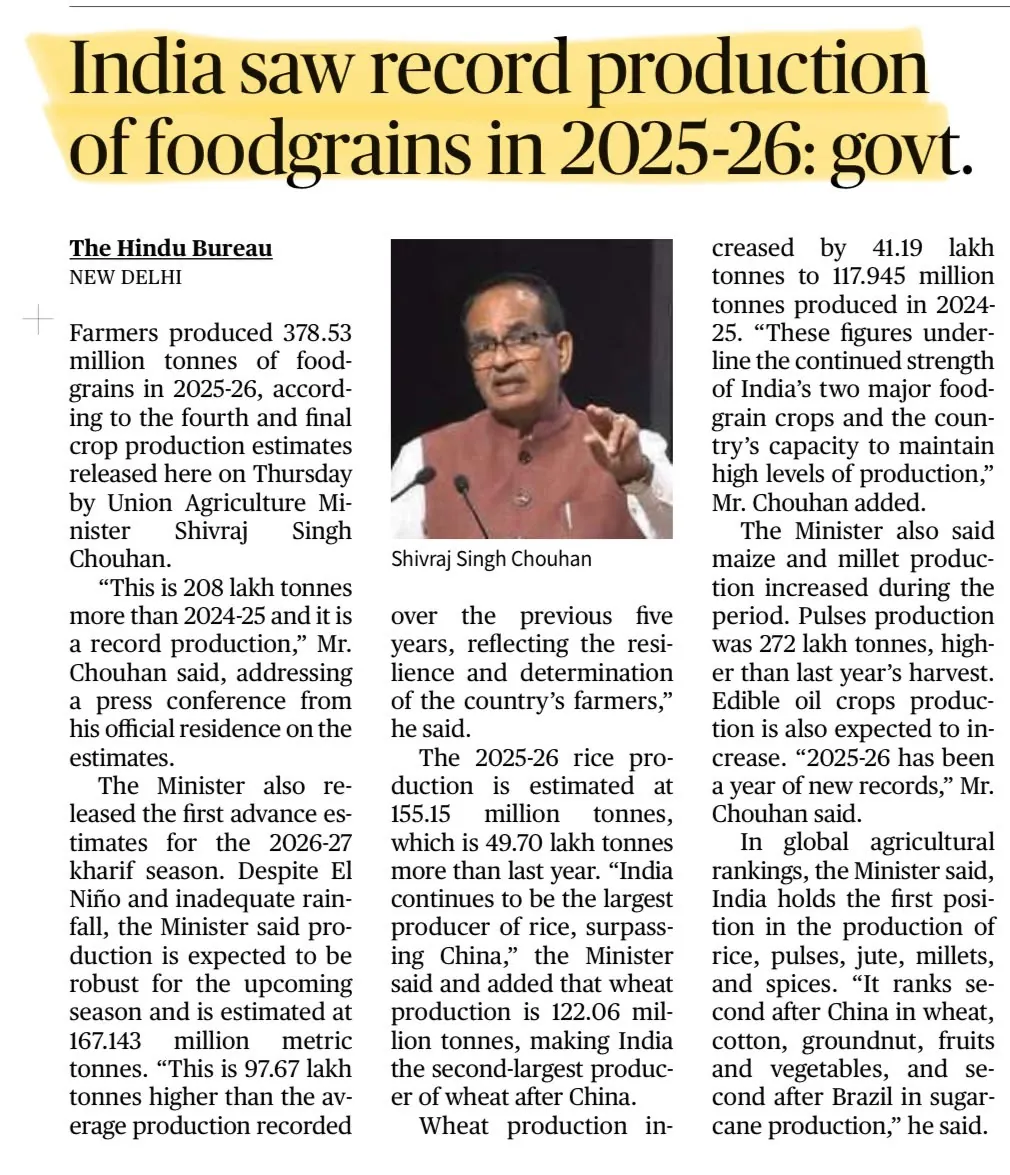
India Records Highest-Ever Foodgrain Production in 2025–26

Context: The fourth and final estimates released by the Agriculture Ministry put 2025–26 foodgrain output at a record 378.53 million tonnes, about 20.8 million tonnes (208 lakh tonnes) more than 2024–25.

India saw record production of foodgrains in 2025-26: 378.53 million tonnes – Shivraj Singh Chouhan (The Hindu)
India saw record production of foodgrains in 2025-26. Source: The Hindu

Crop-wise Output (2024–25 → 2025–26, million tonnes)

Rice
150.18 → 155.15 (+4.97); India stays the largest producer, ahead of China.
Wheat
117.95 → 122.06 (+4.12); second after China.
Maize
43.41 → 55.03 – the biggest jump (+11.62).
Pulses
25.68 → 27.24, above last year.
Oilseeds
42.99 → 43.26; record groundnut (13.17) and rapeseed-mustard (13.77).

Kharif 2026–27: First Advance Estimates

Foodgrains
167.14 MT, about 9.77 MT above the previous five-year average.
Major crops
Rice 121.91 MT, maize 26.06 MT, pulses 7.13 MT, oilseeds 23.95 MT.
Weather risk
Estimate holds despite El Niño and below-normal rainfall.

Regional Challenges

Dry spell
Maharashtra, Karnataka, Telangana and Andhra Pradesh faced drought-like conditions.
Rainfall
June rainfall reportedly 35–40% below normal.
Sowing hit
Paddy, maize, tur, soybean and cotton sowing was delayed.

Significance

Food security
Stronger buffer for PDS and PMGKAY.
Diversification
Maize, pulses and millets show a shift beyond rice and wheat.
Self-reliance
Higher pulses and oilseeds cut import dependence.
Global rank
India is first in rice, pulses, jute, millets and spices.

Government Initiatives

Pulses
Mission for Aatmanirbharta in Pulses – raising domestic output.
Edible oils
National Mission on Edible Oils – Oilseeds – cutting imports.
Data
Digital Crop Survey – better crop data and estimates.
Key Takeaway: Record output shows resilience, but water stress, El Niño and import-heavy edible oils mean the next goal is diversified, climate-resilient production, not just more rice and wheat.

Prelims Practice MCQ

+2 correct • −0.66 wrong

With reference to India’s agricultural production, consider the following statements:
1. India is the largest producer of rice in the world.
2. India is the largest producer of wheat in the world.
3. India ranks first in the production of pulses and millets.
Which of the statements given above are correct?

Explanation: As per the Agriculture Minister, India is first in rice, pulses, jute, millets and spices, but second after China in wheat, cotton, groundnut, fruits and vegetables.

UPSC Mains Question

GS3 • 15 Marks • 250 Words

Record foodgrain production has not removed India’s dependence on edible oil imports. Analyse the reasons and suggest measures for crop diversification towards pulses and oilseeds.

Attempt before opening the value-addition tab.
Accepted: JPG, JPEG, PNG, WEBP or PDF. The standalone file previews your answer locally; connect the API hook for real server submission.
Use after attempting the Mains answer
  • Data — 378.53 MT foodgrains (2025–26); maize +11.62 MT; record groundnut and mustard.
  • Schemes — NMEO-Oilseeds, pulses self-reliance mission, PM-KISAN, PMFBY, Digital Crop Survey.
  • Concepts — advance estimates, crop diversification, El Niño impact, buffer stock.
  • Keywords — climate-resilient seeds, Atmanirbharta in pulses, nutritional security.
NEWS 4 GS3 • Internal Security – Border Management and Infrastructure Source: The Hindu

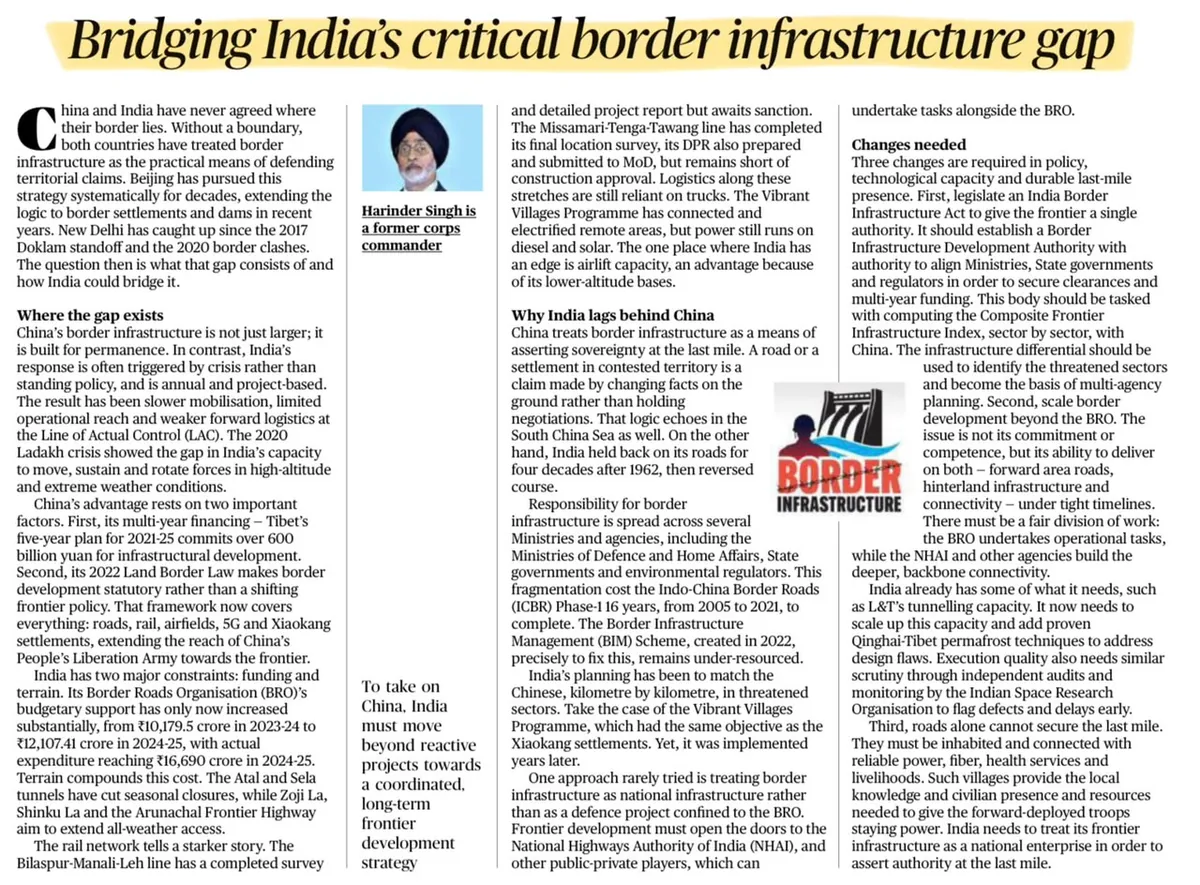
Bridging India’s Critical Border Infrastructure Gap with China

Context: India’s border infrastructure along the Line of Actual Control (LAC) still trails China’s, slowing troop mobilisation and weakening last-mile presence. The article argues for a long-term, coordinated frontier strategy.

Bridging India’s critical border infrastructure gap – India vs China at the LAC (The Hindu, Harinder Singh)
Bridging India’s critical border infrastructure gap. Source: The Hindu

Where the Gap Lies

China’s approach
Built for permanence – roads, rail, airfields, 5G and Xiaokang settlements.
China’s backing
Tibet’s 2021–25 plan committed 600+ billion yuan; the 2022 Land Border Law made it statutory.
India’s approach
Often reactive and project-based, picking up only after Doklam (2017) and Galwan (2020).
Result
Slower mobilisation, limited reach and weaker forward logistics.

India’s Constraints

Funding
BRO budget rose from ₹10,179.5 crore (2023–24) to ₹12,107.41 crore (2024–25); spending reached ₹16,690 crore.
Terrain
High altitude and seasonal closures – even near the Atal and Sela tunnels.
Rail
Bilaspur–Manali–Leh and Missamari–Tenga–Tawang lines have surveys/DPRs but await sanction.
Fragmentation
Many agencies: ICBR Phase-I took 16 years (2005–2021).
Last mile
Electrified villages still run on diesel and solar; logistics depend on trucks.

India’s Edge and Initiatives

Airlift
India’s lower-altitude bases give it an airlift advantage.
BRO
Builds strategic roads, bridges and tunnels.
Vibrant Villages Programme
Connectivity and livelihoods in border villages – India’s answer to Xiaokang, but started years later.
BIM Scheme (2022)
Border Infrastructure Management Scheme, still under-resourced.

Reforms Suggested

Law & authority
An India Border Infrastructure Act and a Border Infrastructure Development Authority.
Index
A Composite Frontier Infrastructure Index to compare with China sector by sector.
Beyond BRO
BRO for operational roads; NHAI and private players for backbone connectivity.
Technology
Permafrost techniques, L&T’s tunnelling capacity, ISRO-based monitoring and independent audits.
Inhabited frontier
Roads plus power, fibre, health and livelihoods so villages stay populated.
Key Takeaway: At the frontier, infrastructure is sovereignty; India must move from crisis-driven projects to a single, long-term national mission for the last mile.

Prelims Practice MCQ

+2 correct • −0.66 wrong

With reference to the Vibrant Villages Programme, consider the following statements:
1. It aims to develop villages along India’s northern land border.
2. It is implemented exclusively by the Border Roads Organisation.
3. It seeks to check out-migration and improve livelihoods in border villages.
Which of the statements given above are correct?

Explanation: The Vibrant Villages Programme (2023), a Centrally Sponsored Scheme under the Ministry of Home Affairs, develops villages along the northern border to improve infrastructure and livelihoods and check out-migration. It is not run only by BRO.

UPSC Mains Question

GS3 • 15 Marks • 250 Words

India’s border infrastructure policy has been reactive rather than strategic. Examine the gaps vis-à-vis China along the LAC and suggest institutional reforms for last-mile frontier development.

Attempt before opening the value-addition tab.
Accepted: JPG, JPEG, PNG, WEBP or PDF. The standalone file previews your answer locally; connect the API hook for real server submission.
Use after attempting the Mains answer
  • Projects — Atal, Sela and Shinku La tunnels; Arunachal Frontier Highway; ICBR; DS-DBO road.
  • Institutions — BRO (MoD), NHIDCL, ITBP, Vibrant Villages Programme (MHA).
  • Concepts — salami slicing, Xiaokang villages, dual-use infrastructure, last-mile connectivity.
  • Keywords — Land Border Law 2022, frontier as national enterprise, whole-of-government approach.
NEWS 5 GS1 • Ancient Indian History | GS2 • Democracy and Governance Source: The Indian Express

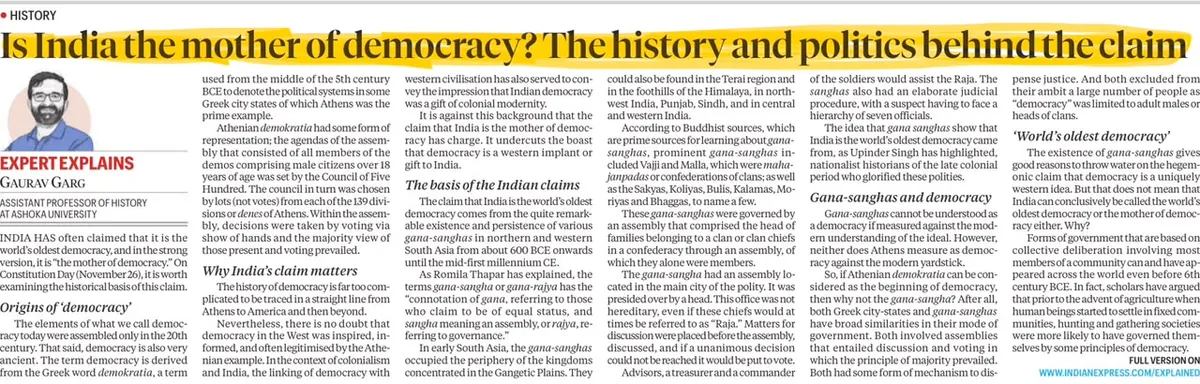
Is India the Mother of Democracy? History and Politics Behind the Claim

Context: On Constitution Day (26 November), historians revisited India’s claim to be the ‘Mother of Democracy’. The claim rests on the gana-sanghas – assembly-based polities found from around 600 BCE.

Is India the mother of democracy? The history and politics behind the claim – gana-sanghas vs Athens (The Indian Express Explained)
Is India the mother of democracy? Source: The Indian Express

Athenian Democracy (5th century BCE)

Meaning
Demokratia = demos (people) + kratos (rule).
Assembly
Open to male citizens above 18; decisions by show of hands and majority.
Council of 500
Chosen by lot from the 139 demes; set the assembly’s agenda.
Limit
Women, slaves and foreigners were excluded.

Gana-Sanghas of Ancient India

Meaning
Gana = people claiming equal status; sangha = assembly.
Period
About 600 BCE to the mid-first millennium CE.
Spread
Periphery of the Gangetic kingdoms, Terai, Himalayan foothills, Punjab, Sindh, central and western India.
Examples
Vajji and Malla (mahajanapadas), Sakyas, Koliyas, Bulis, Kalamas, Moriyas, Bhaggas.
Sources
Mainly Buddhist texts.

How Gana-Sanghas Worked

Assembly
Heads of families or clan chiefs met in the main city.
Leader
Presided over by a chief, sometimes called Raja; the office was not hereditary.
Decisions
Discussion aimed at unanimity; if that failed, matters went to a vote.
Officials
Advisors, a treasurer and a commander assisted the Raja.
Justice
An elaborate procedure with a hierarchy of seven officials.

Were They Democracies?

Similarities with Athens
Assemblies, deliberation, voting and majority rule.
Limits
Participation was narrow – adult males or clan heads only.
Better label
Closer to republics or oligarchies than modern democracy.
Historians’ view
Collective deliberation existed in many early societies, even before settled agriculture.
Key Takeaway: Gana-sanghas prove India had indigenous traditions of republican deliberation, but they do not by themselves make India the world’s oldest or only cradle of democracy.

Prelims Practice MCQ

+2 correct • −0.66 wrong

With reference to the gana-sanghas of ancient India, consider the following statements:
1. The position of the chief or Raja was always hereditary.
2. Matters were discussed in an assembly and put to vote if consensus failed.
3. Buddhist texts are a major source of information about them.
Which of the statements given above are correct?

Explanation: In gana-sanghas the chief, even when called Raja, was not a hereditary office. The assembly preferred unanimity and voted when it could not agree. Buddhist sources are the prime source on them.

UPSC Mains Question

GS1 • 15 Marks • 250 Words

Do the gana-sanghas of ancient India justify the claim that India is the ‘Mother of Democracy’? Critically examine.

Attempt before opening the value-addition tab.
Accepted: JPG, JPEG, PNG, WEBP or PDF. The standalone file previews your answer locally; connect the API hook for real server submission.
Use after attempting the Mains answer
  • Examples — Vajji (Licchavis) of Vaishali, Mallas, Sakyas (Buddha’s clan); Uttaramerur inscriptions (Chola local self-government).
  • Thinkers — Romila Thapar on gana-sangha; Upinder Singh on nationalist historiography.
  • Concepts — republic vs democracy, oligarchy, universal adult franchise.
  • Keywords — deliberative tradition, Sabha and Samiti, Constitution Day (26 November).
NEWS 6 GS3 • Science & Technology – Semiconductors and AI Source: The Hindu

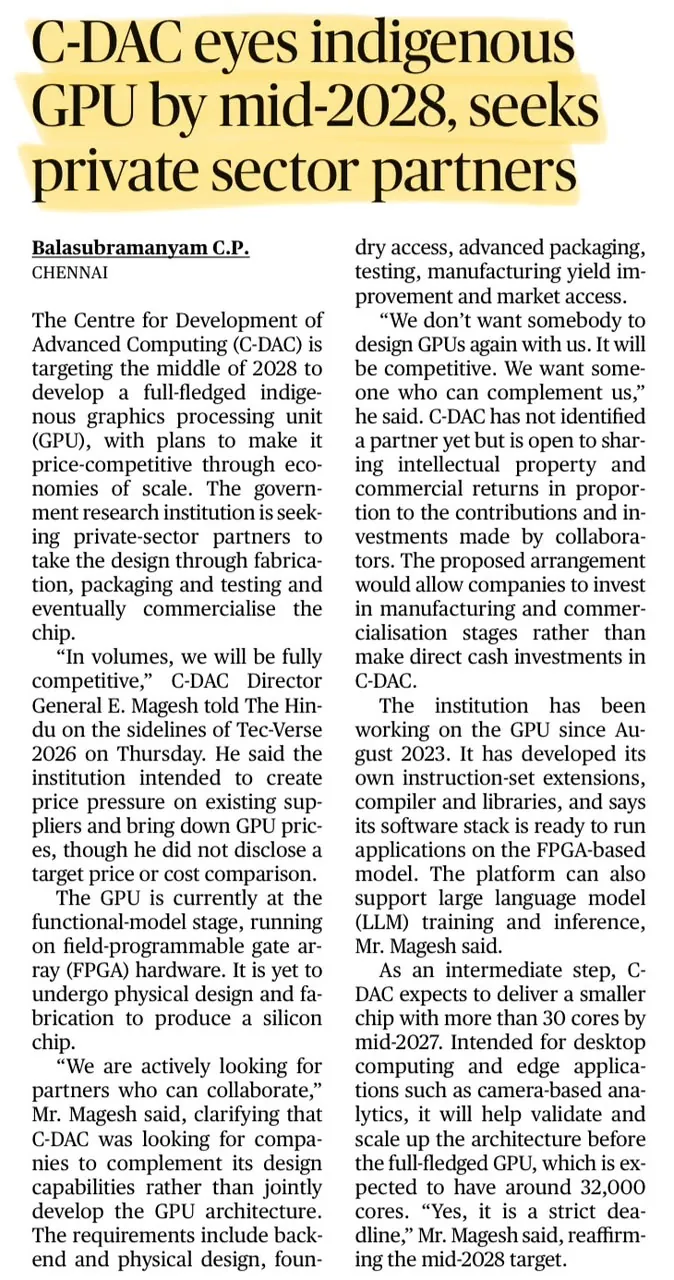
C-DAC Targets Indigenous GPU by Mid-2028, Seeks Private Partners

Context: The Centre for Development of Advanced Computing (C-DAC) aims to build a fully indigenous Graphics Processing Unit (GPU) by mid-2028 and is seeking private-sector partners to take it from design to commercial chip.

C-DAC eyes indigenous GPU by mid-2028, seeks private sector partners (The Hindu)
C-DAC eyes indigenous GPU by mid-2028. Source: The Hindu

The Project

Target
Full GPU with about 32,000 cores by mid-2028.
Milestone
A smaller chip with 30+ cores by mid-2027 for desktop and edge uses like camera analytics.
Current stage
Functional model running on FPGA hardware; physical design and fabrication pending.
Started
Work began in August 2023; own instruction-set extensions, compiler and libraries ready.
AI ready
Platform can support LLM training and inference.

Key Concepts

CPU
General-purpose processor for sequential, varied tasks.
GPU
Thousands of cores for parallel processing – graphics and AI.
FPGA
Reprogrammable chip used to test and validate designs before fabrication.
LLM
Large Language Model; needs massive compute for training and inference.

Partnership Model

What C-DAC needs
Back-end and physical design, foundry access, advanced packaging, testing and market access.
Terms
IP and returns shared in proportion to contribution; partners invest in manufacturing, not cash to C-DAC.
Goal
Price pressure on existing suppliers to bring down GPU costs.

Significance and Challenges

Self-reliance
Cuts dependence on foreign GPU suppliers for AI compute.
IndiaAI link
Supports domestic compute for the IndiaAI Mission and sovereign AI models.
Challenges
Access to advanced fabs, yield, packaging, high R&D cost and a mature software ecosystem.
Remember
DHRUV64 is a separate indigenous 64-bit dual-core microprocessor under the DIR-V programme – not this GPU.
Key Takeaway: Compute is the new strategic resource; an indigenous GPU matters only if India also secures fabrication, packaging and a software ecosystem around it.

Prelims Practice MCQ

+2 correct • −0.66 wrong

Which one of the following best describes a Field-Programmable Gate Array (FPGA)?

Explanation: An FPGA can be reprogrammed after manufacturing, which is why chip designers like C-DAC use it to test and validate a design (here, the GPU) before committing it to silicon. A chip hard-wired for one task is an ASIC.

UPSC Mains Question

GS3 • 15 Marks • 250 Words

Access to advanced computing hardware has become a strategic necessity. Discuss the significance of India developing indigenous GPUs and the challenges in building a domestic semiconductor ecosystem.

Attempt before opening the value-addition tab.
Accepted: JPG, JPEG, PNG, WEBP or PDF. The standalone file previews your answer locally; connect the API hook for real server submission.
Use after attempting the Mains answer
  • Missions — India Semiconductor Mission, IndiaAI Mission (GPU compute portal), DIR-V, National Supercomputing Mission.
  • Indigenous chips — SHAKTI, VEGA, DHRUV64 (RISC-V based).
  • Concepts — ASIC vs FPGA, parallel computing, fabless design, OSAT, chip yield.
  • Keywords — sovereign compute, techno-nationalism, design-led manufacturing.

Copyright © 2026 USARAMBHA EDUCATION (UnderStand UPSC). All Rights Reserved.

MAD-X for UPSC Prelims 2027 – Batch 3 starts 7th December 2026
Batch 3 · Starts 7th Dec 2026

MAD-X for UPSC Prelims 2027

Online & Offline · Fee details + free counselling

Preferred Medium

🔒 Your details are kept confidential.

Call Now · 83770 72252