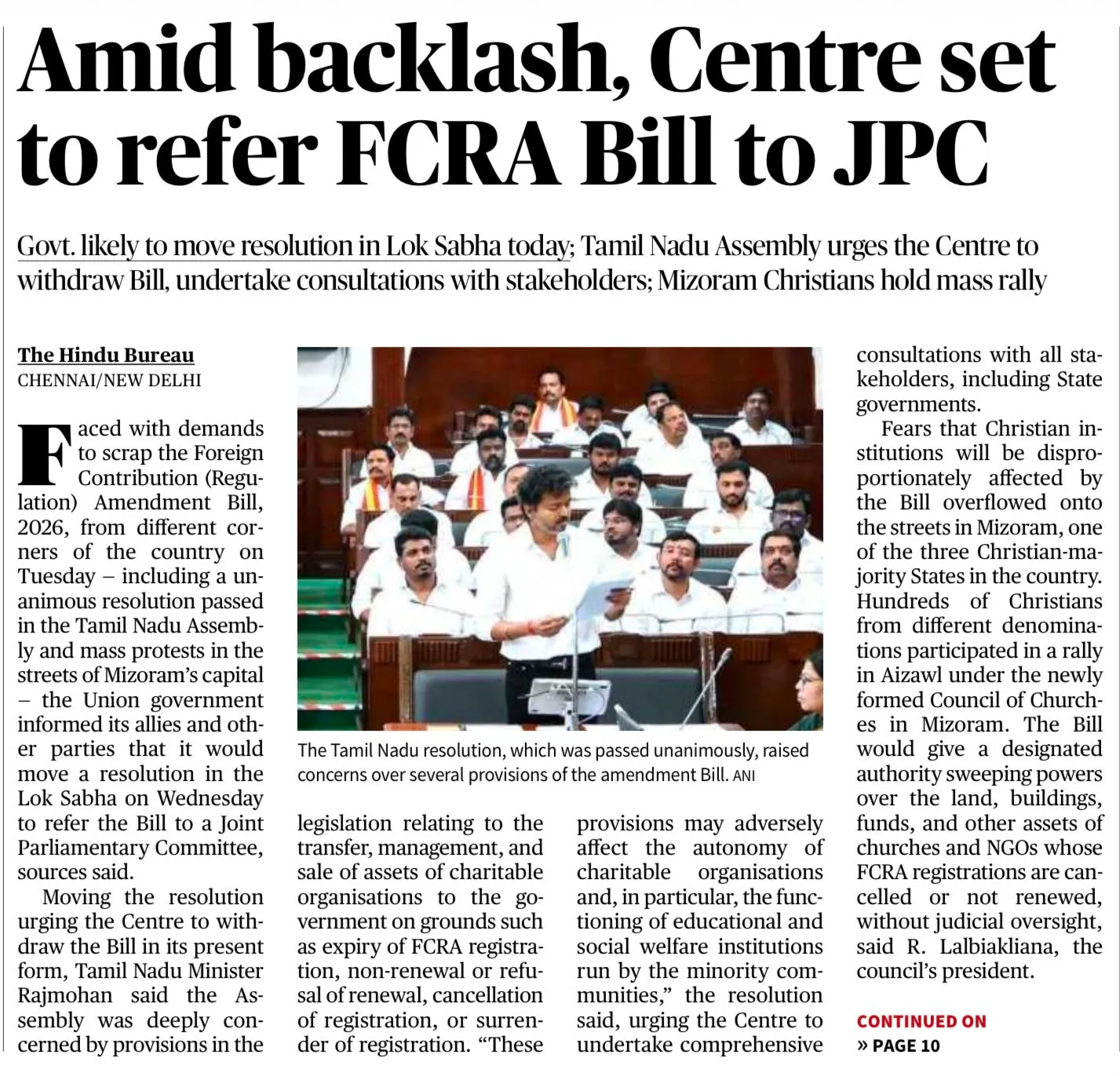
Context: FCRA Amendment Bill 2026
The Foreign Contribution (Regulation) Amendment Bill, 2026, introduced in Lok Sabha on 25 March 2026, has faced Opposition objections over its asset-vesting provisions.
The Government is now considering referring it to a Joint Parliamentary Committee for detailed scrutiny and wider consensus.
Concerns Raised by the Opposition
Asset Vesting
Opposition parties and civil-society or Christian organisations are concerned that assets created partly or wholly through foreign contributions could come under government control when FCRA registration ends.
Mixed Funding
Where an institution uses both foreign and domestic donations, critics fear that the entire asset could be affected even though only part was created from foreign funds.
Civil-Society Space
Concerns have been raised that wider government powers could adversely affect:
- Non-Governmental Organisations
- Schools
- Hospitals
- Charitable institutions dependent on foreign contributions
Due Process
Concerns also centre on the consequences of non-renewal of FCRA registration, particularly safeguards available to organisations against such decisions.
Joint Parliamentary Committee
Nature
A Joint Parliamentary Committee is an ad hoc parliamentary committee.
It is not a permanent committee.
It is created for a specific Bill or issue and dissolves after submitting its report.
Composition
Members are drawn from both Lok Sabha and Rajya Sabha.
The composition broadly reflects the strength of political parties.
Function
A JPC undertakes detailed scrutiny.
It examines stakeholders and evidence.
It submits recommendations to Parliament.
Recommendation
The report of a JPC is not binding.
Parliament takes the final decision.
Key Takeaway
The FCRA Amendment Bill, 2026 raises concerns over asset vesting, mixed funding, civil-society space and due process. Referring it to a JPC can allow detailed scrutiny, stakeholder consultation and wider consensus.