Context: FCRA Amendment Bill 2026
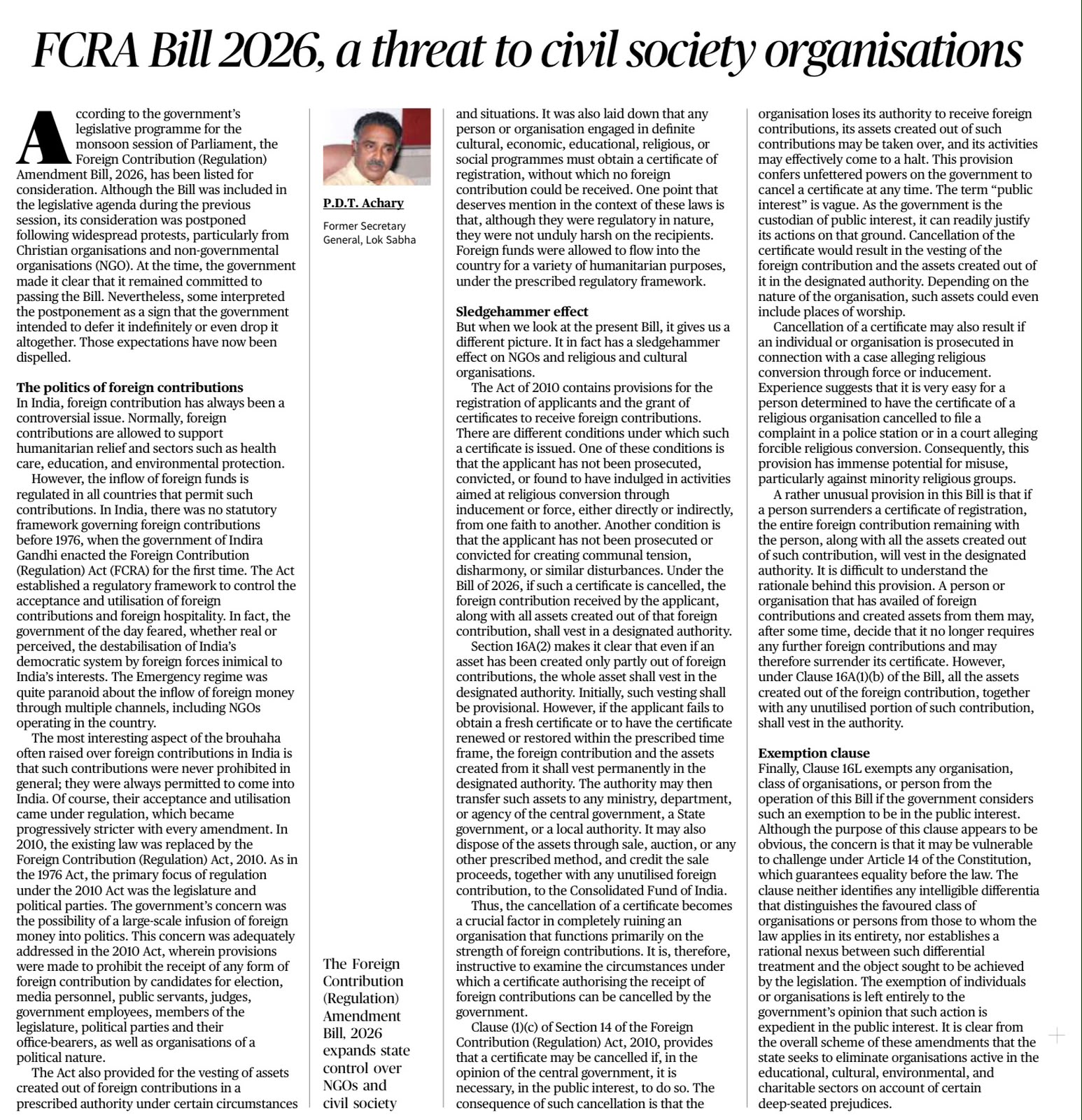
The Foreign Contribution Regulation Amendment Bill, 2026 has been listed for consideration in Parliament.
The Bill seeks to amend the Foreign Contribution Regulation Act, 2010 by expanding government control over NGOs receiving foreign funds. This has raised concerns about the autonomy of civil society organisations.
Why FCRA Was Enacted
FCRA was enacted to regulate the acceptance and use of foreign contributions.
The aim is to ensure that foreign funds do not adversely affect India’s:
- Sovereignty
- Integrity
- Security
- Public interest
- Democratic processes
India first enacted FCRA in 1976.
It was later replaced by the Foreign Contribution Regulation Act, 2010.
FCRA 2010: Basic Features
FCRA is administered by the Ministry of Home Affairs.
Any NGO or organisation that wants to receive foreign contributions must obtain either registration or prior permission.
Registration is generally valid for five years and must be renewed.
The Act prohibits foreign contributions to:
- Election candidates
- Legislators
- Political parties
- Judges
- Government servants
- Certain public functionaries
It also provides for suspension or cancellation of registration in specified cases.
Major Changes Proposed in FCRA Amendment Bill 2026
The Bill proposes that assets created from foreign contributions may vest in a designated government authority if an organisation’s registration is:
- Cancelled
- Expired
- Not renewed
- Voluntarily surrendered
It expands the government’s power to cancel registration in the public interest.
However, the term “public interest” is not clearly defined.
The Bill also empowers the government to exempt any individual or organisation from the Act if it considers such exemption to be in public interest.
Concerns
The Bill may increase executive discretion over NGOs and civil society organisations.
The undefined phrase “public interest” may allow arbitrary cancellation of registrations.
Vesting NGO assets in the government may discourage charitable and humanitarian work.
The exemption clause may be challenged under Article 14 because it may lack clear and objective criteria.
It may disproportionately affect NGOs working in:
- Education
- Health
- Environment
- Religion
- Social welfare
Governance Angle
The issue reflects the tension between regulation and civil society autonomy.
The government has a legitimate interest in ensuring that foreign funds are not misused.
But excessive control can weaken democratic participation, humanitarian work and independent civil society action.
Key Takeaway
FCRA regulation is necessary for transparency and national interest, but the 2026 Bill raises concerns because it may expand executive control over NGOs without enough safeguards against arbitrary action.