Source: Indian Express | Tags: 20 June 2026, Constitutional Amendments, Fundamental Rights, GS2, Judicial Review, Parliament–Judiciary Relations, Polity & Constitution
Context: First Constitutional Amendment Act 1951
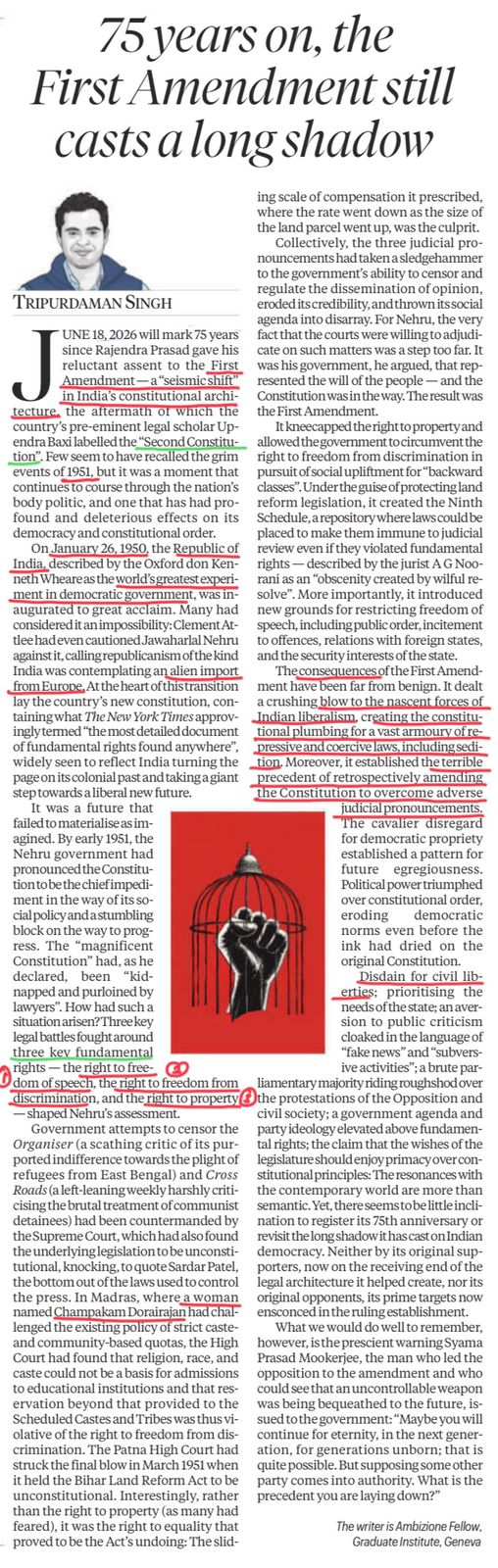
The First Constitutional Amendment Act was enacted on 18 June 1951. It was Parliament’s response to early Supreme Court judgments on free speech, reservations and land reforms.
Upendra Baxi described it as India’s “Second Constitution” because of its transformative impact.
Key Triggers and Constitutional Response
1. Freedom of Speech — Article 19(1)(a)
Cases
Response
Article 19(2) was amended.
Grounds Added
- Public Order
- Friendly Relations with Foreign States
- Incitement to an Offence
2. Reservations and Equality — Article 15
Case
Response
Article 15(4) was inserted.
Outcome
It created a constitutional basis for reservations for:
- Socially and Educationally Backward Classes
- Scheduled Castes
- Scheduled Tribes
3. Land Reforms and Right to Property — Article 31
Issue
Zamindari abolition and agrarian reforms were challenged before courts.
Response
Inserted:
- Article 31A
- Article 31B
- Ninth Schedule
Outcome
Land reform laws were protected from judicial challenge.
Why the First Amendment Is Still Debated
Supporters’ Argument
- Protected land reforms and abolition of zamindari.
- Enabled affirmative action through Article 15(4).
- Strengthened the welfare-state vision.
- Supported socio-economic transformation.
- Ensured judicial interpretation did not obstruct democratic reforms.
Critics’ Argument
- Expanded State power over civil liberties through Article 19(2).
- Introduced the Ninth Schedule, reducing judicial scrutiny.
- Set a precedent for constitutional amendments to overcome court rulings.
- Raised concerns about constitutional checks and balances.
Constitutional Voices
Jawaharlal Nehru
- Constitution should serve as an instrument of social transformation and not become an obstacle to reform.
Syama Prasad Mookerjee
- Excessive concentration of State power may undermine democratic freedoms and individual liberty.
Upendra Baxi
- Described the First Constitutional Amendment as India’s “Second Constitution” because it fundamentally altered the constitutional balance.
A.G. Noorani
- Criticised the Ninth Schedule for insulating laws from constitutional scrutiny and weakening judicial review.