
Future of the Quad: Challenges and India’s Role Explained

Context: Future of the Quad
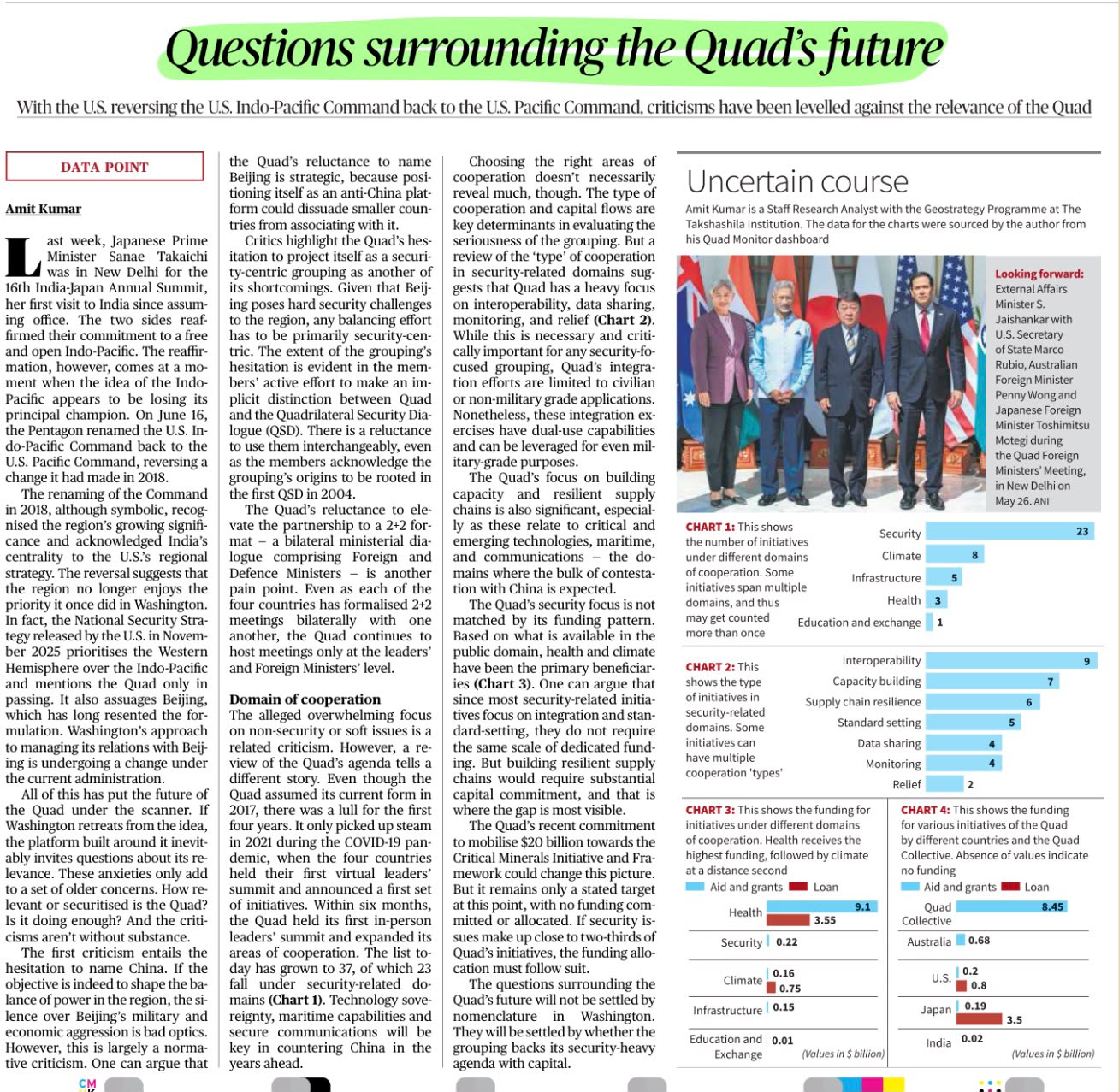
The article discusses uncertainty around the future of the Quad due to shifting U.S. priorities, questions over institutional depth and concerns about whether the grouping can deliver concrete outcomes in the Indo-Pacific.

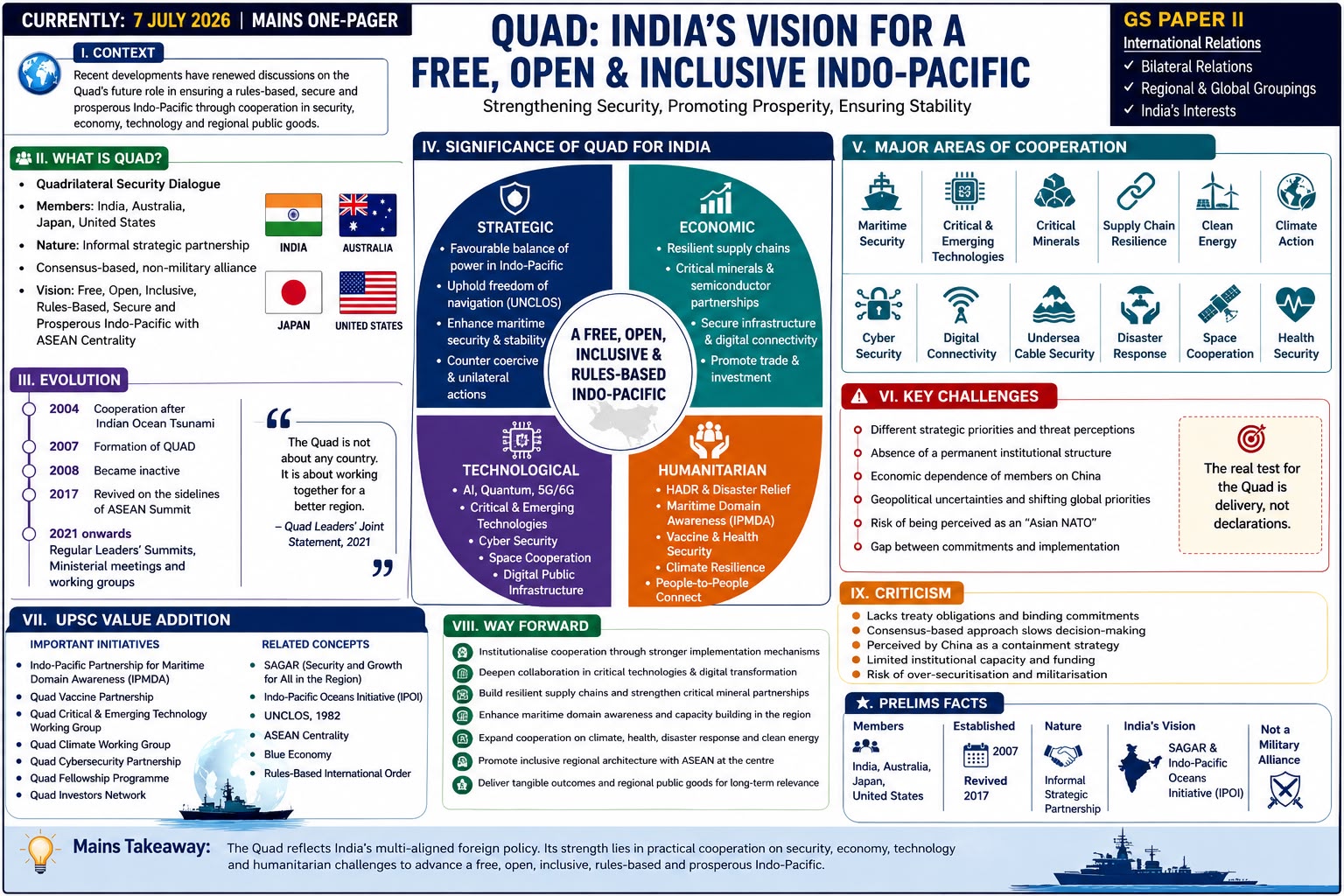
Quad

Full Form

  • Quadrilateral Security Dialogue

Members

  • India
  • United States
  • Japan
  • Australia

Core Vision

A free, open, inclusive and rules-based Indo-Pacific.

Evolution

  • 2004: Cooperation after Indian Ocean Tsunami.
  • 2007: Formation of Quad.
  • 2017: Revival on the sidelines of ASEAN Summit.
  • 2021 onwards: Regular leaders’ summits, ministerial meetings and working groups.

Why Quad Matters for India

1. Strategic Balancing

Quad helps India balance China’s assertiveness in the Indo-Pacific.

2. Maritime Security

Supports freedom of navigation and maritime domain awareness.

3. Economic Security

Can strengthen supply chains and reduce dependence on China.

4. Technology Cooperation

Important for:

  • Critical technologies
  • Semiconductors
  • Cybersecurity
  • Digital public infrastructure
  • Space cooperation

5. Humanitarian Assistance

Quad supports cooperation on:

  • Disaster relief
  • Health security
  • Climate resilience
  • Infrastructure

Major Areas of Cooperation

  • Maritime security
  • Critical and emerging technologies
  • Critical minerals
  • Supply-chain resilience
  • Clean energy
  • Climate action
  • Cybersecurity
  • Digital connectivity
  • Undersea cable security
  • Disaster response
  • Space cooperation
  • Health security

Key Challenges

1. Different Strategic Priorities

All members have different threat perceptions and regional priorities.

2. Lack of Formal Structure

Quad is not a treaty alliance and has no permanent secretariat.

3. China Factor

China sees Quad as an anti-China grouping.

4. Delivery Deficit

There are concerns that Quad announces many initiatives but implementation remains slow.

5. U.S. Policy Uncertainty

Changes in U.S. priorities can affect the grouping’s momentum.

6. India’s Strategic Autonomy

India supports Quad but avoids turning it into a military alliance.

Criticism

  • It lacks binding obligations.
  • It may duplicate other Indo-Pacific mechanisms.
  • It risks becoming overly security-focused.
  • It may not deliver enough public goods.

Way Forward

  • Build institutional continuity.
  • Focus on deliverables.
  • Strengthen maritime domain awareness.
  • Expand cooperation on resilient supply chains.
  • Deliver climate, health and digital public goods.
  • Avoid excessive militarisation.
  • Maintain ASEAN centrality.
  • Respect India’s strategic autonomy.

Key Takeaway

The Quad’s future depends on whether it can move from symbolism to delivery while maintaining flexibility, inclusiveness and strategic balance in the Indo-Pacific.
Subscribe
Notify of
guest
0 Comments
Oldest
Newest Most Voted

Future of the Quad: Challenges and India’s Role Explained

Got a question? We're here to help!

Our dedicated Student Support team is ready to assist you and guide you every step of the way.
Reach out to us, and let’s tackle your queries together!


About the UPSC Civil Services Examination (UPSC CSE)

The UPSC Civil Services Examination (CSE) is one of the most competitive and esteemed examinations in India, conducted by the Union Public Service Commission to recruit officers for services such as the Indian Administrative Service (IAS), Indian Police Service (IPS), Indian Foreign Service (IFS), and others. The exam comprises three stages — Prelims, Mains, and the Personality Test (Interview) — designed to test a candidate’s knowledge, aptitude, decision-making, and leadership skills.


How to Prepare Effectively for UPSC CSE

Cracking the UPSC CSE requires a deep understanding of the syllabus, consistent revision, structured answer writing, and smart test-taking strategies. The Prelims test analytical and conceptual clarity, the Mains focuses on critical thinking, articulation, and subject mastery, while the Interview assesses presence of mind, ethical judgment, and personality traits relevant to public service.

At UnderStand UPSC, we empower aspirants with a personalized and focused approach to each stage of the exam.


Why Choose UnderStand UPSC?

UnderStand UPSC is a mentorship-driven platform offering a clear, clutter-free strategy to tackle the Civil Services Examination. Our programs like Transform (for beginners and intermediate learners) and Conquer (for advanced mains preparation) provide structured study plans, syllabus-wise video content, interactive live sessions, and answer writing support.

We emphasize:

  • Concept clarity through topic-wise lectures

  • Test series designed around real UPSC standards

  • Personalized mentorship in small groups

  • Regular performance tracking and peer benchmarking

  • Doubt-clearing sessions, current affairs analysis, and monthly magazines


Join the UnderStand UPSC Learning Community

Our mission is to make UPSC preparation less overwhelming and more strategic. We combine mentorship, discipline, and academic rigor to help you clear CSE with confidence. Whether you’re preparing from Delhi, Mumbai, Bangalore, or a remote village — our online-first model ensures quality guidance reaches every corner of India.

Join the thousands of aspirants who trust UnderStand UPSC to guide their journey toward becoming civil servants.

Stay connected with us through our Telegram, YouTube, and Instagram channels for daily tips, strategies, and updates.

Copyright © 2026 USARAMBHA EDUCATION (UnderStand UPSC). All Rights Reserved.

Fill out the form for

Downloading the free Agriculture Short Notes


0
Would love your thoughts, please comment.x
()
x








