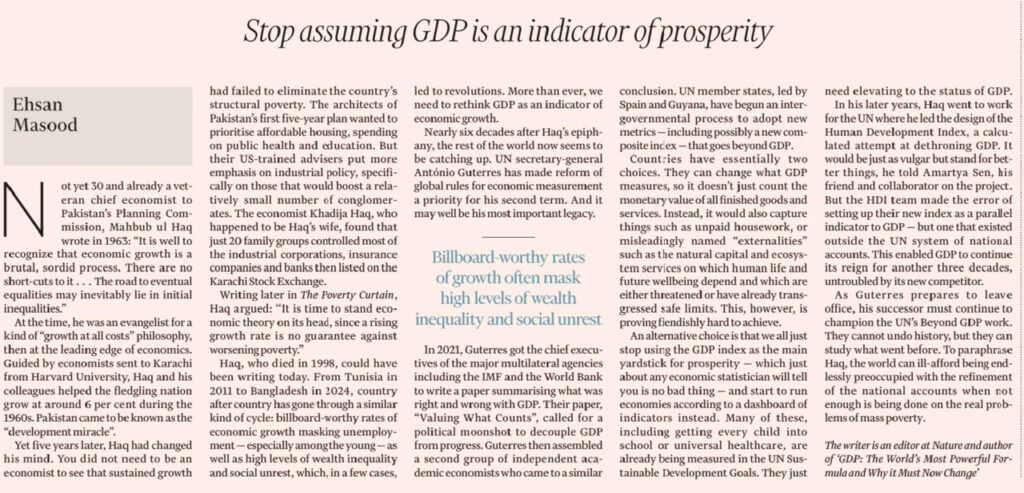
Context: GDP and prosperity limitations
High economic growth does not automatically translate into prosperity or better quality of life.
GDP measures economic output, but it does not fully capture people’s actual wellbeing, distribution of income, social progress or environmental sustainability.
Gross Domestic Product
Gross Domestic Product, or GDP, is the monetary value of all final goods and services produced within a country’s territory during a given period.
It measures the size and growth of an economy.
Limitation of GDP
GDP does not adequately reflect:
- Income distribution
- Poverty
- Health
- Education
- Unpaid household work
- Environmental sustainability
- Quality of life
- Overall wellbeing
Why GDP Alone Is Inadequate
Growth Does Not Always Mean Prosperity
A country can record high GDP growth and still face poverty, unemployment and social unrest.
The document gives Pakistan as an example, where growth has not automatically eliminated structural poverty.
GDP Does Not Show Distribution
GDP is an aggregate measure.
It does not show who benefits from economic growth.
A rising GDP can coexist with high income inequality and wealth concentration.
GDP Misses Social Wellbeing
GDP does not properly capture healthcare access, education quality, living standards and unpaid household or care work.
This means economic expansion may not automatically translate into human development.
GDP Ignores Environmental Costs
GDP can rise even when growth damages ecosystems or depletes natural resources.
Activities that increase output may also increase pollution, ecological degradation and climate risk.
Sustainable prosperity requires accounting for natural capital and environmental wellbeing.
Way Forward
GDP should be retained as a measure of economic activity.
But it should not be treated as the sole measure of prosperity.
Countries need a dashboard of indicators covering:
- Income distribution
- Health
- Education
- Employment
- Environment
- Wellbeing
Frameworks such as the Human Development Index and Sustainable Development Goals can complement GDP.
Key Takeaway
GDP is useful for measuring economic output, but it is not enough to measure prosperity. Real development must include equality, health, education, jobs, environment and wellbeing.