Context: ILO Convention 193 Gig Workers
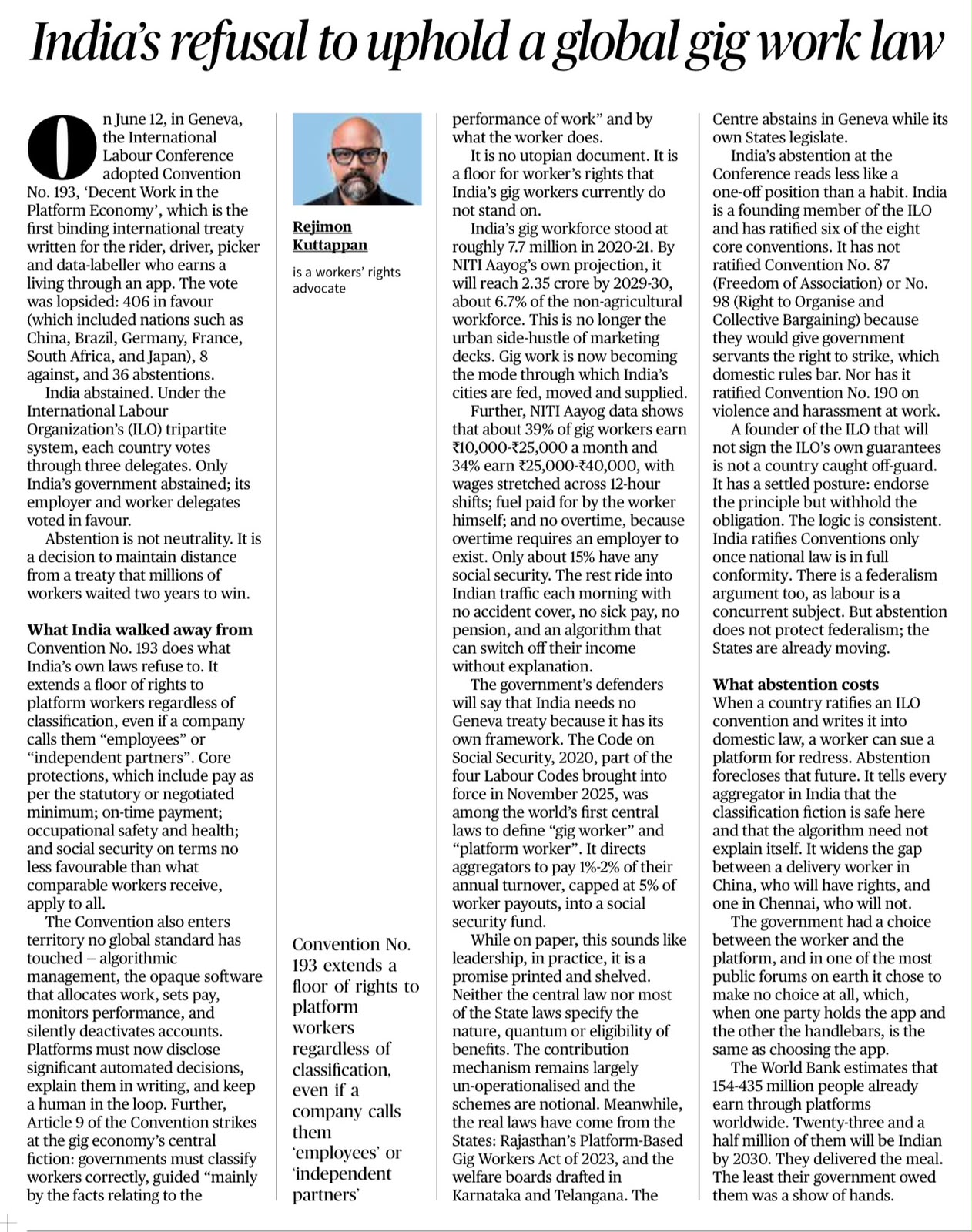
The International Labour Conference adopted ILO Convention No. 193 on Decent Work in the Platform Economy.
This is the first legally binding international treaty on gig and platform workers. India abstained from voting, raising questions about its approach to labour rights in the platform economy.
ILO Convention No. 193
ILO Convention No. 193 seeks to establish minimum labour rights for gig and platform workers.
It applies irrespective of whether workers are classified as employees or independent contractors.
This is important because platform companies often classify workers as independent partners, which limits access to labour protections.
Rights Covered
The Convention provides for:
- Fair remuneration
- Timely payment
- Occupational safety
- Social security
- Algorithmic transparency
- Protection against arbitrary deactivation
- Access to grievance redressal
Ratifying countries must align their domestic laws with the Convention.
India’s Position
India abstained from voting.
India argued that labour is a Concurrent List subject and domestic laws should be aligned before accepting international obligations.
India has already recognised gig workers and platform workers under the Code on Social Security, 2020.
The Code provides for social security schemes funded through contributions from platform aggregators.
Gaps in India’s Framework
Several welfare measures under the Code on Social Security are still not fully operational.
Some States have moved ahead separately.
For example, Rajasthan has enacted legislation for platform workers.
This shows that India’s gig-worker framework is still evolving.
Why Gig Work Matters
India’s gig workforce is large and growing.
Platform workers are now central to urban services such as:
- Food delivery
- Ride-hailing
- Logistics
- Home services
- E-commerce delivery
- On-demand work
However, many workers face insecure income, long working hours, algorithmic control and weak social protection.
Policy Challenge
India must balance three objectives:
- Labour protection
- Platform innovation
- Employment generation
Too much rigidity may affect platform growth.
Too little protection may leave workers vulnerable.
The challenge is to create a fair, flexible and enforceable framework.
Key Takeaway
India’s abstention shows the difficulty of regulating gig work. The future policy challenge is to protect platform workers without weakening innovation and employment opportunities.