Context:
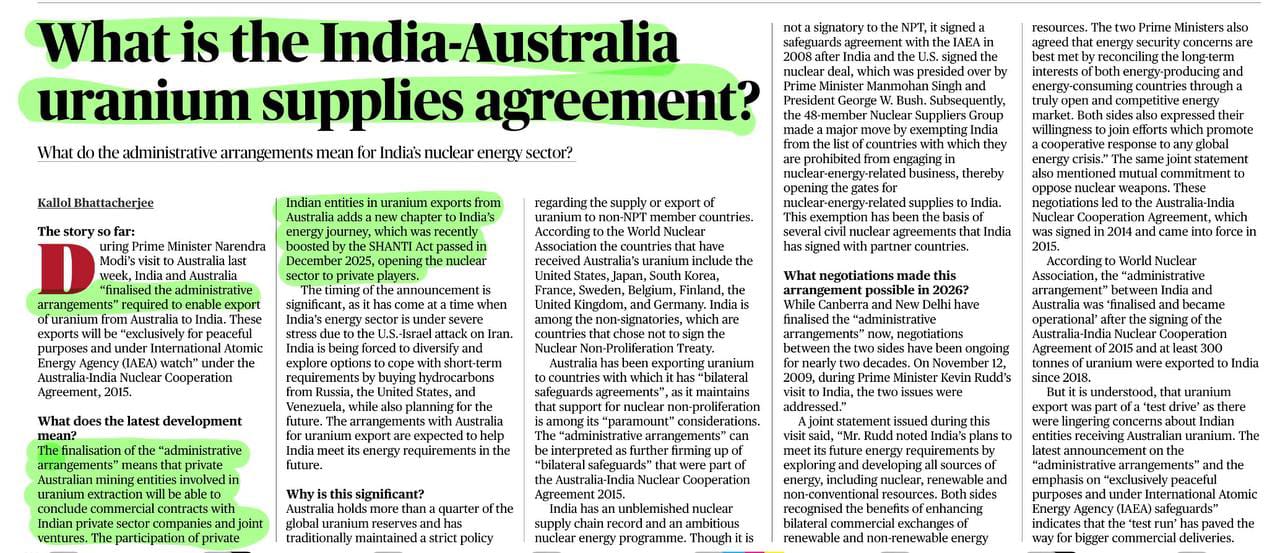
India and Australia have finalised administrative arrangements under the Australia–India Nuclear Cooperation Agreement, 2015, paving the way for commercial uranium exports from Australia to India for peaceful civilian nuclear use.
Australia–India Nuclear Cooperation Agreement
Signed
- 2014
Came Into Force
- 2015
Purpose
Allows Australia to export uranium to India exclusively for peaceful civilian nuclear purposes.
Safeguards
Exports will be under International Atomic Energy Agency safeguards.
NSG Waiver Link
The agreement builds on the Nuclear Suppliers Group waiver of 2008, which allowed civil nuclear commerce with India despite India not being a signatory to the Nuclear Non-Proliferation Treaty.
Administrative Arrangements, 2026
The new arrangements operationalise the 2015 agreement.
They provide procedures for:
- Commercial uranium exports.
- Export contracts by Australian private mining companies.
- Supply to Indian public and private entities.
- Tracking and accounting of uranium.
- End-use verification under IAEA safeguards.
Significance for India
1. Energy Security
Assured uranium supply supports India’s expanding nuclear power programme.
2. Clean Energy Transition
Nuclear energy provides low-carbon baseload power.
3. Private Participation
The arrangement coincides with the SHAKTI Act, 2025, which opens India’s civilian nuclear sector to greater private participation.
4. Strategic Partnership
Deepens India–Australia Comprehensive Strategic Partnership.
5. Critical Minerals and Clean Energy
Builds wider cooperation in:
- Uranium
- Critical minerals
- Clean energy
- Nuclear technology
International Atomic Energy Agency
Established
- 1957
Headquarters
- Vienna, Austria
Role
IAEA promotes safe, secure and peaceful use of nuclear energy.
It conducts safeguards and inspections to ensure civilian nuclear material is not diverted for military purposes.
Key Takeaway
The uranium supply arrangement strengthens India’s long-term clean energy security while deepening strategic cooperation with Australia.