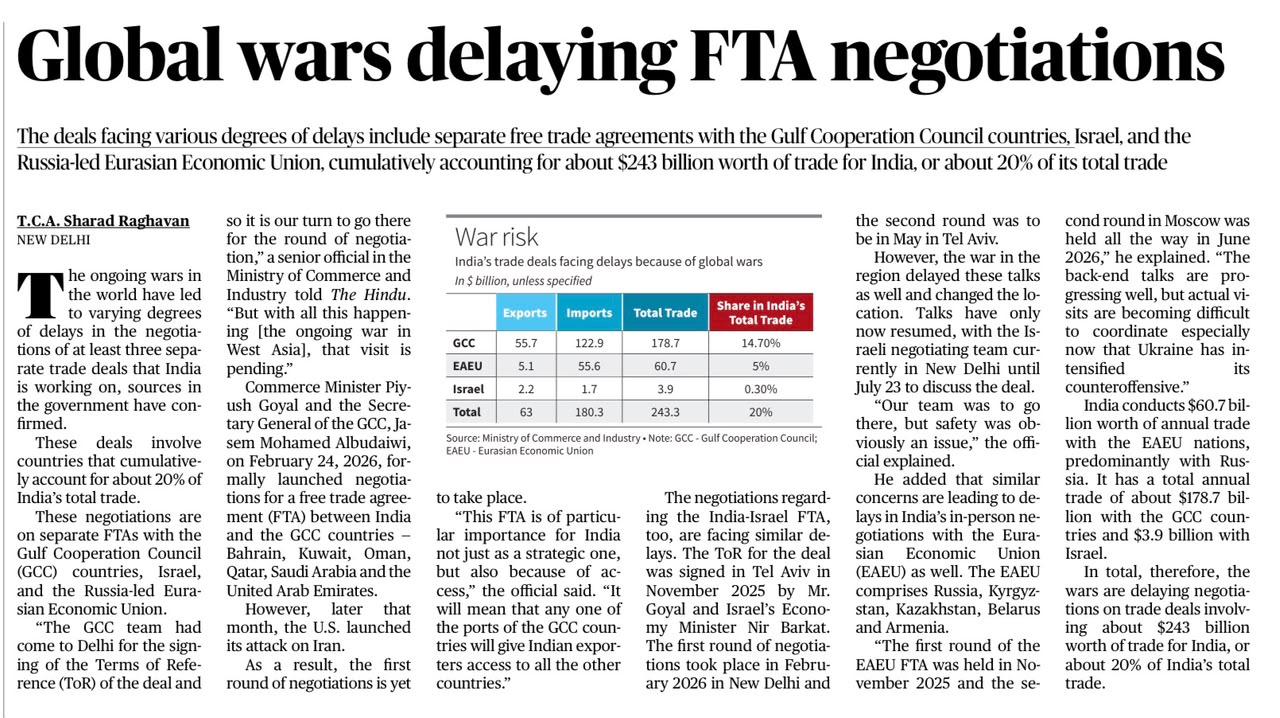
Context: India FTA negotiations delayed
Ongoing conflicts in West Asia and Eastern Europe have delayed India’s Free Trade Agreement negotiations with:
These trade partnerships together account for nearly 20% of India’s total merchandise trade.
Free Trade Agreement
A Free Trade Agreement is an arrangement between countries to reduce or remove trade barriers such as tariffs and quotas.
It aims to improve:
- Market access
- Trade competitiveness
- Investment flows
- Supply-chain integration
Gulf Cooperation Council
Established
- 1981
Headquarters
- Riyadh, Saudi Arabia
Members
- Bahrain
- Kuwait
- Oman
- Qatar
- Saudi Arabia
- United Arab Emirates
Eurasian Economic Union
Established
- 2015
Headquarters
- Moscow, Russia
Members
- Russia
- Belarus
- Kazakhstan
- Armenia
- Kyrgyzstan
Important Trade Data
India–GCC Trade
- US$178.7 billion
- Around 14.7% of India’s total trade
India–EAEU Trade
- US$60.7 billion
- Around 5% of India’s total trade
India–Israel Trade
- US$3.9 billion
Total Trade Affected
- US$243.3 billion
- Nearly 20% of India’s total trade
Key Points
Geopolitical conflicts have disrupted physical negotiations, although technical-level discussions continue.
The India–GCC FTA is strategically important because one agreement would give Indian exporters wider market access across all six Gulf countries.
Delays in India–Israel and India–EAEU FTAs may affect India’s efforts to diversify export markets and strengthen supply chains.
Key Takeaway
Global conflicts are now directly affecting India’s trade diplomacy. Timely FTAs are important for export growth, supply-chain resilience and deeper integration with global value chains.