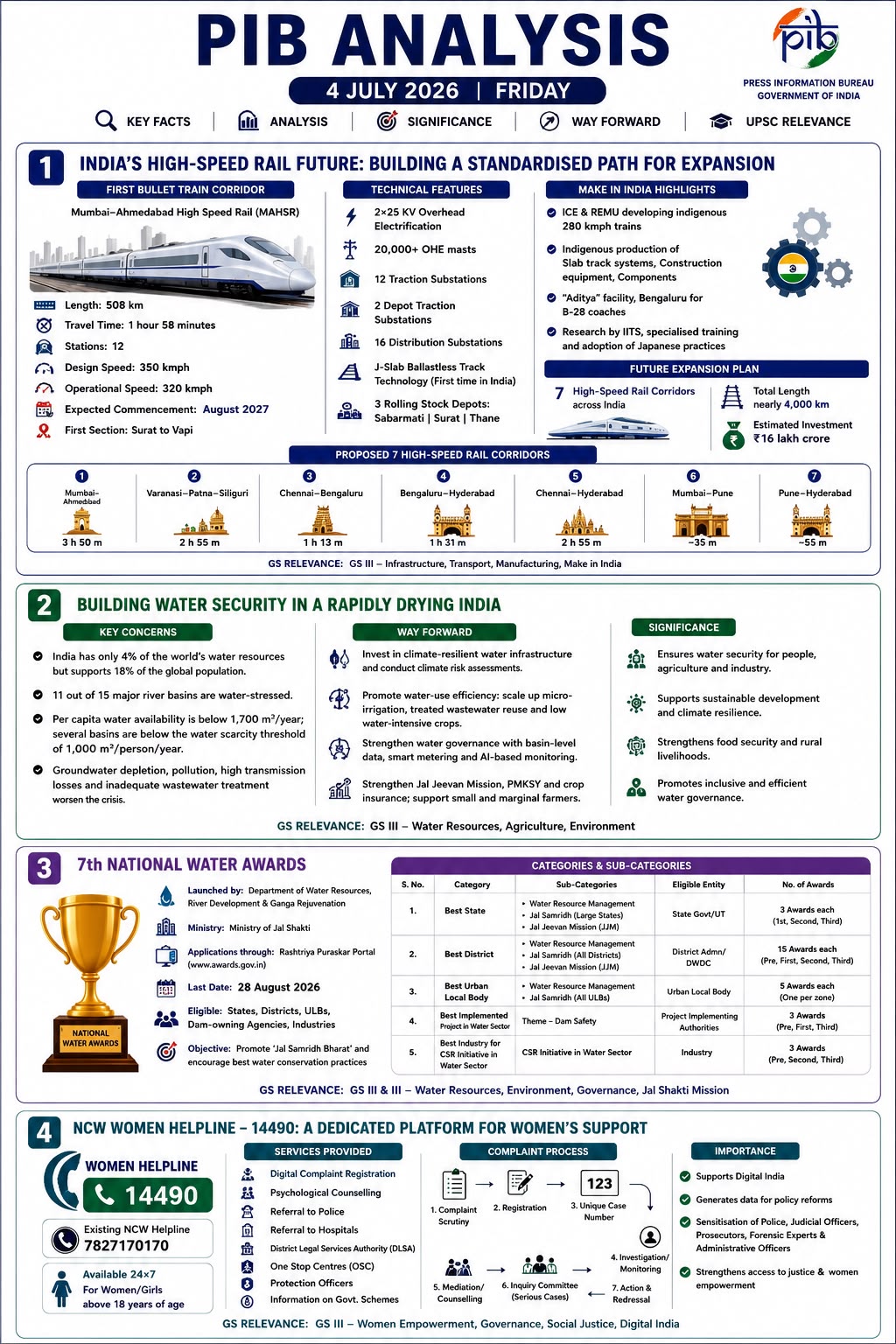
Context: India High-Speed Rail Expansion
India is planning a standardised approach for future high-speed rail corridors to enable faster expansion, lower costs, domestic manufacturing and better interoperability.
High-Speed Rail
High-speed rail refers to passenger railway systems designed for significantly higher speeds than conventional rail.
India’s First Bullet Train Corridor
Mumbai–Ahmedabad High-Speed Rail Corridor
Key Features
- India’s first bullet train corridor.
- Uses Japanese Shinkansen technology.
- Designed for high-speed passenger movement.
- Expected to reduce travel time between Mumbai and Ahmedabad.
Why Standardisation Matters
A standardised high-speed rail framework helps in:
- Reducing project delays
- Lowering construction costs
- Improving interoperability
- Promoting domestic manufacturing
- Simplifying operations and maintenance
- Creating common technical standards
- Supporting Make in India
Areas of Standardisation
- Track design
- Signalling systems
- Rolling stock
- Safety protocols
- Station design
- Construction methods
- Training systems
- Maintenance protocols
Significance
- Supports expansion of high-speed rail corridors.
- Improves passenger mobility.
- Reduces travel time.
- Promotes regional economic integration.
- Supports industrial development.
- Generates jobs in manufacturing and construction.
- Strengthens transport infrastructure.
- Reduces pressure on roads and airports.
Challenges
- High capital cost
- Land acquisition
- Technology transfer
- Financing
- Environmental clearance
- Skilled workforce requirement
- Integration with existing transport networks
Way Forward
- Develop indigenous standards.
- Promote domestic manufacturing of components.
- Strengthen technology transfer.
- Build specialised training centres.
- Ensure multimodal connectivity at stations.
- Use phased expansion.
- Ensure financial viability and safety.