Context: India Nepal Relations
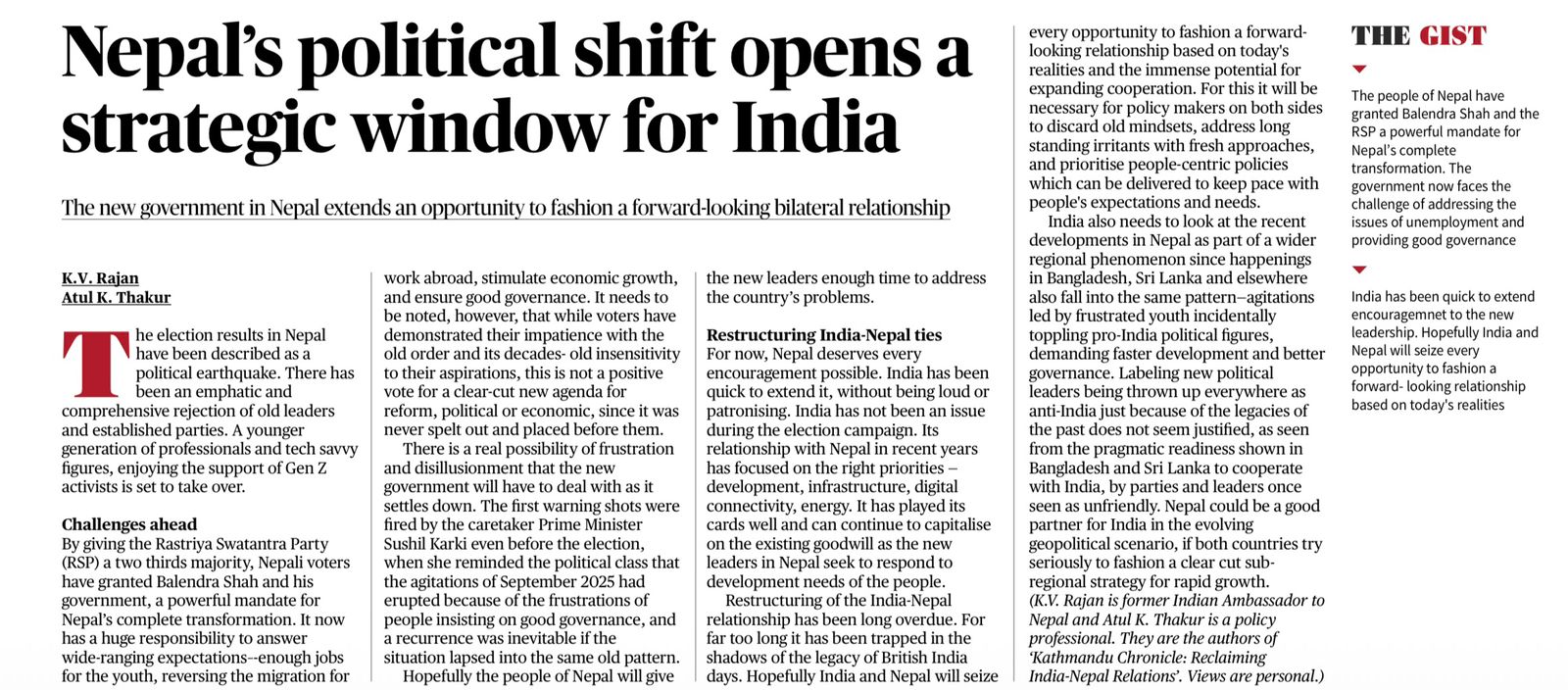
A new political mandate in Nepal has brought a leadership focused on governance and development, creating space for India to reset ties and move beyond legacy irritants.
1) Political Shift in Nepal
- Rejection of old parties → rise of new, younger leadership
- Strong mandate → focus on jobs, governance, stability
- Warning signal → public frustration can re-emerge if delivery fails
2) Core Issues in India–Nepal Relations
2.1 Trust Deficit
• Perception of Indian interference in internal politics
• Anti-India narratives used in Nepal’s domestic politics
2.2 Boundary Dispute
• Kalapani–Lipulekh–Limpiyadhura dispute
• Triggered by new maps on both sides → affects diplomatic trust
2.3 Treaty Issue
• 1950 Treaty of Peace and Friendship
Why revision demand?
- Asymmetry perception → Nepal sees it as favouring India
- Security provisions → Nepal informally expected to consult India on defence matters
- Open border & economic privileges → seen as unequal in changing context
- Desire for sovereign equality and modernisation of terms
2.4 Economic & Transit Issues
• Nepal is landlocked → heavy dependence on India for trade routes
• 2015 blockade perception → major trust erosion
• Need for diversification vs dependence
2.5 China Factor
• Increasing Chinese role in infrastructure and connectivity
• Nepal balancing between India and China
• Strategic concern for India