India Rice Methane Emissions: Causes and Solutions

Context: India rice methane emissions
A Nature Food study reported by The Hindu found that greenhouse gas emissions from paddy fields have nearly doubled since the 1960s.

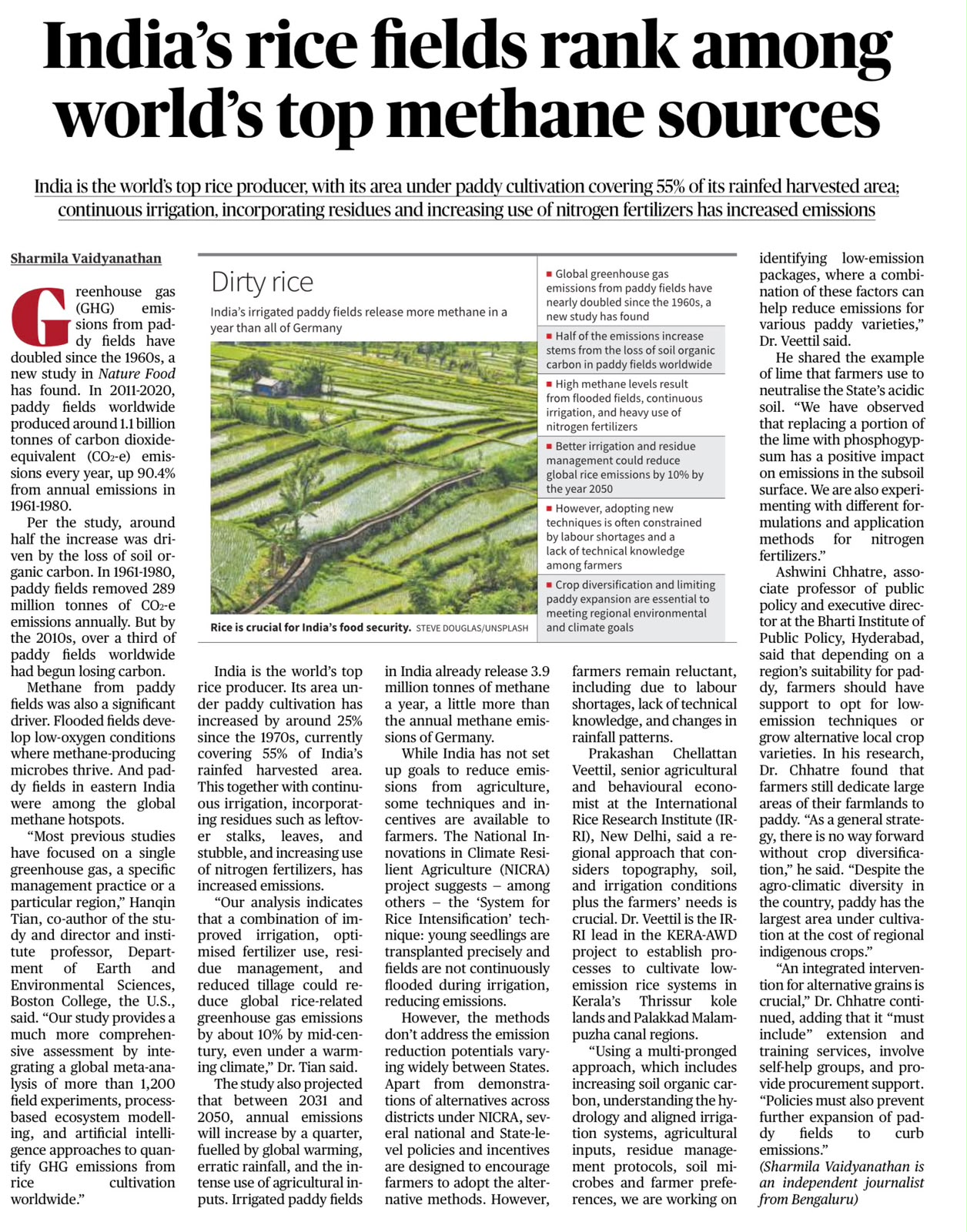
India, being the world’s largest rice producer, is among the largest methane emitters from rice cultivation due to flooded fields, crop residue incorporation and intensive fertiliser use.

Methane

Methane, or CH₄, is a powerful greenhouse gas.

It is much more potent than carbon dioxide in terms of warming impact over a 100-year period.

Methane is produced under anaerobic conditions, where oxygen is absent or very limited.

Why Paddy Fields Emit Methane

Rice is often grown in flooded fields.

Flooded soil creates oxygen-deficient conditions.

Under such conditions, methane-producing microbes become active and release methane into the atmosphere.

Major Sources of Methane

Important methane sources include:

  • Wetlands
  • Paddy fields
  • Livestock
  • Landfills
  • Oil and gas extraction
  • Coal mining

Indian Context

India is the world’s largest rice producer.

Paddy cultivation covers around 55% of India’s rainfed harvested area.

Irrigated paddy fields in India emit around 3.9 million tonnes of methane per year.

The main drivers are:

  • Continuous flooding
  • Crop residue incorporation
  • Nitrogen fertiliser use
  • Large paddy cultivation area

Environmental Concern

Methane from rice cultivation adds to agricultural greenhouse gas emissions.

This makes paddy farming important not only for food security but also for climate policy.

India must balance rice production with low-emission agricultural practices.

Mitigation Measures

Alternate Wetting and Drying

This method allows fields to dry for certain periods instead of keeping them continuously flooded.

It reduces methane emissions by limiting anaerobic conditions.

System of Rice Intensification

SRI uses improved water, seedling and soil management practices.

It can reduce water use and help lower emissions.

Better Fertiliser and Residue Management

Efficient fertiliser use and improved crop residue handling can reduce emissions.

Crop Diversification

Diversifying away from water-intensive paddy in suitable regions can reduce environmental stress.

Key Takeaway

Rice is crucial for India’s food security, but paddy cultivation is also a major methane source. India needs climate-smart rice farming to protect both food security and environmental goals.

Subscribe
Notify of
guest
0 Comments
Oldest
Newest Most Voted

India Rice Methane Emissions: Causes and Solutions

Got a question? We're here to help!

Our dedicated Student Support team is ready to assist you and guide you every step of the way.
Reach out to us, and let’s tackle your queries together!

About the UPSC Civil Services Examination (UPSC CSE)

The UPSC Civil Services Examination (CSE) is one of the most competitive and esteemed examinations in India, conducted by the Union Public Service Commission to recruit officers for services such as the Indian Administrative Service (IAS), Indian Police Service (IPS), Indian Foreign Service (IFS), and others. The exam comprises three stages — Prelims, Mains, and the Personality Test (Interview) — designed to test a candidate’s knowledge, aptitude, decision-making, and leadership skills.

How to Prepare Effectively for UPSC CSE

Cracking the UPSC CSE requires a deep understanding of the syllabus, consistent revision, structured answer writing, and smart test-taking strategies. The Prelims test analytical and conceptual clarity, the Mains focuses on critical thinking, articulation, and subject mastery, while the Interview assesses presence of mind, ethical judgment, and personality traits relevant to public service.

At UnderStand UPSC, we empower aspirants with a personalized and focused approach to each stage of the exam.

Why Choose UnderStand UPSC?

UnderStand UPSC is a mentorship-driven platform offering a clear, clutter-free strategy to tackle the Civil Services Examination. Our programs like Transform (for beginners and intermediate learners) and Conquer (for advanced mains preparation) provide structured study plans, syllabus-wise video content, interactive live sessions, and answer writing support.

We emphasize:

  • Concept clarity through topic-wise lectures

  • Test series designed around real UPSC standards

  • Personalized mentorship in small groups

  • Regular performance tracking and peer benchmarking

  • Doubt-clearing sessions, current affairs analysis, and monthly magazines

Join the UnderStand UPSC Learning Community

Our mission is to make UPSC preparation less overwhelming and more strategic. We combine mentorship, discipline, and academic rigor to help you clear CSE with confidence. Whether you’re preparing from Delhi, Mumbai, Bangalore, or a remote village — our online-first model ensures quality guidance reaches every corner of India.

Join the thousands of aspirants who trust UnderStand UPSC to guide their journey toward becoming civil servants.

Stay connected with us through our Telegram, YouTube, and Instagram channels for daily tips, strategies, and updates.

Copyright © 2026 USARAMBHA EDUCATION (UnderStand UPSC). All Rights Reserved.

Fill out the form for

Downloading the free Agriculture Short Notes


0
Would love your thoughts, please comment.x
()
x