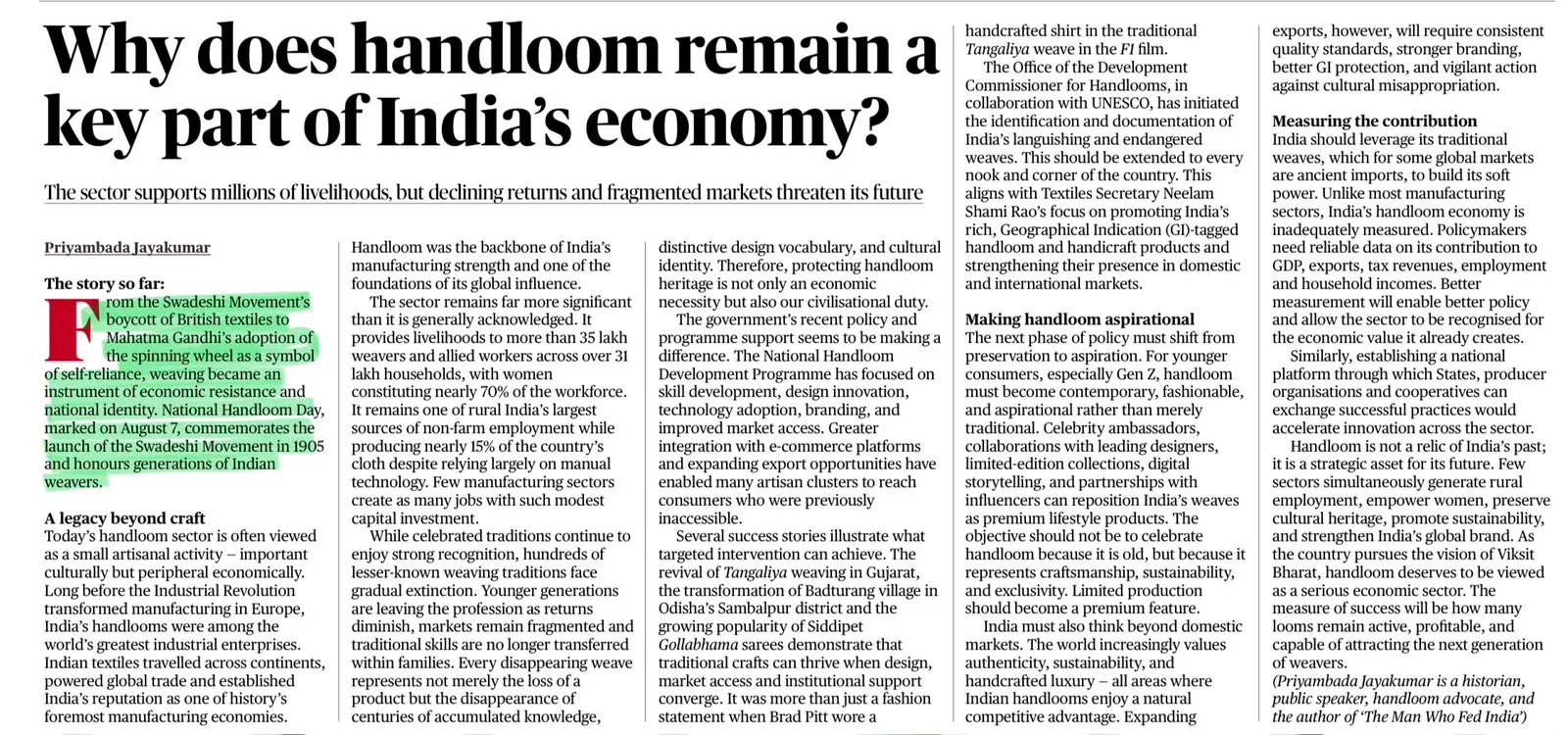
Context: Indian handloom sector
National Handloom Day is observed on 7 August to commemorate the Swadeshi Movement of 1905. The topic highlights handloom as both a source of rural employment and an important part of India’s cultural and economic heritage.
Handloom Sector in India
Handloom has been one of India’s oldest manufacturing traditions.
It is not only an economic activity, but also a carrier of regional identity, traditional knowledge and cultural heritage.
The sector supports millions of livelihoods, especially in rural areas.
Economic Significance
The handloom sector supports more than 35 lakh weavers and over 31 lakh allied workers across around 31 lakh households.
Nearly 70% of the workforce is women, making it important for women’s employment and rural household income.
Despite being largely manual and low-capital intensive, handloom produces nearly 15% of India’s cloth.
It is also a major source of non-farm rural employment.
Cultural and Heritage Value
Handloom preserves:
- Indigenous designs
- Traditional skills
- Regional identities
- Local weaving knowledge
- Community-based craftsmanship
Important examples include:
- Tangaliya from Gujarat
- Sambalpuri from Odisha
- Siddipet / Gollabhama tradition
These traditions show that handloom is not just cloth production, but cultural documentation through craft.
Need for GI Protection
Geographical Indication recognition can help protect traditional weaves from cultural misappropriation.
GI tagging, documentation and branding can also improve market recognition and support artisans.
Key Challenges
The sector faces declining returns and fragmented markets.
Younger generations are leaving the profession because income is uncertain.
Traditional skills are not being transferred properly to the next generation.
Many weavers face limited access to:
- Technology
- Branding
- Finance
- Design support
- E-commerce
- Export markets
Another major problem is lack of reliable data on GDP contribution, exports, employment and household income.
Without proper data, policy planning becomes weak.
Policy Link
The National Handloom Development Programme focuses on:
- Skill development
- Design innovation
- Technology adoption
- Market access
However, the sector needs stronger implementation and better integration with modern markets.
Way Forward
Handloom should be connected with e-commerce and export platforms.
GI protection and branding must be strengthened.
Designer collaborations, limited editions and digital storytelling can make handloom aspirational for younger consumers.
A national handloom data platform should be created to track employment, income, exports and productivity.
States should also share best practices to improve innovation and market access.
Key Takeaway
Handloom remains important because it combines employment, women’s participation, cultural heritage and rural economy. The next step is to make handloom commercially viable, aspirational and globally competitive.