Long-duration energy storage UPSC for Green Transition

Context: Long-duration energy storage UPSC
India’s electricity demand is rising rapidly, with peak demand reaching a record 270.8 GW in May 2026.

At the same time, the growing share of renewable energy requires reliable storage to ensure uninterrupted power supply.

India’s current storage roadmap envisages:

  • 80 GW of Battery Energy Storage Systems
  • 94 GW of Pumped Hydro Energy Storage

by 2035–36, but much of this capacity is designed for short-duration storage.
Core Issue

Renewable energy sources such as solar and wind are intermittent.

They depend on:

  • Sunlight
  • Wind speed
  • Weather conditions
  • Seasonal patterns

This creates a need for reliable energy storage.

Long-Duration Energy Storage

Long-Duration Energy Storage refers to technologies that can supply electricity for days rather than hours.

This is important when solar and wind generation remain low for extended periods.

Why Short-Duration Storage Is Not Enough

Short-duration storage can help manage daily fluctuations, but it may be inadequate during:

  • Seasonal variation
  • Extreme weather events
  • Long periods of low solar generation
  • Long periods of low wind generation
  • Peak demand stress

Storage Technologies Needed

India needs a diversified portfolio of storage technologies, including:

1. Pumped Hydro Energy Storage

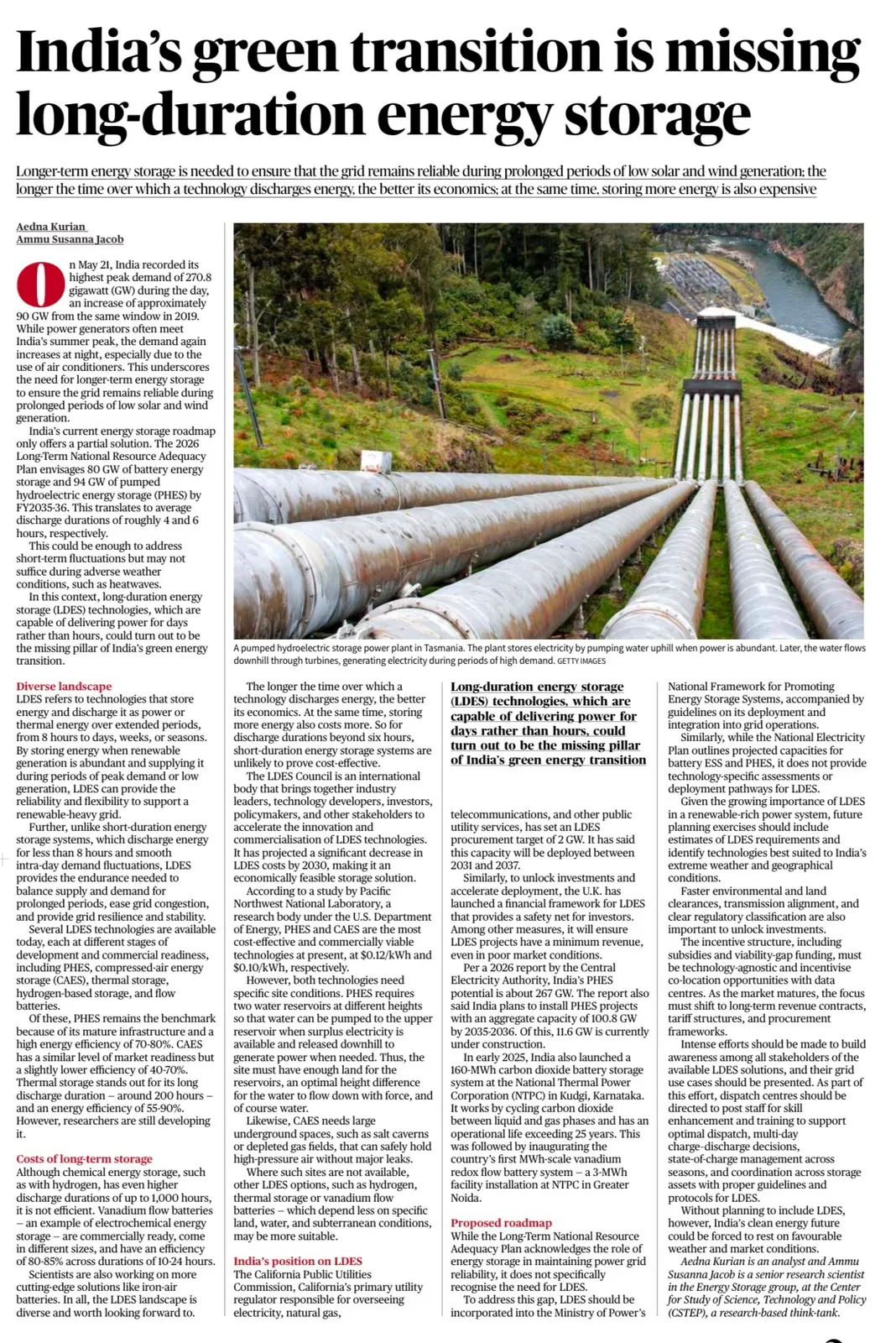
Uses water reservoirs at different heights to store and generate electricity.

2. Compressed Air Energy Storage

Stores energy by compressing air and releasing it later to generate power.

3. Thermal Energy Storage

Stores energy in the form of heat for later use.

4. Hydrogen Storage

Uses electricity to produce hydrogen, which can later be used as fuel.

5. Flow Batteries

Use liquid electrolytes to store and release electricity over longer durations.

Core Arguments

1. Grid Reliability

LDES is essential to ensure grid reliability during prolonged low renewable generation.

2. Renewable Integration

India’s clean energy transition requires storage that can balance supply and demand.

3. Climate Resilience

Extreme weather events may disrupt generation, making long-duration backup important.

4. Policy Gap

Absence of dedicated policy, incentives and deployment roadmap for LDES can become a bottleneck.

Way Forward

  • Integrate LDES into national energy planning.
  • Set clear deployment targets.
  • Provide regulatory support.
  • Promote research and innovation.
  • Support pilot projects.
  • Encourage domestic manufacturing.
  • Develop market mechanisms and investment incentives.
  • Use viability gap funding to attract private participation.
  • Strengthen grid planning with LDES.

Key Takeaway

India’s green transition cannot depend only on short-duration batteries. Long-duration storage is essential for a reliable renewable energy grid.


Subscribe
Notify of
guest
0 Comments
Oldest
Newest Most Voted

Long-duration energy storage UPSC for Green Transition

Got a question? We're here to help!

Our dedicated Student Support team is ready to assist you and guide you every step of the way.
Reach out to us, and let’s tackle your queries together!

About the UPSC Civil Services Examination (UPSC CSE)

The UPSC Civil Services Examination (CSE) is one of the most competitive and esteemed examinations in India, conducted by the Union Public Service Commission to recruit officers for services such as the Indian Administrative Service (IAS), Indian Police Service (IPS), Indian Foreign Service (IFS), and others. The exam comprises three stages — Prelims, Mains, and the Personality Test (Interview) — designed to test a candidate’s knowledge, aptitude, decision-making, and leadership skills.


How to Prepare Effectively for UPSC CSE

Cracking the UPSC CSE requires a deep understanding of the syllabus, consistent revision, structured answer writing, and smart test-taking strategies. The Prelims test analytical and conceptual clarity, the Mains focuses on critical thinking, articulation, and subject mastery, while the Interview assesses presence of mind, ethical judgment, and personality traits relevant to public service.

At UnderStand UPSC, we empower aspirants with a personalized and focused approach to each stage of the exam.


Why Choose UnderStand UPSC?

UnderStand UPSC is a mentorship-driven platform offering a clear, clutter-free strategy to tackle the Civil Services Examination. Our programs like Transform (for beginners and intermediate learners) and Conquer (for advanced mains preparation) provide structured study plans, syllabus-wise video content, interactive live sessions, and answer writing support.

We emphasize:

  • Concept clarity through topic-wise lectures

  • Test series designed around real UPSC standards

  • Personalized mentorship in small groups

  • Regular performance tracking and peer benchmarking

  • Doubt-clearing sessions, current affairs analysis, and monthly magazines


Join the UnderStand UPSC Learning Community

Our mission is to make UPSC preparation less overwhelming and more strategic. We combine mentorship, discipline, and academic rigor to help you clear CSE with confidence. Whether you’re preparing from Delhi, Mumbai, Bangalore, or a remote village — our online-first model ensures quality guidance reaches every corner of India.

Join the thousands of aspirants who trust UnderStand UPSC to guide their journey toward becoming civil servants.

Stay connected with us through our Telegram, YouTube, and Instagram channels for daily tips, strategies, and updates.

Copyright © 2026 USARAMBHA EDUCATION (UnderStand UPSC). All Rights Reserved.

Fill out the form for

Downloading the free Agriculture Short Notes


0
Would love your thoughts, please comment.x
()
x