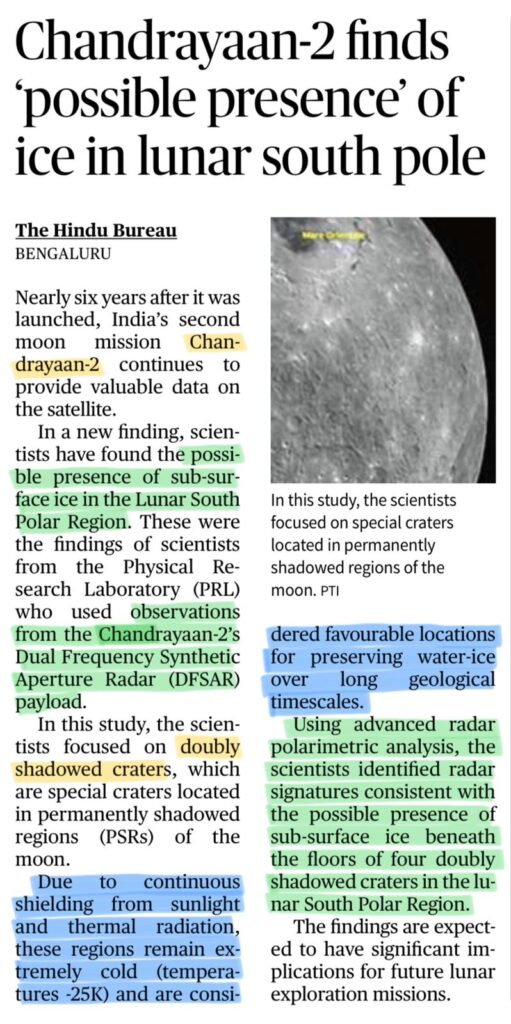
Context: Lunar South Pole
Scientists from the Physical Research Laboratory, using data from Chandrayaan-2’s Dual Frequency Synthetic Aperture Radar, have reported evidence suggesting the possible presence of subsurface water-ice in the Lunar South Polar Region.
Key Findings
- Study focused on Doubly Shadowed Craters located within Permanently Shadowed Regions of the Moon.
- Radar signatures indicate the possible presence of subsurface ice beneath four crater floors in the Lunar South Pole.
- These regions remain extremely cold, around 25 Kelvin, due to the absence of sunlight and thermal radiation.
- Such conditions favour the preservation of water-ice over geological timescales.
Why Lunar South Pole Matters?
- Contains numerous Permanently Shadowed Regions.
- Considered the most promising location for water-ice deposits on the Moon.
- Water can support human habitation, oxygen production and rocket fuel generation for future lunar missions.
Chandrayaan-2 — Basics
- Launched in 2019 by the Indian Space Research Organisation.
- Components: Orbiter, Vikram Lander and Pragyan Rover.
- Orbiter remains operational and continues to generate scientific data.
- Dual Frequency Synthetic Aperture Radar is designed to detect water-ice beneath the lunar surface.
Prelims Pointers
Permanently Shadowed Region:
Areas near lunar poles that never receive direct sunlight.
Doubly Shadowed Crater:
Crater within a Permanently Shadowed Region receiving even lesser solar exposure, making it a potential ice trap.
Chandrayaan-3:
India’s Chandrayaan-3 successfully landed near the lunar south polar region in 2023.