Context: NASA ISRO Moon Base
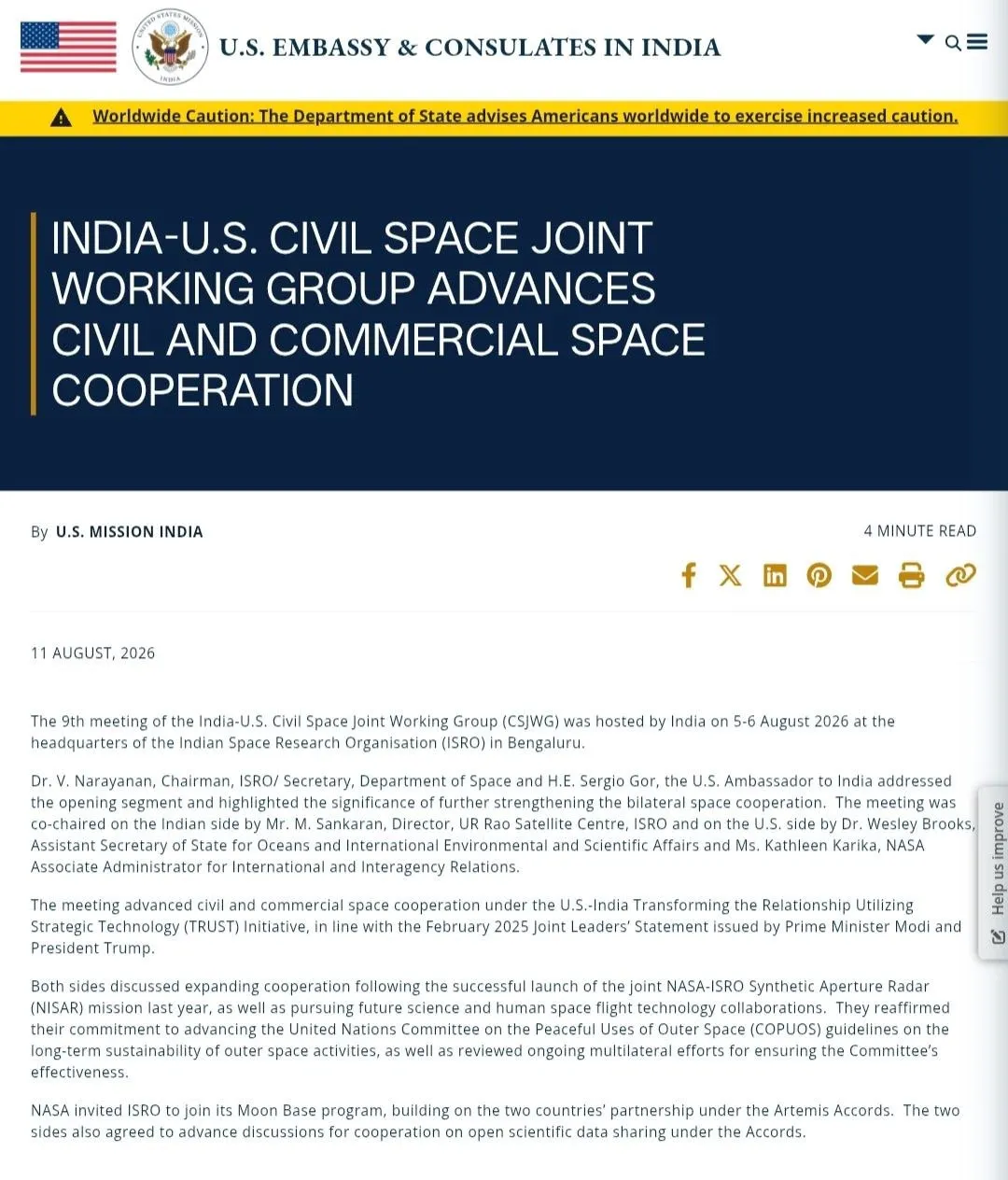
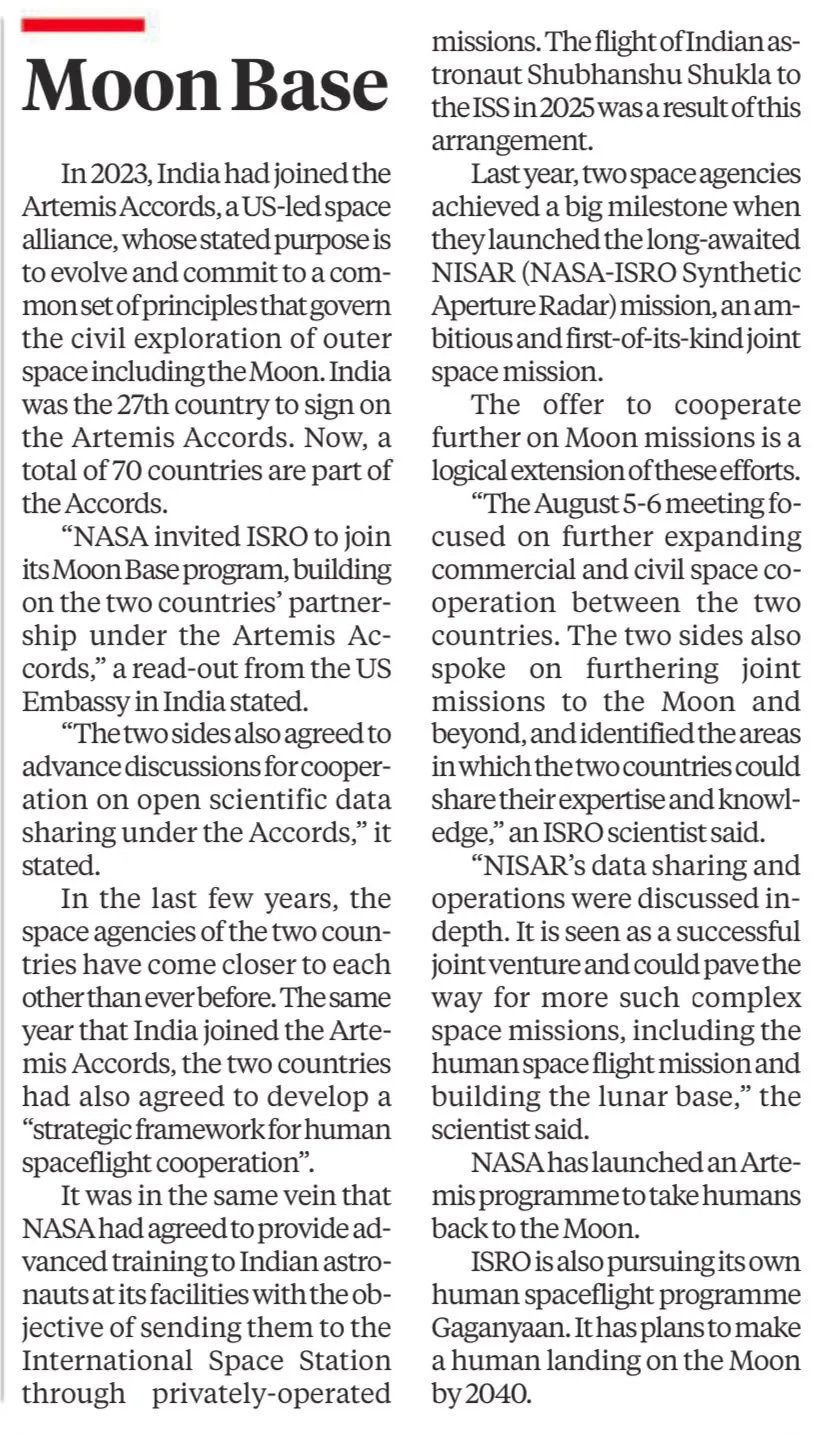
At the 9th India–U.S. Civil Space Joint Working Group meeting in Bengaluru on 5–6 August 2026, NASA invited ISRO to join its Moon Base programme, deepening cooperation in lunar exploration, human spaceflight and commercial space.
India–U.S. Space Cooperation
Artemis Accords
India joined the U.S.-led Artemis Accords in 2023 as the 27th signatory.
There are now 70 signatories.
The Artemis Accords provide principles for peaceful and sustainable exploration of the Moon and beyond.
Moon Base
NASA’s programme aims at sustained human presence on the Moon.
ISRO’s participation can expand Indian capabilities in lunar technology and human spaceflight.
Human Spaceflight
India–U.S. cooperation has already included astronaut training and support for Shubhanshu Shukla’s 2025 International Space Station mission.
NISAR: Key Joint Mission
NISAR stands for NASA–ISRO Synthetic Aperture Radar.
It was launched on 30 July 2025 by ISRO’s GSLV-F16.
It is the first joint NASA–ISRO Earth-observation satellite.
It is also the first spaceborne mission combining L-band and S-band Synthetic Aperture Radar.
Uses of NISAR
NISAR provides all-weather observations for:
- Natural-disaster monitoring
- Agriculture
- Glaciers and ice sheets
- Soil moisture
- Ecosystem changes
- Land deformation
Coverage
NISAR provides global observations approximately every 12 days.
It has a wide imaging swath of about 240 km.
Way Forward in Cooperation
Both sides agreed to advance open scientific-data sharing under the Artemis framework.
Cooperation can extend from NISAR and lunar missions to:
- Human spaceflight
- Advanced space technologies
- Commercial space
India’s Goal
ISRO aims for a human lunar landing by 2040.
This makes deeper international cooperation strategically relevant.
Key Takeaway
NASA’s invitation to ISRO for the Moon Base programme reflects deepening India–U.S. space cooperation in lunar exploration, human spaceflight, scientific data sharing and commercial space.