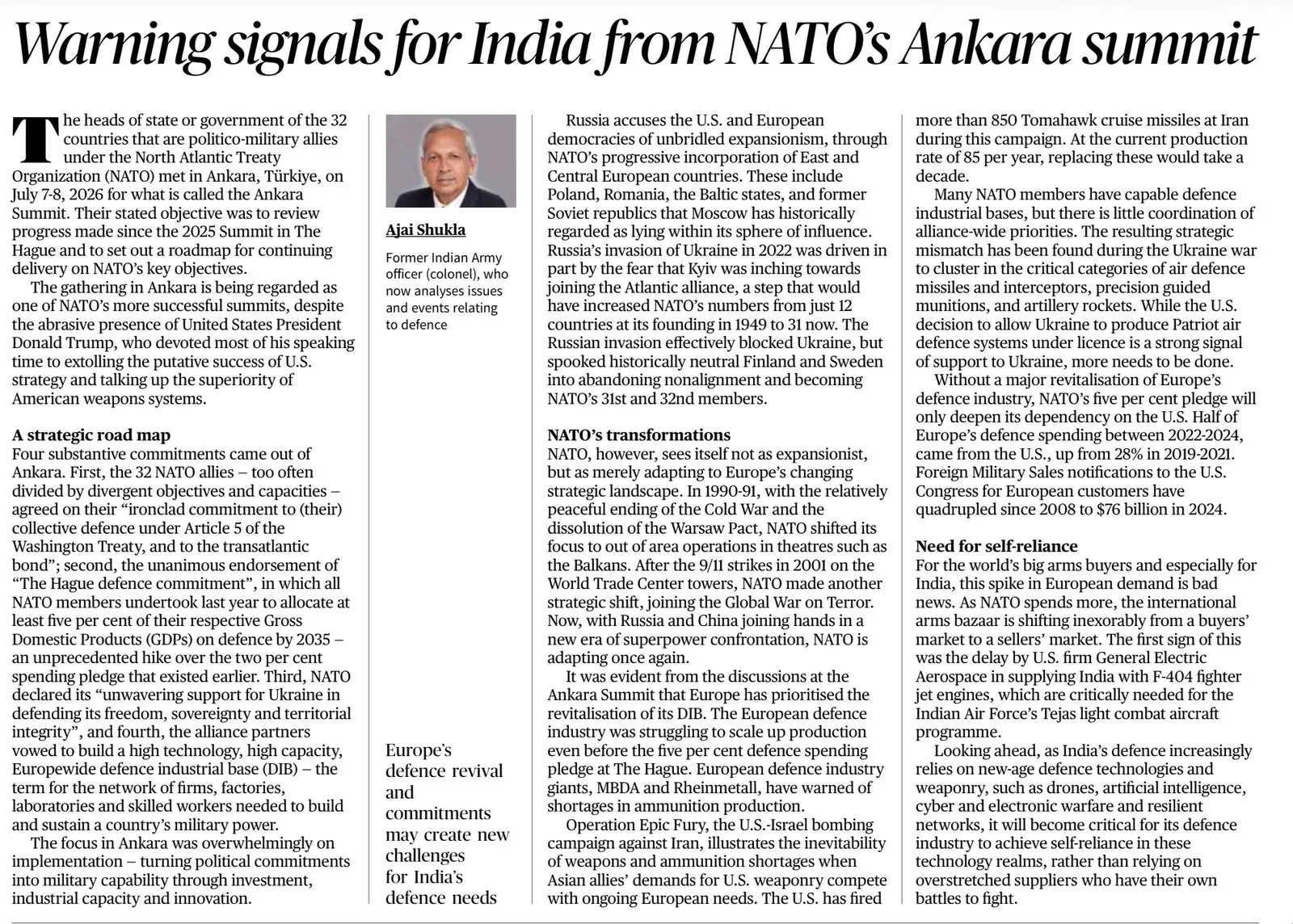
Context: NATO Ankara Summit implications
The article examines the strategic implications of NATO’s Ankara Summit for India.
NATO reaffirmed its commitment to collective defence, higher defence spending, stronger defence-industrial capacity and sustained support for Ukraine.
For India, the key concern is that rising global defence demand may strain international supply chains, especially when India still depends on imports in several critical defence sectors.
NATO
NATO stands for North Atlantic Treaty Organization.
It is a political and military alliance established in 1949 through the North Atlantic Treaty, also called the Washington Treaty.
Key Facts About NATO
NATO has 32 member countries from North America and Europe.
Its headquarters is in Brussels, Belgium.
Its principal decision-making body is the North Atlantic Council.
The alliance is headed by the Secretary-General.
Article 5
The core principle of NATO is collective defence under Article 5.
This means an attack on one member is considered an attack on all members.
Recent Expansion
NATO expanded after the Cold War.
Its newest members are:
- Finland — 2023
- Sweden — 2024
Why the Ankara Summit Matters
The summit showed that NATO countries are increasing defence spending and strengthening defence production.
This may increase global demand for weapons, ammunition, advanced platforms and defence technologies.
As a result, countries dependent on defence imports may face delays, cost escalation and supply-chain stress.
Implications for India
India must accelerate Aatmanirbhar Bharat in defence by strengthening indigenous design, development and manufacturing.
India also needs to reduce excessive dependence on defence imports by diversifying procurement sources and expanding domestic production.
Areas India Must Focus On
India should invest in:
- Artificial Intelligence
- Drones
- Cyber capabilities
- Semiconductors
- Advanced materials
- Defence electronics
- Resilient supply chains
Way Forward
India should:
- Strengthen domestic defence manufacturing.
- Increase private sector, MSME and start-up participation.
- Build strategic reserves.
- Expand defence exports.
- Deepen technology partnerships with trusted countries.
- Balance self-reliance with co-development and technology transfer.
Key Takeaway
NATO’s defence revival is a warning for India. In a crisis-driven world, defence security depends not only on buying weapons but on building resilient domestic defence-industrial capacity.