Context:
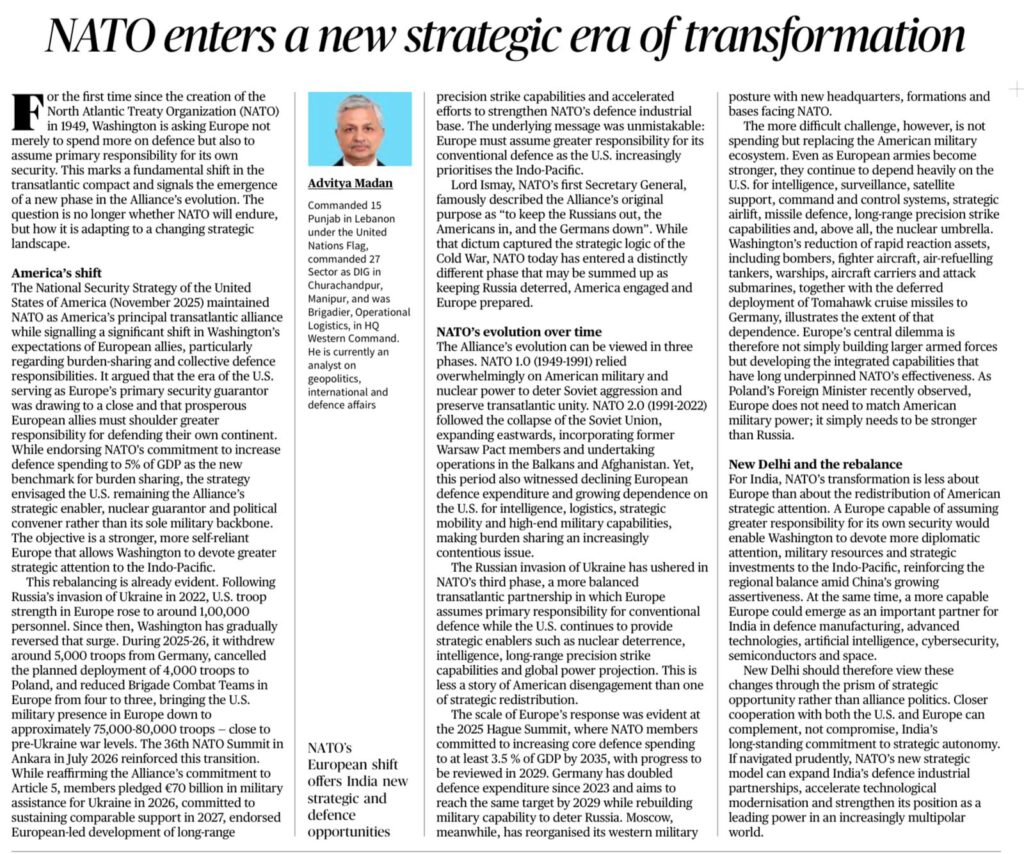
NATO is redefining its security role amid the Russia–Ukraine war and the United States’ strategic shift towards the Indo-Pacific.
This transformation has implications for Europe, the United States and India’s strategic interests.
Basics of NATO
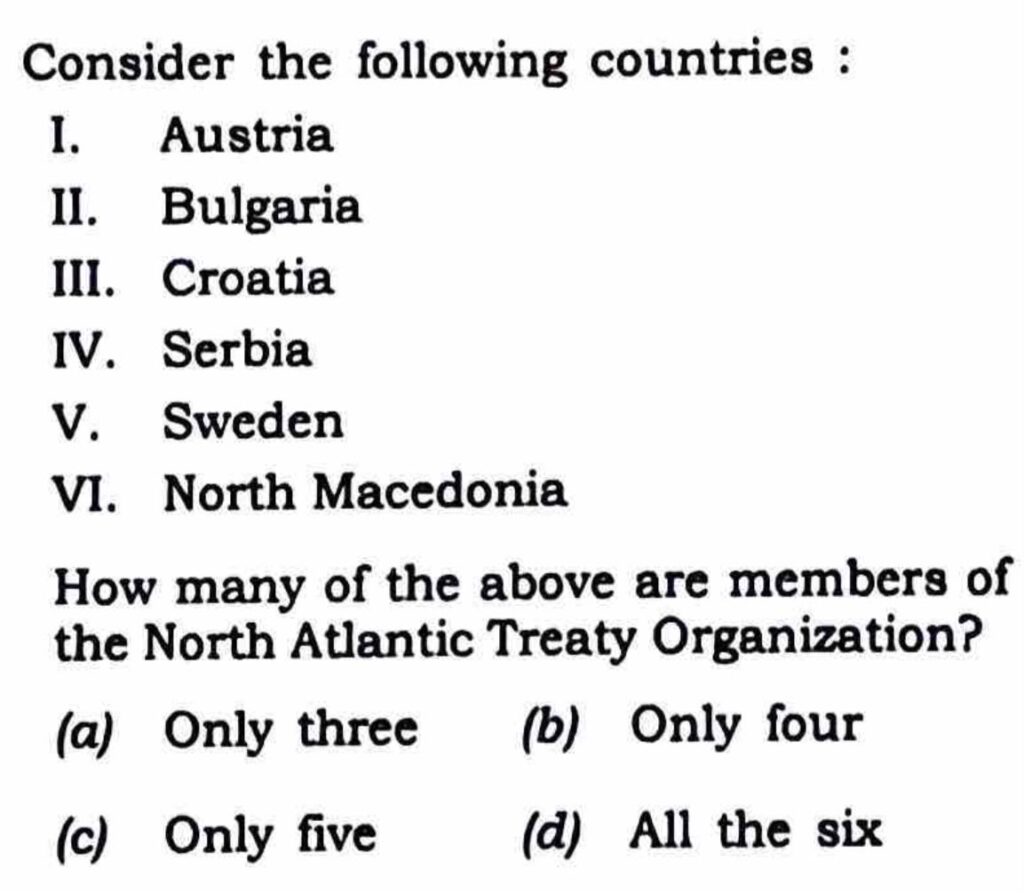
NATO stands for the North Atlantic Treaty Organization.
It was founded in 1949 through the Washington Treaty.
Its headquarters is in Brussels, Belgium.
It has 32 members.
Its newest members are:
- Finland — 2023
- Sweden — 2024
Article 5
Article 5 is the core principle of NATO.
It means an attack on one member is treated as an attack on all members.
This is the foundation of NATO’s collective defence system.
NATO’s Evolution
1949–1991
During the Cold War, NATO’s main role was to counter the Soviet Union.
1991–2022
After the Cold War, NATO expanded eastwards.
It was also involved in operations in the Balkans and Afghanistan.
2022 Onwards
After the Russia–Ukraine war, NATO renewed its focus on collective defence.
European security has again become central to NATO’s purpose.
Europe Must Become Stronger
The article argues that Europe must take greater responsibility for its own conventional defence.
This means European countries need to:
- Increase defence spending
- Improve military preparedness
- Strengthen industrial defence capacity
- Reduce excessive dependence on the United States
The United States may continue to provide strategic support through nuclear deterrence, intelligence and missile defence.
However, Washington is increasingly focused on the Indo-Pacific.
Implications for India
Greater U.S. focus on the Indo-Pacific can align with India’s strategic interests.
It may create more space for India-U.S. cooperation in the region.
India may also benefit from deeper cooperation with Europe in:
- Defence
- Artificial Intelligence
- Cybersecurity
- Semiconductors
- Space technology
Key Takeaway
NATO’s transformation shows that Europe must carry more of its own security burden while the United States focuses more on the Indo-Pacific. For India, this creates opportunities for deeper strategic cooperation with both the U.S. and Europe.