
Context: Politicisation of Anti-Corruption Bodies
The collapse of a high-profile corruption case (Delhi excise policy) highlights concerns that weak evidence and perceived political influence are undermining the credibility of anti-corruption investigations.
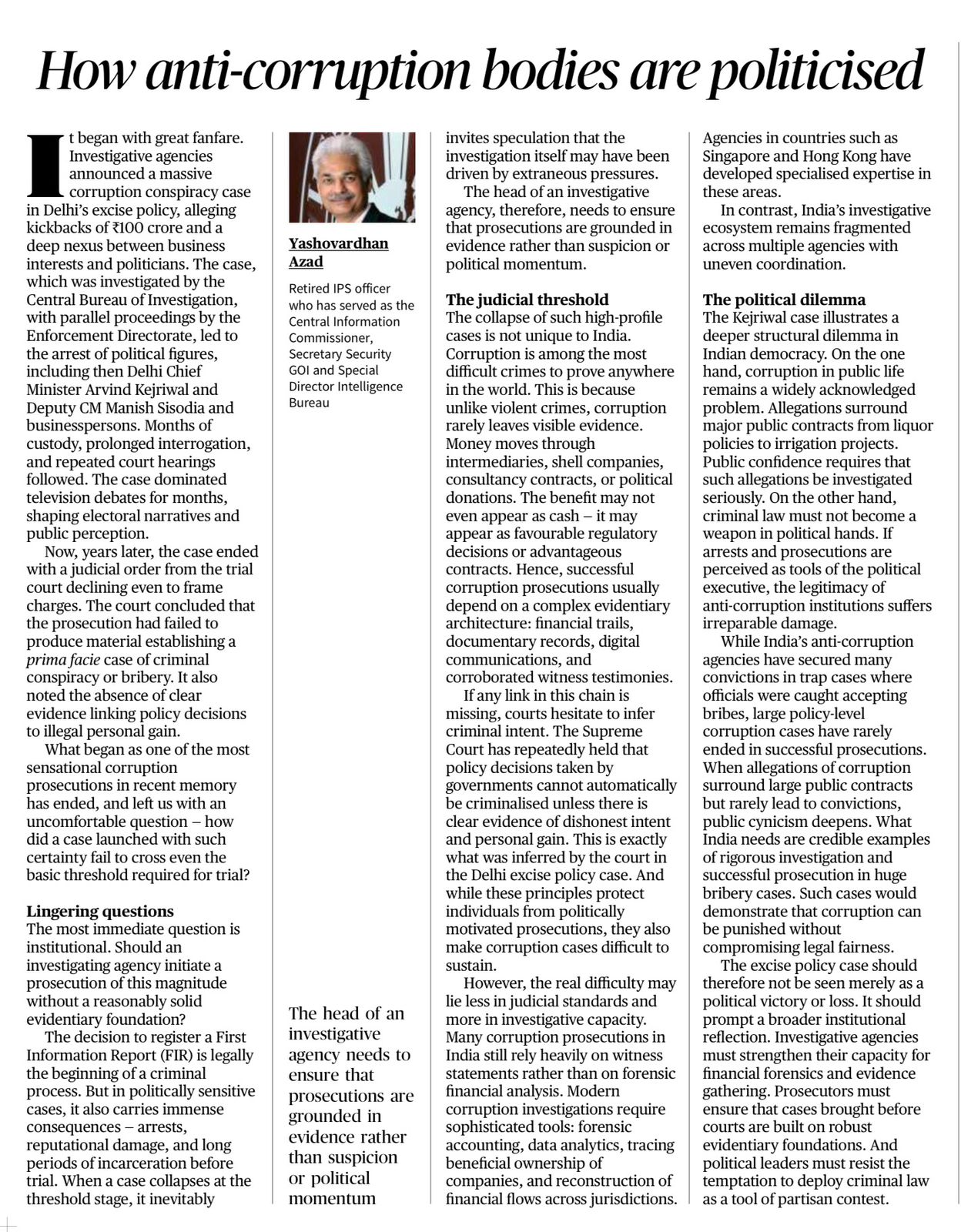
Core Issues
1. Evidence Deficit
• Weak financial forensics; reliance on statements
• Failure to establish money trail + personal gain
2. Judicial Standards
• Courts require intent + quid pro quo
• 2G case → acquittal due to lack of proof
3. Perception of Politicisation
• Action timing creates political bias narrative
• Early arrests, late evidence → credibility loss
4. Structural Weakness
• Fragmented agencies (CBI, ED, ACBs)
• Weak coordination vs specialised models like:
• Independent Commission Against Corruption
• Corrupt Practices Investigation Bureau
Implications
• Low conviction rate → public distrust
• Criminal law seen as political tool
• Policy paralysis in governance
Way Forward
• Forensic-led investigation (money trail, data analytics)
• Institutional autonomy (transparent appointments)
• Evidence-first approach (avoid premature action)
• Integrated framework (better coordination)
• Adopt international best practices: specialised independent agencies (Hong Kong, Singapore)
Conclusion
Anti-corruption must be firm yet fair—driven by proof, independence, and global best practices, ensuring credibility and democratic trust.







