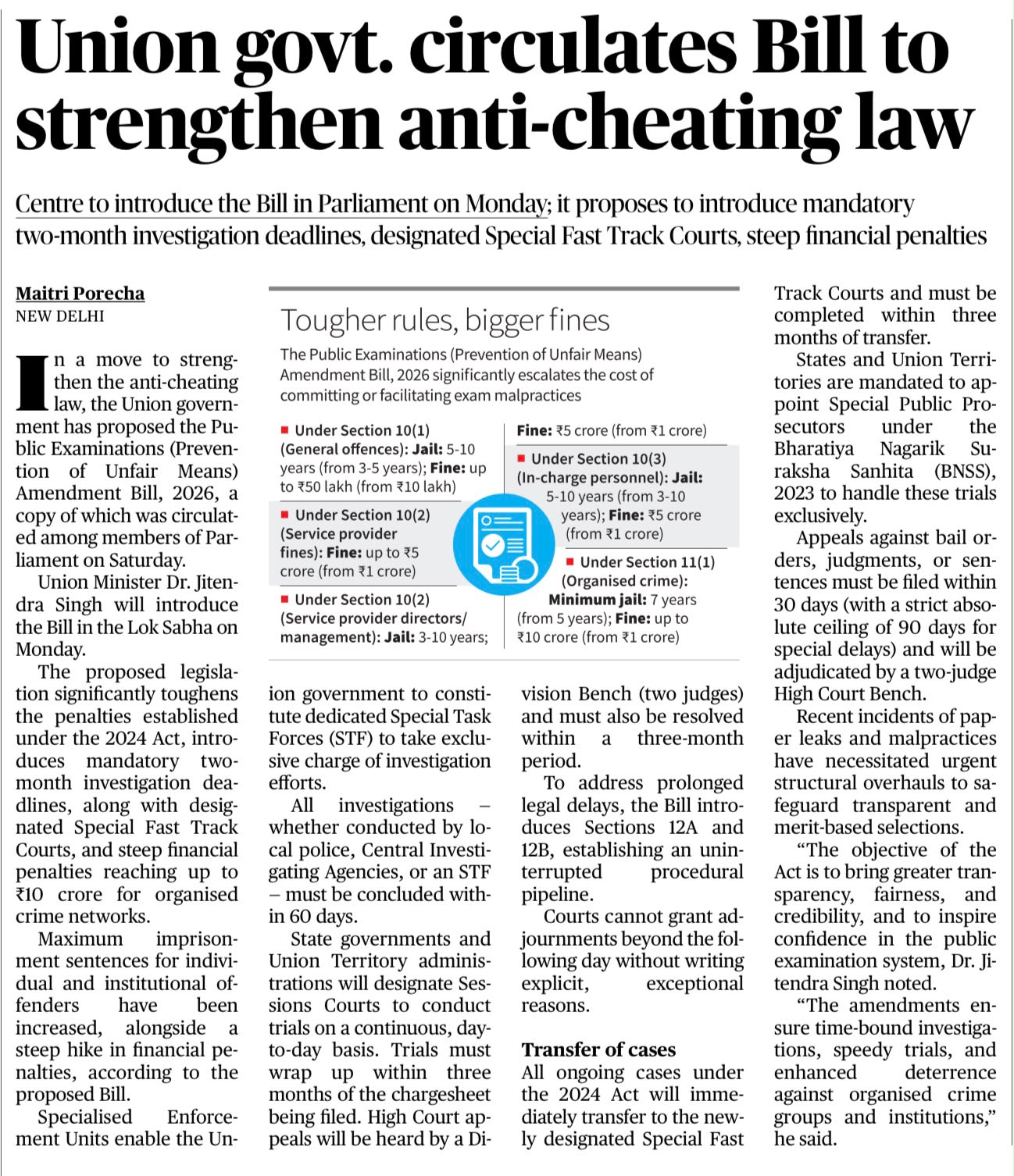
Context: Public Examinations Amendment Bill 2026
The Union Government has circulated the Public Examinations (Prevention of Unfair Means) Amendment Bill, 2026.
The Bill seeks to strengthen the anti-cheating framework introduced under the 2024 Act by proposing stricter penalties, time-bound investigations, special courts and dedicated enforcement mechanisms.
Objective
The Bill aims to ensure that public examinations remain:
- Fair
- Transparent
- Merit-based
- Credible
It seeks to deter organised paper leaks and examination fraud through stronger enforcement.
Key Provisions
1. Time-Bound Investigation
Investigations must be completed within 60 days.
This is meant to prevent prolonged delay in exam-related offences.
2. Special Fast Track Courts
The Bill proposes the establishment of Special Fast Track Courts for speedy trial and disposal of examination fraud cases.
3. Special Task Forces
Special Task Forces may be created for investigation.
This can help deal with organised cheating networks more effectively.
4. Special Public Prosecutors
States and Union Territories will appoint Special Public Prosecutors to handle cases under the law.
5. Restrictions on Delays
The Bill provides for time-bound appeals and restrictions on unnecessary adjournments.
This is aimed at faster judicial disposal.
Enhanced Penalties
General Offences
Punishment may include 5–10 years imprisonment and fine up to ₹50 lakh.
Service Providers and In-Charge Personnel
For service providers or in-charge personnel involved in malpractice, fine may go up to ₹5 crore, with imprisonment up to 10 years.
Organised Crime
For organised examination fraud, minimum imprisonment may be 7 years, with fine up to ₹10 crore.
Significance
The Bill strengthens deterrence against:
- Paper leaks
- Organised cheating
- Institutional collusion
- Exam fraud networks
- Malpractices by service providers
It also aims to restore public confidence in the examination system.
Governance Angle
Public examinations are linked to equality of opportunity.
Paper leaks hurt honest candidates and weaken trust in recruitment and admission processes.
Stronger laws must therefore be backed by credible investigation, quick trials and institutional accountability.
Key Takeaway
The proposed amendment seeks to make exam fraud costlier, faster to prosecute and harder to organise, thereby protecting merit and public trust in examinations.