Context: RBI Polymer Banknotes Pilot
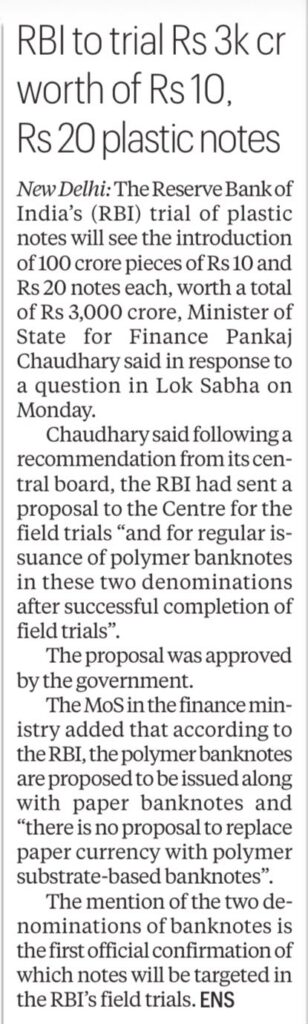
The Reserve Bank of India has received approval from the Central Government to conduct field trials of ₹10 and ₹20 polymer banknotes.
The objective is to test whether polymer banknotes are more durable, secure and cost-effective than existing cotton-based paper notes. The RBI has clarified that these notes are only under trial and will not immediately replace paper currency.
What Are Polymer Banknotes?
Polymer banknotes are currency notes printed on a special plastic substrate.
They are different from conventional cotton-based paper notes.
The material is designed specifically for currency production.
Polymer banknotes generally offer better durability and improved security features.
Why RBI Is Testing Polymer Banknotes
Polymer notes may last longer than cotton-based paper notes.
They are more resistant to water and dirt.
They can carry advanced security features, making counterfeiting more difficult.
Even if the initial printing cost is higher, their longer lifespan may reduce long-term replacement cost.
Will Polymer Notes Replace Paper Notes?
No.
Polymer notes are currently being introduced only for field trials.
If the trial is successful, they may coexist with cotton-based paper notes.
At present, there is no proposal to replace all paper currency with polymer notes.
Scale of the Trial
The RBI trial will involve ₹10 and ₹20 notes.
The proposal includes introduction of polymer notes worth around ₹3,000 crore.
This includes 100 crore pieces each of ₹10 and ₹20 notes.
Prelims Angle
For UPSC, polymer banknotes are important because they connect:
- RBI currency management
- Counterfeit prevention
- Currency durability
- Cost efficiency
- Banking technology
- Material science
Key Takeaway
RBI’s polymer banknote pilot is a currency management experiment. The aim is not to replace paper money immediately, but to test whether plastic notes can be more durable, secure, and cost-effective.+