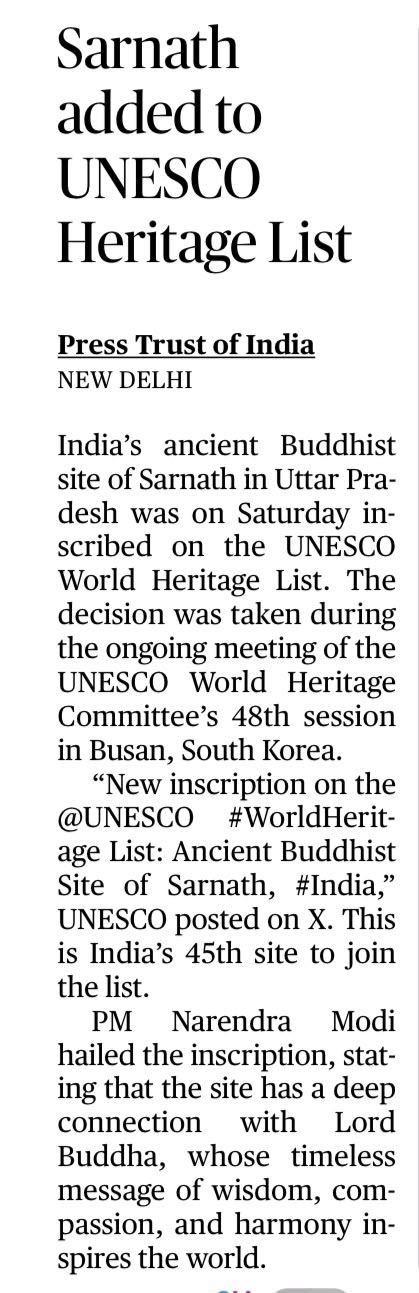
Context: Sarnath UNESCO World Heritage Site
At the 48th Session of the UNESCO World Heritage Committee held in Busan, South Korea, UNESCO inscribed three new World Heritage Sites:
- Ancient Buddhist Site of Sarnath — India
- Sebastia — West Bank, Palestine
- Five Castles of Mount Amel — Lebanon
With the inscription of Sarnath, India now has 45 UNESCO World Heritage Sites. The sites in the West Bank and Lebanon were also placed on the List of World Heritage in Danger due to the ongoing conflict in West Asia.
Sarnath
Sarnath is located near Varanasi, Uttar Pradesh.
It is one of the most important Buddhist pilgrimage sites in the world.
Why Sarnath Is Important
Sarnath is the place where Lord Buddha delivered his first sermon after attaining enlightenment.
This event is known as Dharmachakra Pravartana, or the turning of the wheel of Dharma.
Sarnath is also one of the four major Buddhist pilgrimage sites.
Important Monuments
Sarnath is famous for:
- Dhamek Stupa
- Ashokan Lion Capital
- Ancient monasteries
- Buddhist archaeological remains
The Ashokan Lion Capital from Sarnath is also the basis of India’s National Emblem.
Sebastia
Sebastia is located northwest of Nablus in the West Bank.
It is identified with the ancient city of Samaria.
The site has remains from:
- Iron Age
- Roman period
- Byzantine period
- Islamic period
Five Castles of Mount Amel
The Five Castles of Mount Amel are located in southern Lebanon.
They represent medieval fortified architecture influenced by:
- Crusader architecture
- Ayyubid architecture
- Mamluk architecture
- Local architectural traditions
These castles were also added to the List of World Heritage in Danger.
Key Takeaway
Sarnath’s inscription strengthens India’s global cultural profile and highlights the civilisational importance of Buddhism in India’s heritage diplomacy.