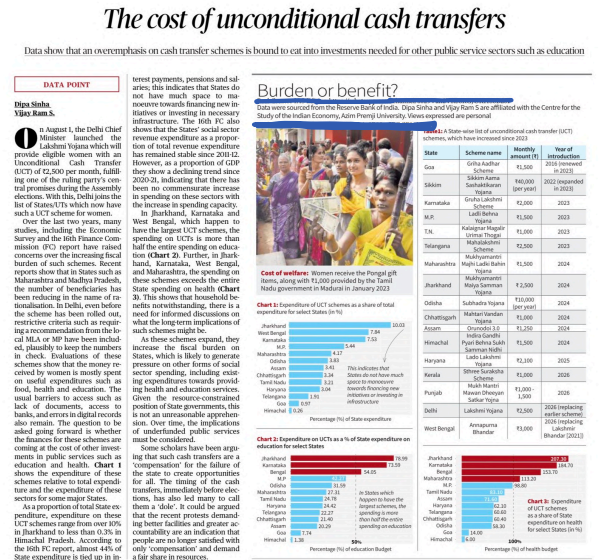
Context: Unconditional cash transfers
Unconditional cash transfers by States can provide immediate income support.
However, rapid expansion of such schemes can create large recurring expenditure commitments and may crowd out spending on education, health and infrastructure.
What Are Unconditional Cash Transfers?
Unconditional Cash Transfers, or UCTs, are direct cash payments given without requiring recipients to meet specific conditions.
They are usually used for welfare support, income support or social protection.
Why UCTs Matter
Income Support
UCTs provide immediate money for food, health, household expenses and basic needs.
Women’s Empowerment
Direct transfers can increase women’s financial autonomy.
They can improve women’s role in household decision-making.
Social Protection
Cash transfers help households cope with economic distress, livelihood shocks and rising costs.
Fiscal Concern
The main concern is not cash transfer itself, but the scale and sustainability of recurring commitments.
Regular transfers create a continuous revenue expenditure burden.
If poorly targeted, they can reduce fiscal space for long-term public investment.
Crowding-Out Risk
In some States, UCTs are becoming a large share of total expenditure.
The document gives examples:
- Jharkhand: UCT spending is 10.03% of total State expenditure
- West Bengal: 7.84%
- Karnataka: 7.53%
Education Trade-Off
UCT spending equals:
- 79% of the education budget in Jharkhand
- 74% in Karnataka
- 54% in West Bengal
This shows that large cash-transfer commitments can compete with human-capital spending.
Health Trade-Off
UCT spending equals:
- 207% of the health budget in Jharkhand
- 185% in Karnataka
- 154% in West Bengal
This makes the fiscal trade-off even sharper.
Deeper Issue
States already have large committed expenditure towards salaries, pensions and interest payments.
This limits resources available for new investments.
Excessive revenue expenditure can constrain capital expenditure, infrastructure creation and productive public spending.
The concern is not anti-welfare.
The concern is poorly targeted and fiscally unsustainable welfare.
Way Forward
Cash transfers should prioritise genuine vulnerability instead of becoming blanket schemes.
Education, health, nutrition and infrastructure spending must be protected.
Cash support should be combined with skills, livelihoods and employment opportunities.
States should conduct cost-benefit and outcome-based evaluation before expanding schemes.
Key Takeaway
Unconditional cash transfers can help vulnerable households, but if they expand without targeting and fiscal discipline, they can weaken long-term spending on health, education and infrastructure.