Context: UNFPA Demographic Futures Survey
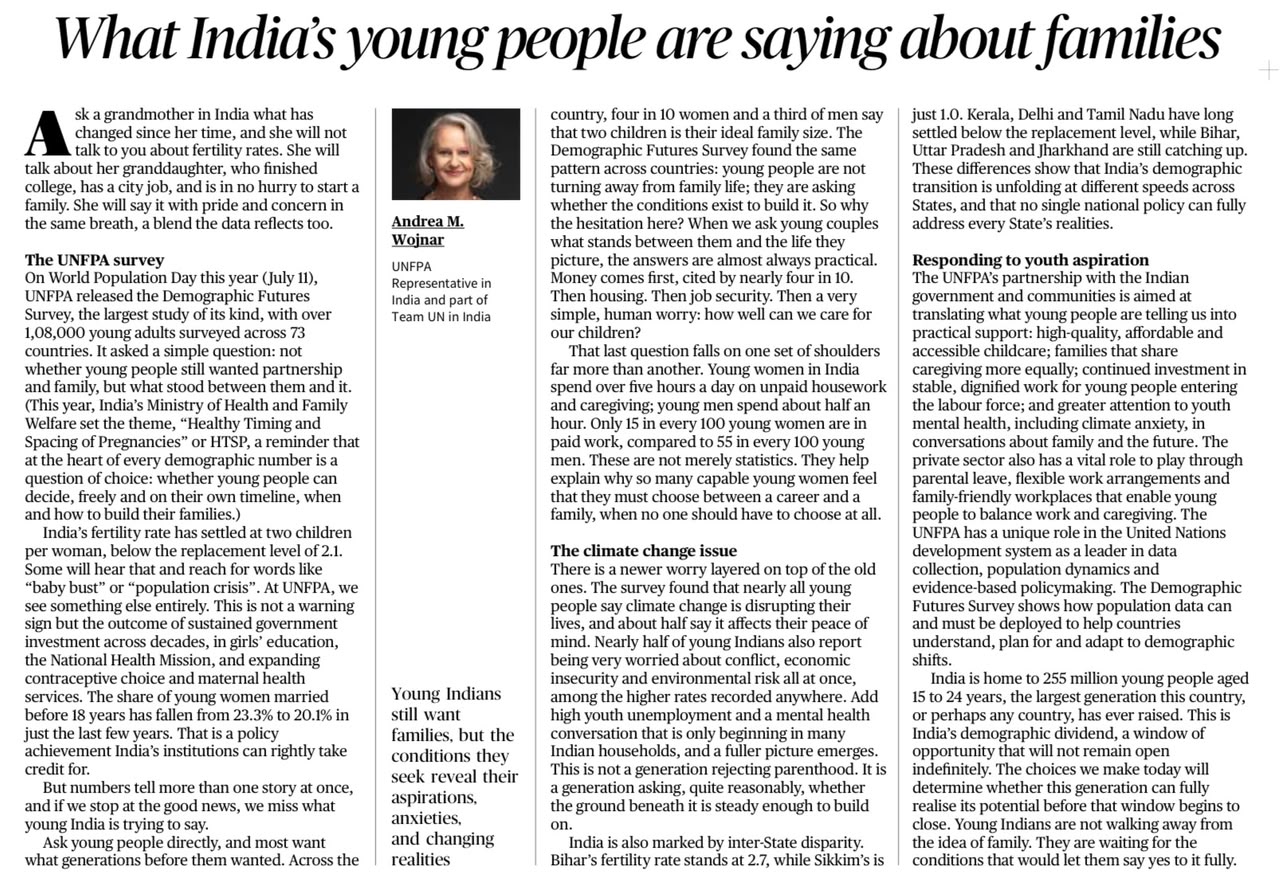
The UNFPA Demographic Futures Survey 2025 shows that Indian youth still aspire for marriage and parenthood.
However, socio-economic, gender and environmental factors are changing when and how families are formed.
Key Findings
Family Aspirations Remain Strong
Most young Indians still prefer marriage and children.
Two children continue to emerge as the ideal family size.
India’s Total Fertility Rate has declined to 2.0, below the replacement level of 2.1.
This reflects demographic transition, not a rejection of family life.
Economic Security Shapes Family Decisions
Young people are delaying marriage and parenthood because of concerns such as:
- Financial stability
- Affordable housing
- Secure employment
- Cost of raising children
- Social security
Gender Equality Is Central
Women continue to carry a disproportionate burden of unpaid care work.
Lower female labour force participation also affects family and fertility decisions.
Better demographic outcomes require:
- Shared caregiving
- Quality childcare
- Family-friendly workplaces
- Equal opportunities for women
Demographic Transition Is Becoming Complex
Fertility behaviour is now affected by:
- Climate change
- Mental health concerns
- Economic uncertainty
- Regional differences
- Urbanisation
- Employment insecurity
UPSC Value Addition
Important Data
- UNFPA Demographic Futures Survey: over 1.08 lakh respondents across 73 countries
- India’s youth population aged 15–24 years: 255 million
- TFR: 2.0
- Replacement level: 2.1
- Bihar TFR: 2.7
- Sikkim TFR: 1.0
Policy Priorities
- Improve women’s labour force participation.
- Expand affordable childcare.
- Provide parental support.
- Generate quality employment for youth.
- Strengthen reproductive healthcare.
- Strengthen mental health services.
- Use State-specific demographic policies.
Key Takeaway
India’s fertility decline should not be seen only as a population-control success. It also reflects young people’s concerns about jobs, housing, care work, gender equality and future security.