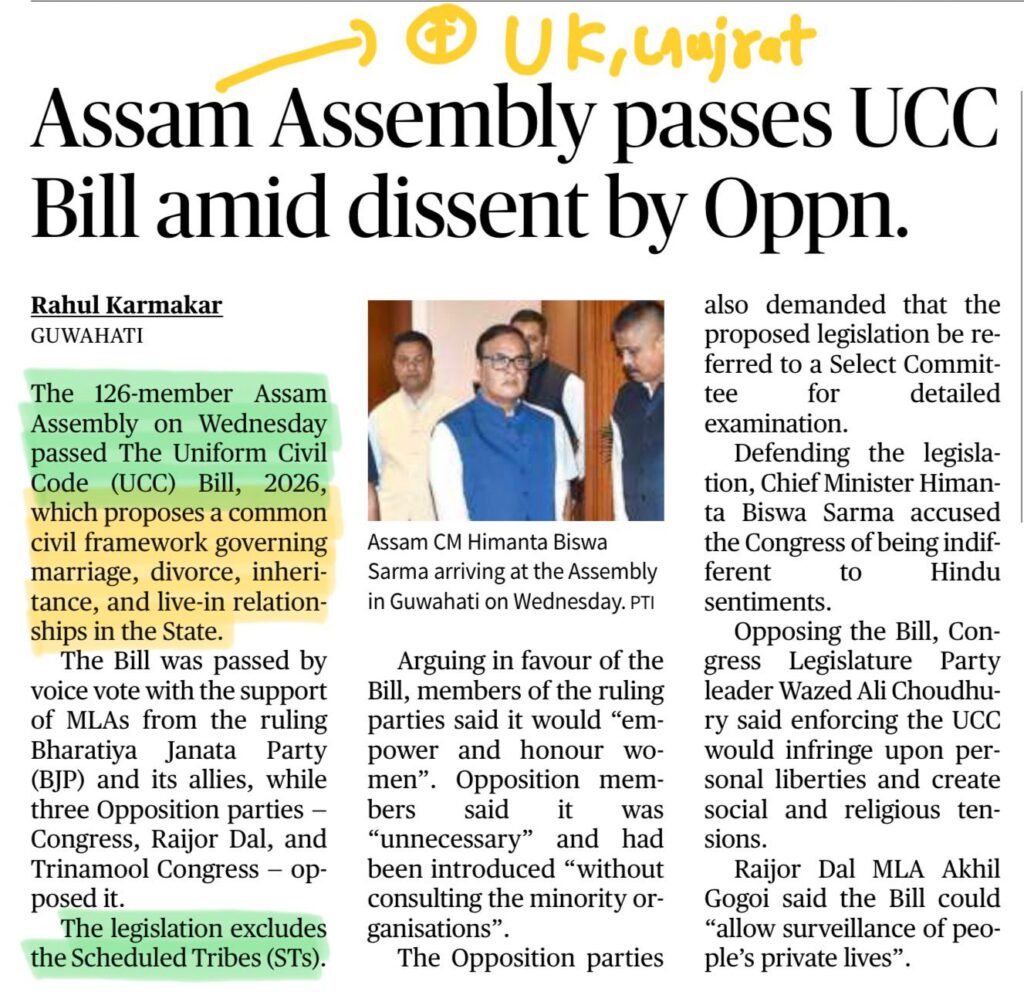
Context: Uniform Civil Code
Assam Assembly passed the Uniform Civil Code Bill, 2026 proposing a common civil framework for marriage, divorce, inheritance and live-in relationships; Scheduled Tribes are kept outside its ambit.
Uniform Civil Code
- Common set of civil laws applicable to all citizens irrespective of religion.
- Covers marriage, divorce, adoption, guardianship, succession and inheritance.
- Aim: Ensure equality before law and uniformity in personal laws.
- Personal laws currently differ across religious communities.
- Goa Civil Code is often cited as an example of a form of UCC in India.
Constitutional Basis
- Article 44: Directive Principle of State Policy asking the State to endeavour to secure Uniform Civil Code for citizens.
- Article 14: Equality before law.
- Article 15: Prohibition of discrimination on religious grounds.
- Article 25: Freedom of religion subject to public order, morality and health.
- Debate: Balance between religious freedom and gender justice or equality.
Key Features of Assam UCC Bill
- Common civil framework for marriage, divorce, inheritance and live-in relationships.
- Scheduled Tribes excluded from ambit of Bill.
- Government argues UCC promotes gender justice and uniformity.
- Critics argue it may affect cultural autonomy and personal liberty.
Important Supreme Court Judgments
- Shah Bano Case, 1985: Favoured common civil framework for gender justice.
- Sarla Mudgal vs Union of India, 1995: Highlighted misuse of personal laws and supported UCC idea.
- John Vallamattom vs Union of India, 2003: Observed need for uniform civil laws.
- Shayara Bano Case, 2017: Triple talaq declared unconstitutional; reinforced constitutional morality and gender equality.